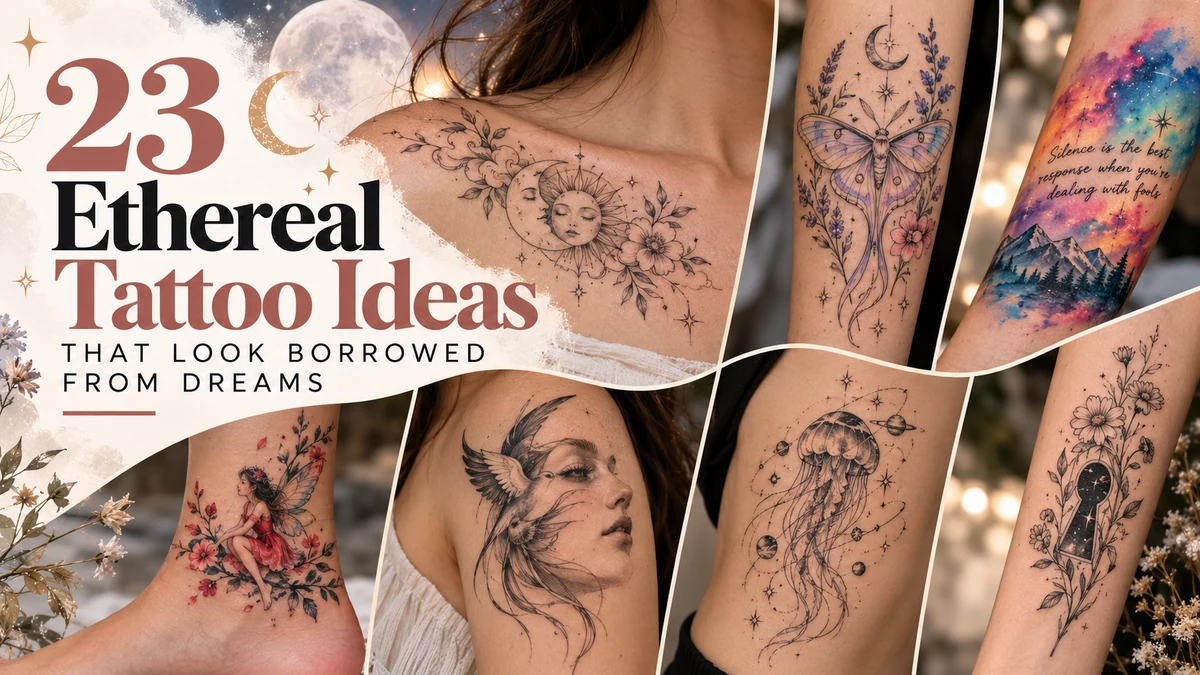
23 Ethereal Tattoos That Look Borrowed From Dreams
Some tattoos feel grounded in the everyday; others seem to have arrived from somewhere between sleep and waking. Ethereal tattoos create that otherworldly effect through floating compositions, celestial imagery, translucent shading, delicate movement, and carefully preserved negative space.
This collection moves beyond one predictable “dreamy” aesthetic. You will find fine-line celestial pieces, surreal portraits, botanical forms, abstract color work, and darker fantasy concepts across discreet and statement-making placements. Use these ideas as visual directions—not designs to copy exactly—then work with a professional artist to adapt the scale, contrast, and details to your anatomy.
1. Sleeping Moon Among Drifting Clouds
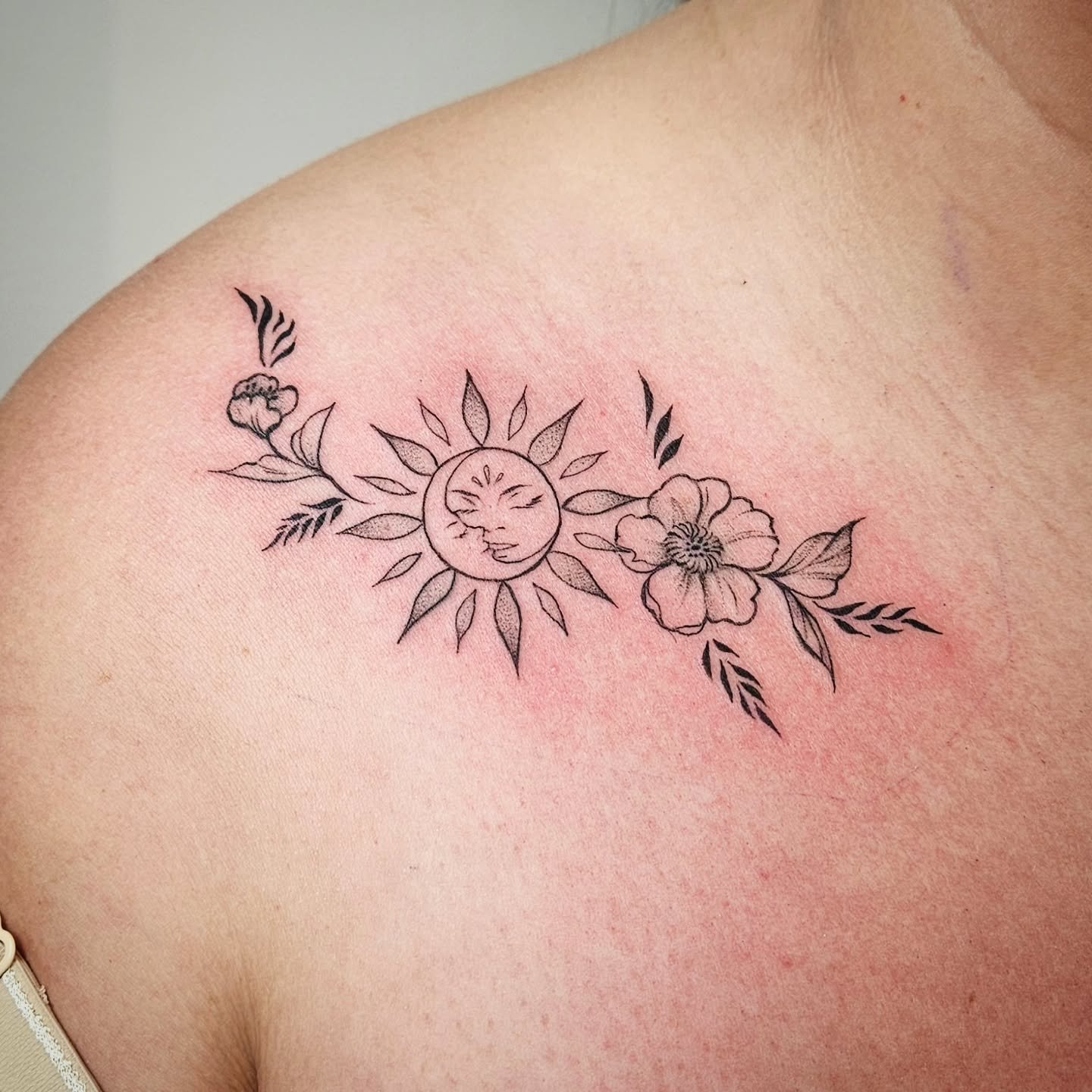
The photograph shows a fine-line black tattoo on the upper chest and right shoulder, rather than a lone crescent beneath the collarbone. A serene moon face sits directly over a sun with straight rays, so the two celestial faces share one central composition, and delicate flowers and leaves frame the design on either side.
Because the moon and sun are combined, the piece reads as a balanced day-and-night emblem instead of a drifting, cloud-wrapped crescent. The fine lines keep it light, while the floral framing softens the geometric rays and gives the tattoo a gentle, ornamental finish.
2. Moth With Constellation Wings
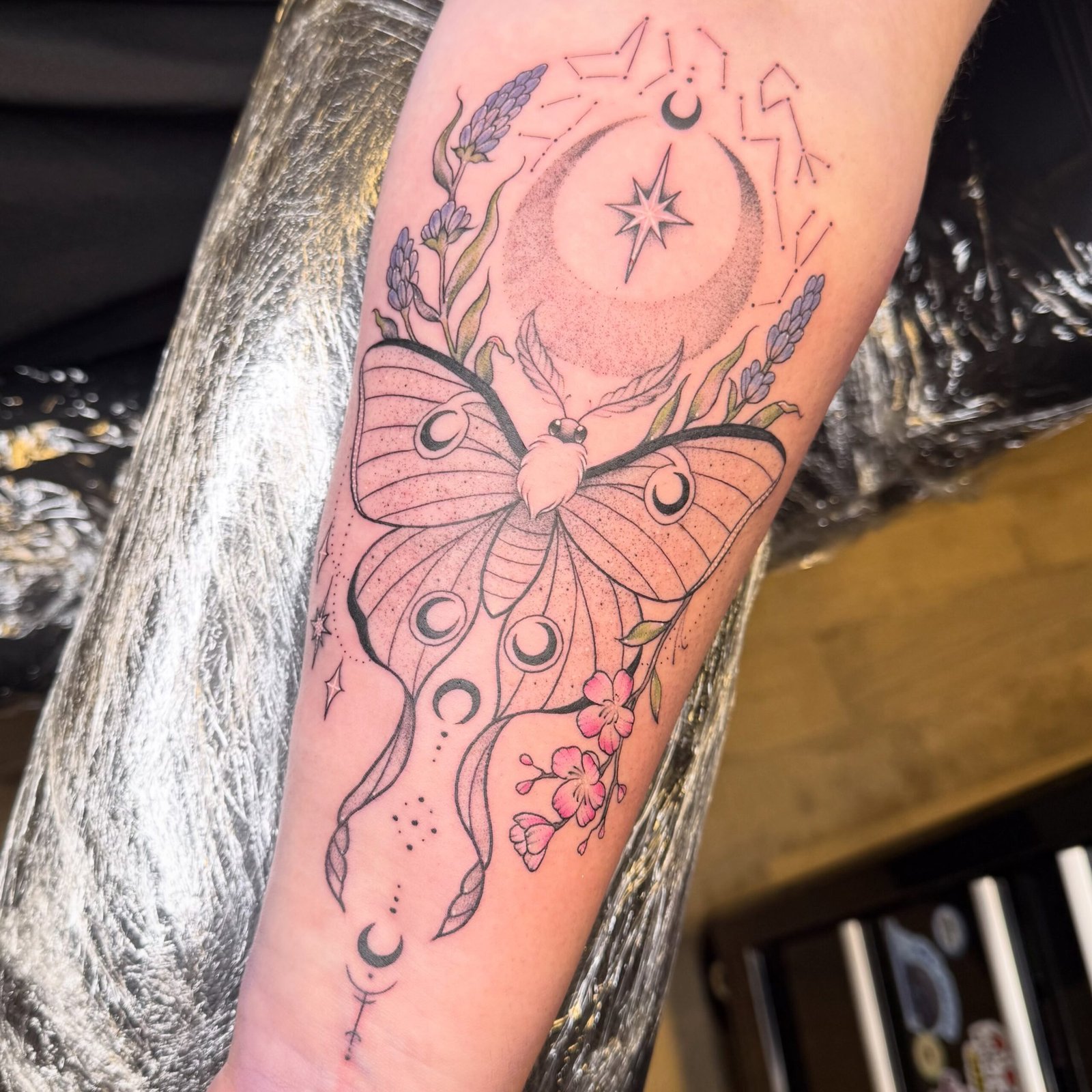
The photograph shows a luna moth on the forearm, not the upper back. Its pale wings carry constellation lines and small stars, with a crescent moon and a star above the moth, a small crescent below it, and long, elegant tails trailing downwards.
Lavender sprigs frame the moth on both sides, and pink cherry blossom appears at the lower right, adding soft colour to an otherwise delicate black-and-grey design. The vertical forearm placement lets the moth, constellations and flowers read as one flowing, nocturnal composition.
3. Watercolor Aurora Forearm Band
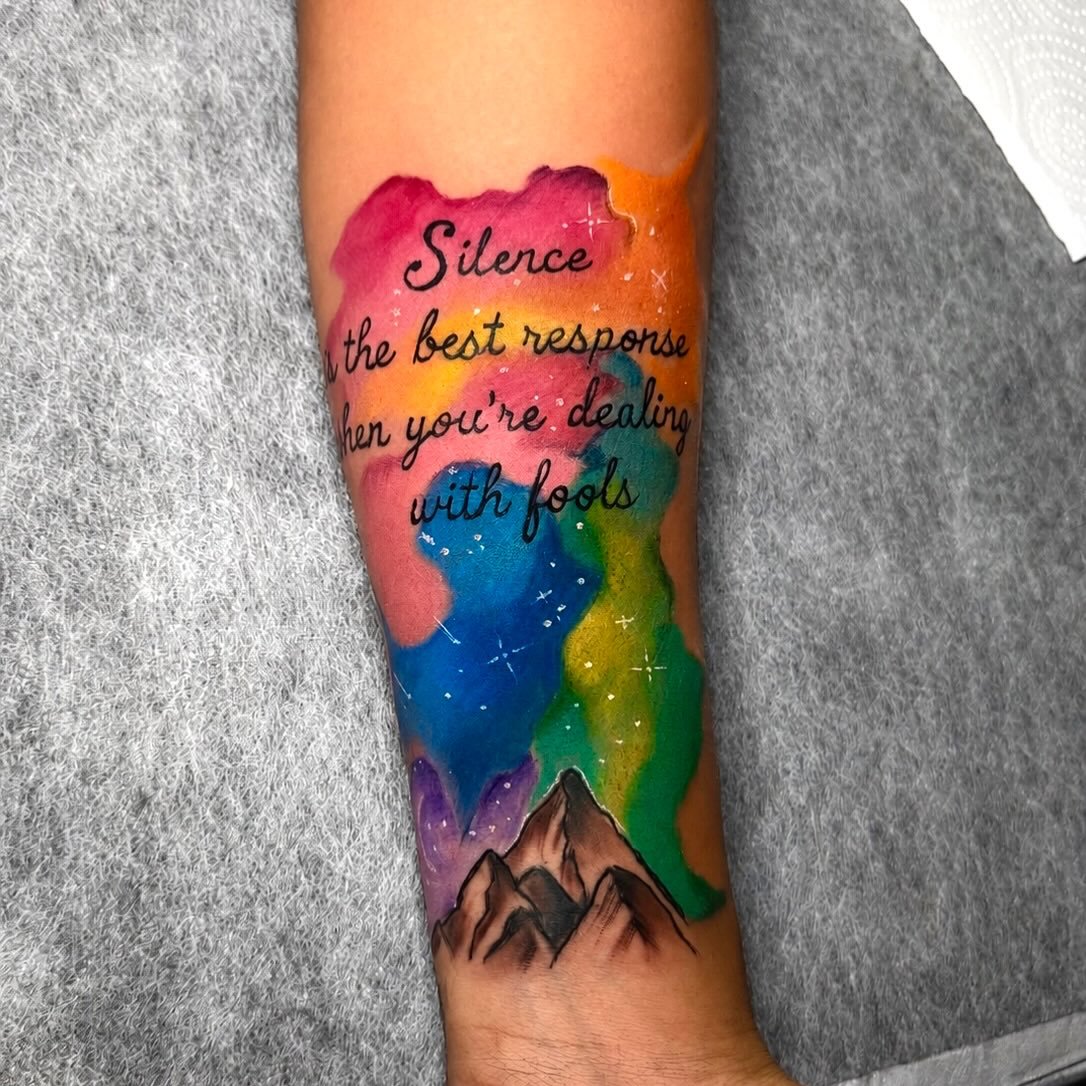
The photograph shows a bright watercolour aurora on the inner forearm, with vivid pink, red, orange, yellow, blue, green and purple washes flowing across the skin and a dark mountain range along the bottom of the design. Script lettering runs over the colour, reading “Silence is the best response when you’re dealing with fools”, and it is part of the tattoo itself rather than a separate graphic added to the photograph.
The lettering changes the character of the piece: it is not a plain, wraparound aurora band, but a statement tattoo in which the mountains ground the composition and the words sit directly within the sky. The saturated watercolour keeps the effect luminous, while the dark mountains give the bright washes a clear base.
4. Fairy Silhouette in Falling Starlight
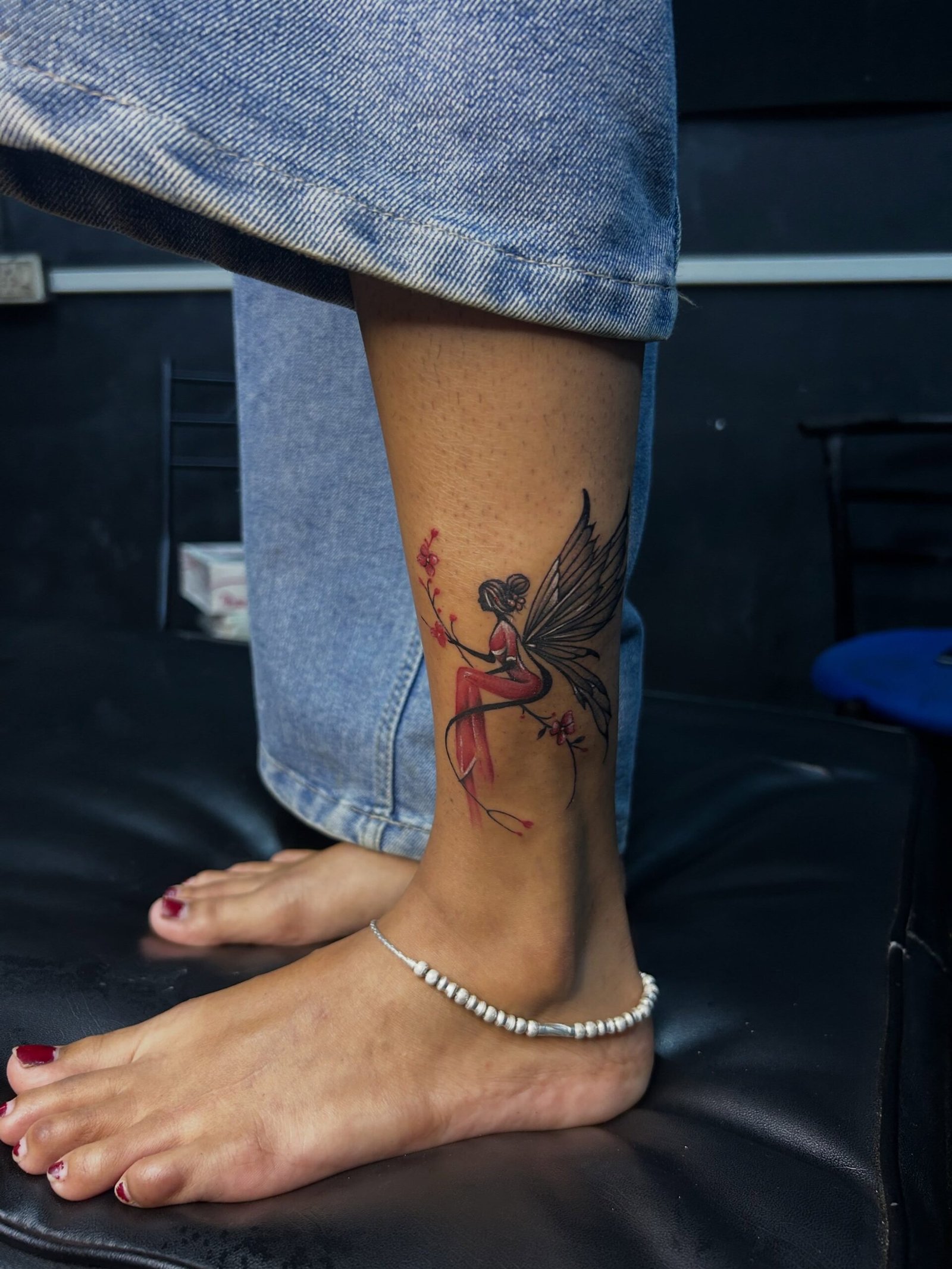
The photograph shows a coloured fairy on the ankle, not a black silhouette, and there is no trail of falling stars. The fairy wears a red dress, with coloured wings and hair, and sits among dark branches and red flowers that fill the ankle composition.
The colour is the point of the piece: the red dress and flowers stand out against the darker branches, giving the small ankle tattoo a vivid, storybook quality. Its charm comes from the figure and the surrounding blooms rather than from starlight or a silhouette effect.
5. Face Dissolving Into Birds
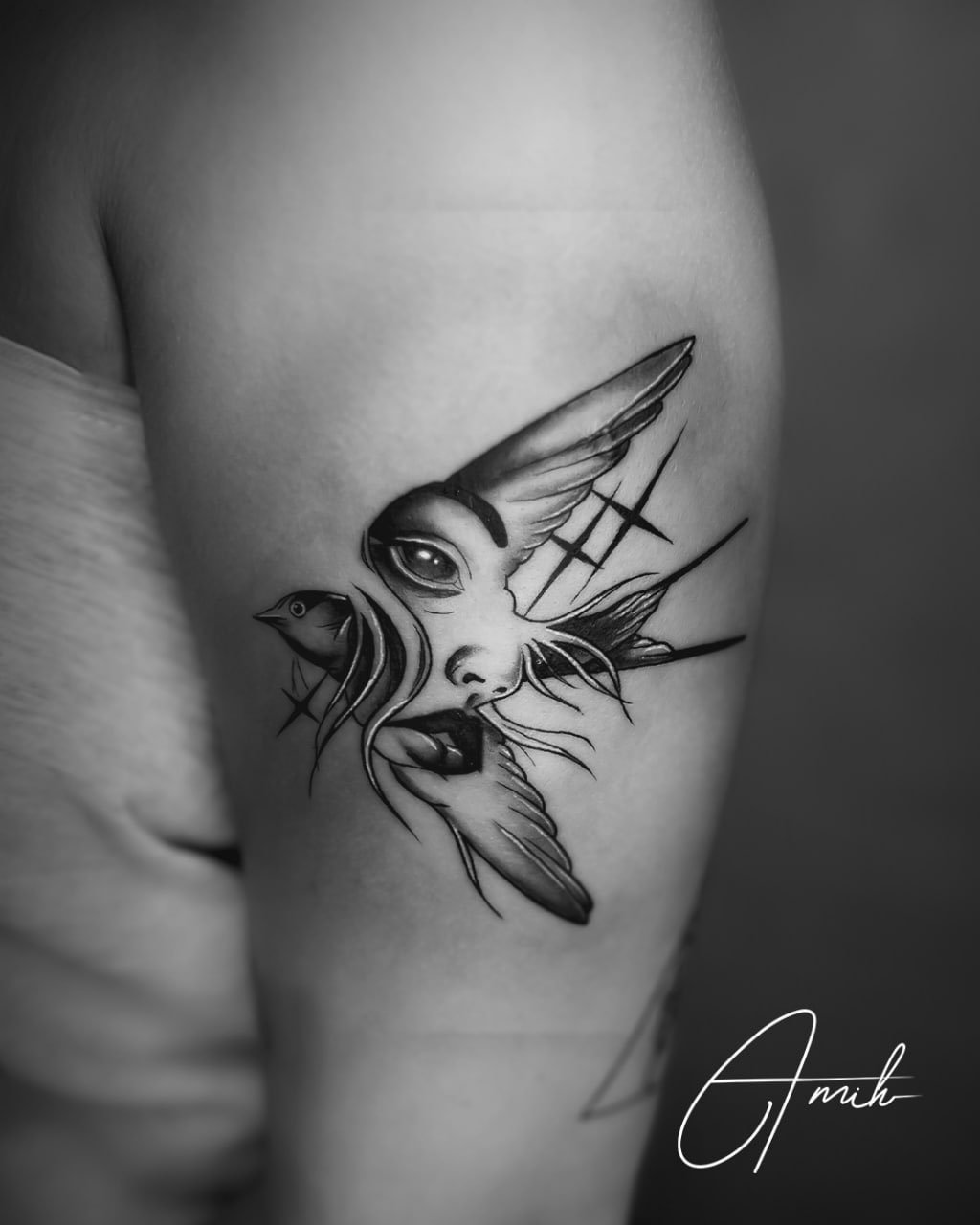
The photograph shows a single swallow merging with a woman’s face on the upper arm, rather than a profile dissolving into several birds. The bird and the face share the same flowing outline, so the swallow appears to grow out of, or melt back into, the portrait in one continuous movement.
Keeping the composition to one bird makes the transformation easy to read: the eye follows a single flight path instead of tracking a flock. On the upper arm, the design has room to breathe, and the shared contour gives it a quiet, dreamlike quality.
6. Jellyfish Carrying a Tiny Night Sky
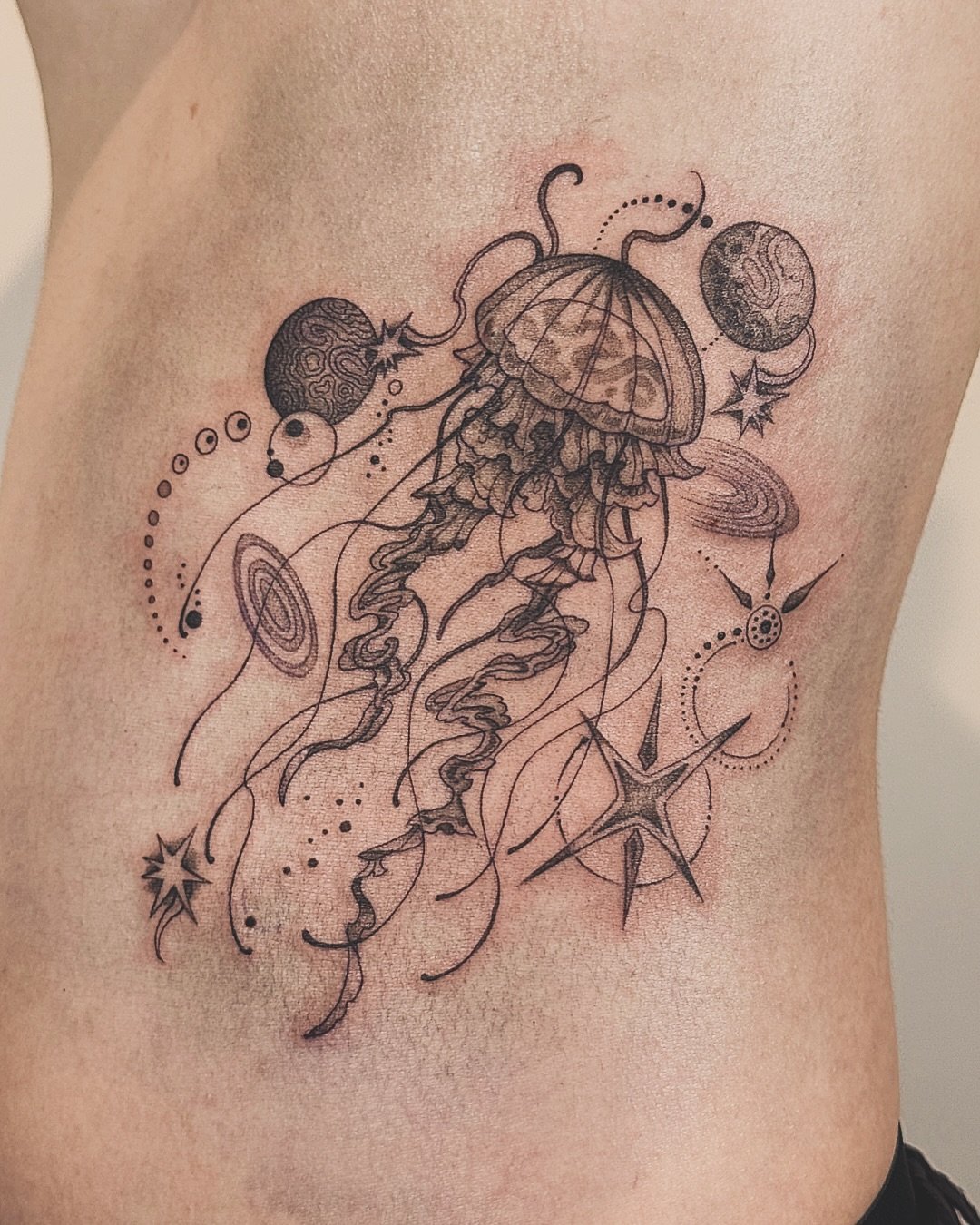
The photograph shows a black fine-line jellyfish on the left ribcage, not a pale blue-grey wash. Its bell and trailing tentacles are drawn in crisp black linework, and the night sky is carried through the whole design: small planets, orbital rings and stars surround the jellyfish rather than sitting only inside its bell.
The ribcage placement suits the vertical, drifting shape, letting the tentacles follow the body’s natural curve. The black linework keeps the celestial details legible, and the planets and orbits turn a simple sea creature into a small, self-contained cosmos.
7. Wildflowers Growing Through a Keyhole
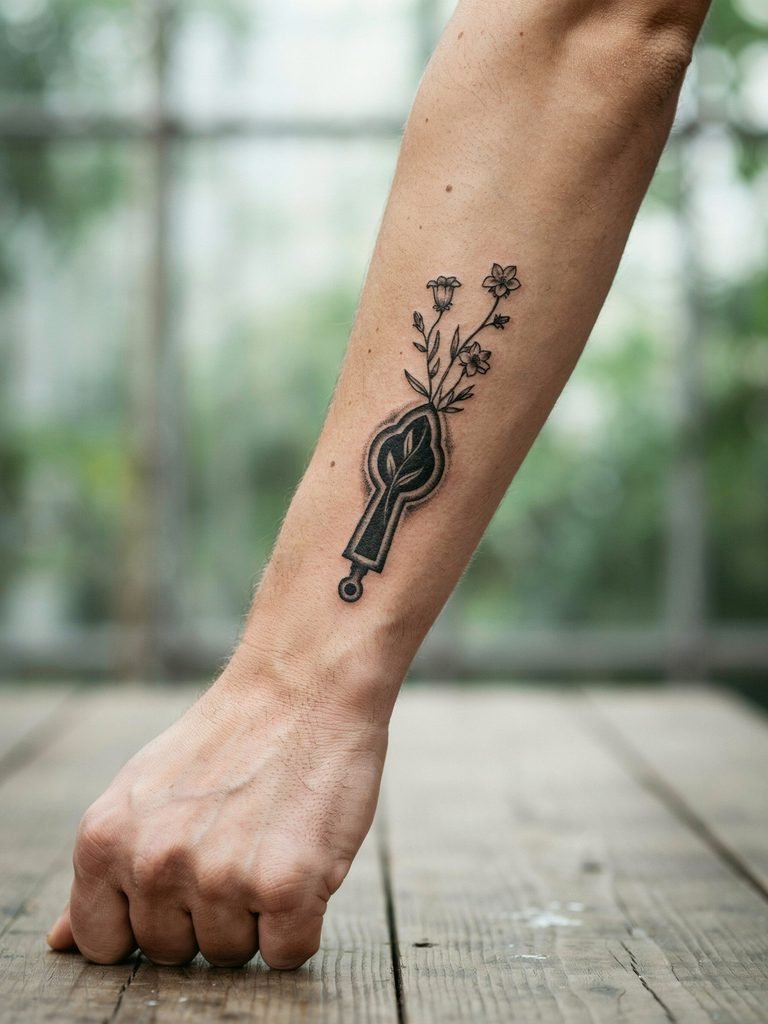
A black keyhole forms the focal point on the inner forearm, but delicate wildflower stems emerge through its opening and extend upward. The keyhole uses solid black and a firm outline, while flowers are drawn with lighter lines and restrained grey shading. At five inches tall, the design creates contrast between architectural geometry and loose botanical movement.
The keyhole can suggest privacy, curiosity, memory, or an unseen place, although its meaning should remain yours rather than being treated as universal symbolism. Choose flowers for their shapes or personal associations, but avoid squeezing numerous species into the composition. Two or three clearly differentiated blooms will read more convincingly. The vertical format also leaves room for future vines or scattered petals to connect the piece with a larger forearm collection.
8. Ornamental Moonphase Spine Tattoo
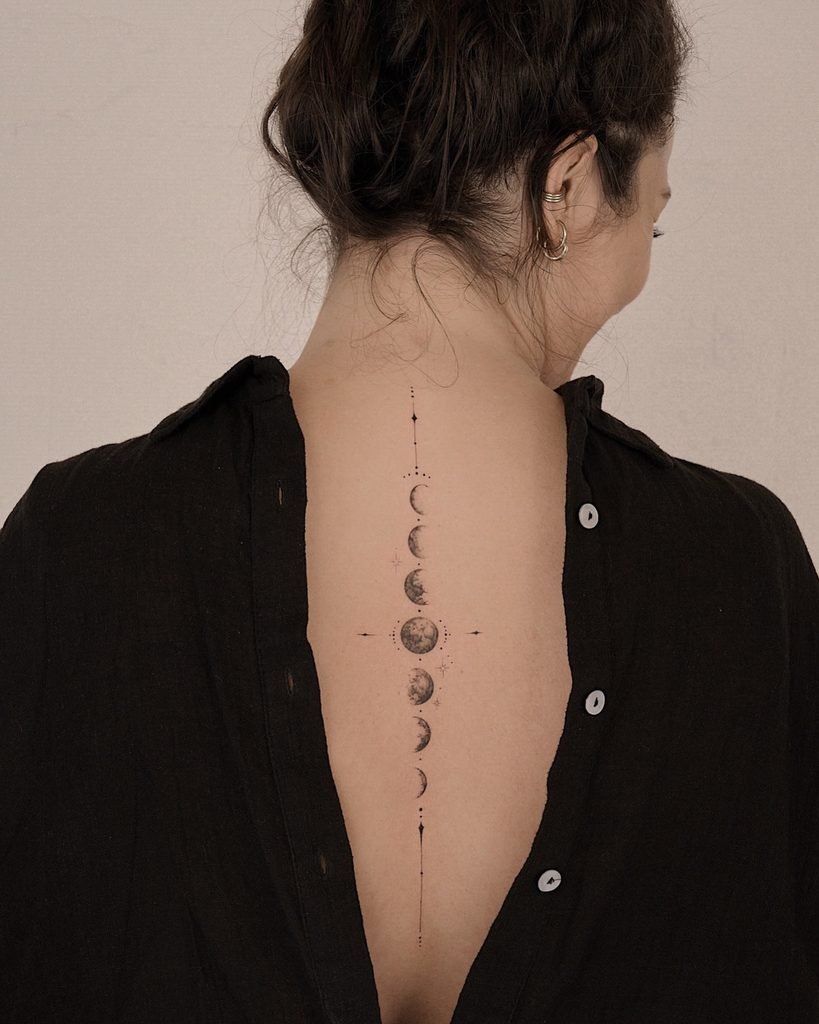
Seven simplified lunar phases descend along the spine, connected by extremely thin ornamental curves and small suspended dots. Rather than copying an astronomical chart, the composition treats the phases as a decorative rhythm. The central full moon carries soft dotwork shading, while the surrounding crescents remain lighter and more open.
A narrow spine tattoo can visually lengthen the back, particularly when its upper and lower endings taper instead of stopping abruptly. However, tiny ornaments packed too closely together may lose their separation, so simplicity matters more than the number of details. The artist should position every element with the wearer standing naturally, checking how the sequence aligns with the spine and shoulder balance rather than relying only on a flat reference drawing.
9. Mist-Wrapped Mountain Window
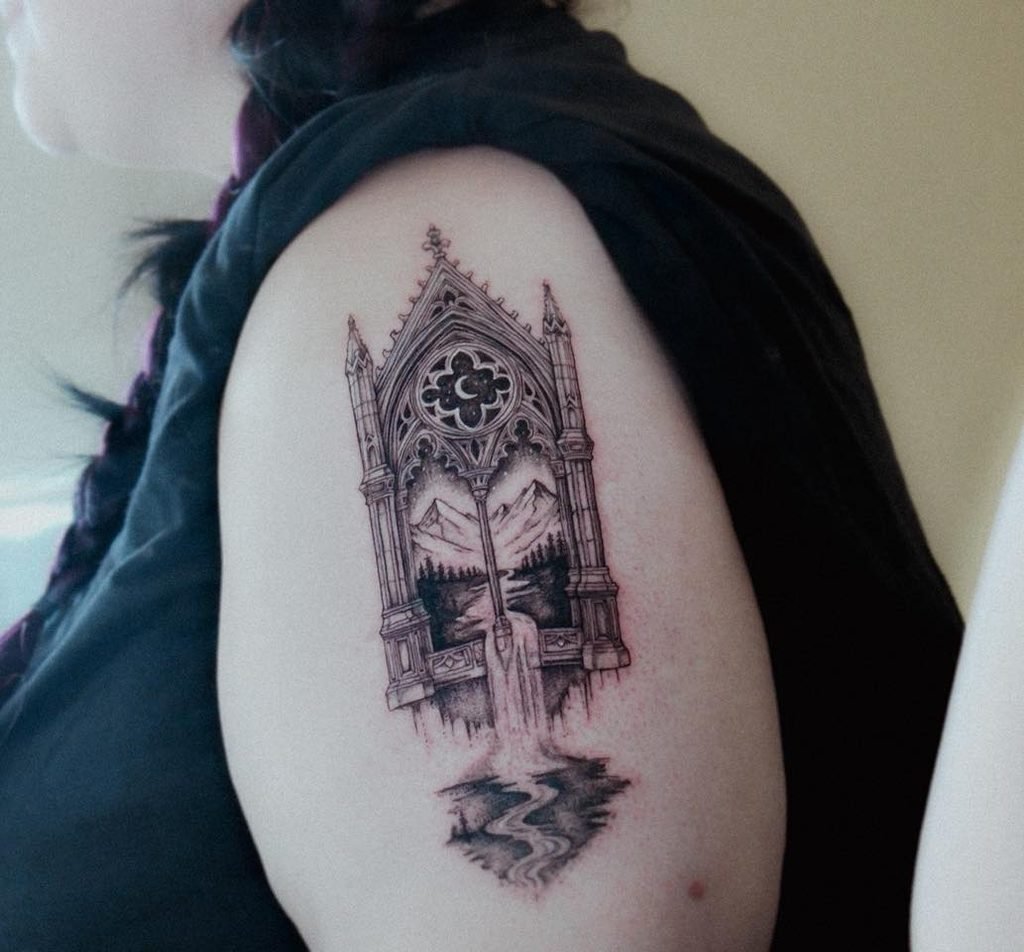
An arched window frames a distant mountain ridge on the back of the upper arm. The lower landscape is anchored by crisp black-and-grey linework, while fog escapes beyond the window frame and dissolves into the surrounding skin. Fine stippling makes the mist appear softer without turning the entire design into an indistinct grey patch.
This concept combines an enclosed scene with one deliberate rule break: the fog refuses to remain inside the frame. That contrast delivers the ethereal mood more effectively than adding numerous stars or sparkles. It can represent a remembered landscape, but it also works as a purely imaginative scene. Personalise the ridge line from your own photograph only if you have the right to use it and the silhouette can be simplified cleanly.
10. Glasswing Butterfly With Crystal Veins
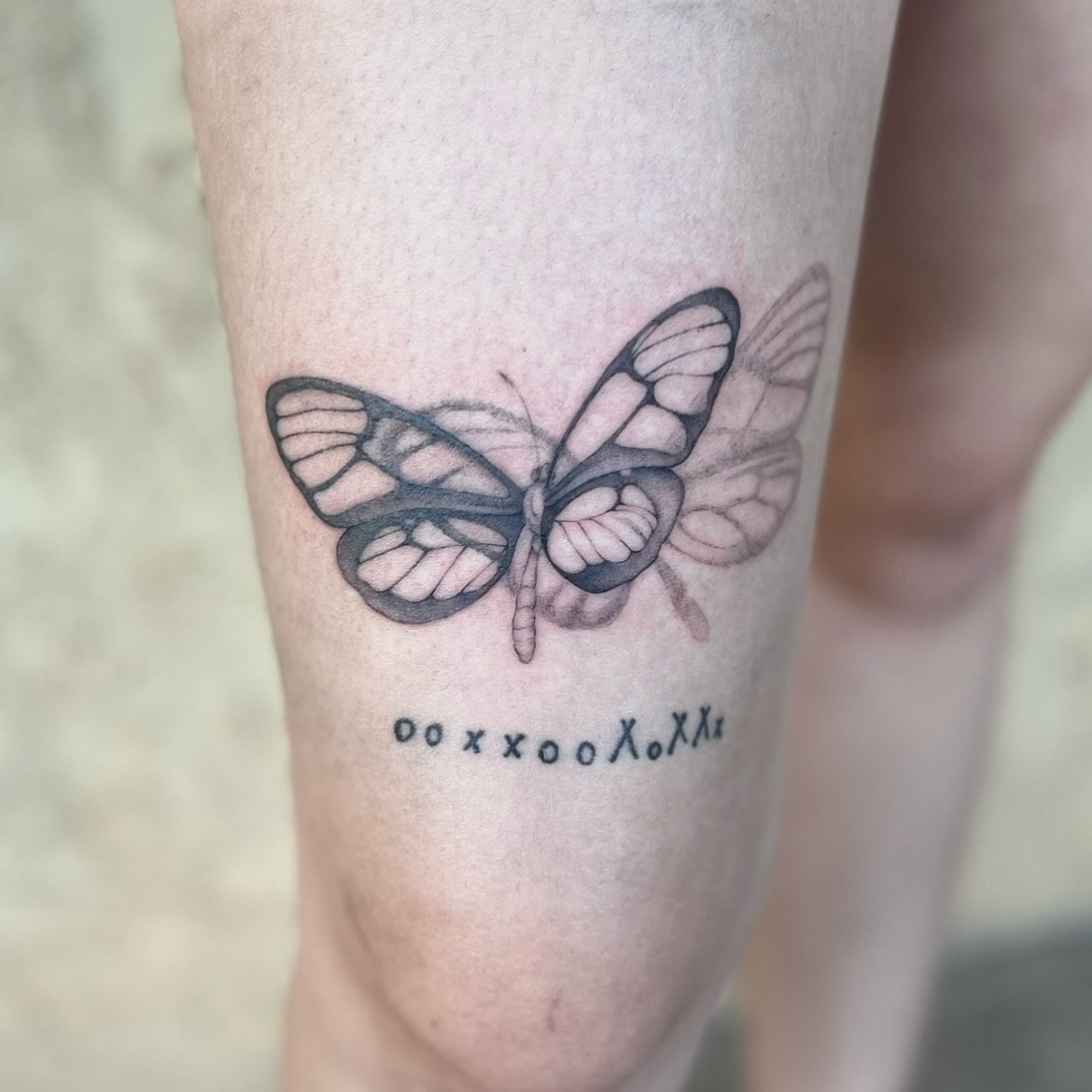
The photograph shows a glasswing butterfly on the lower leg, just above the knee, rather than on the sternum. Its wings are largely open and translucent in effect, with fine dark outlines and delicate vein-like lines, and hand-lettering sits beneath the butterfly as an extra element of the photograph’s tattoo presentation.
Because the butterfly sits on the leg, the composition is read from a different angle than a chest piece, and the pale, airy wings stand out clearly against the skin. The design keeps its ethereal quality through lightness and transparency rather than through crystal veins or droplets.
11. Koi Swimming Through Clouds
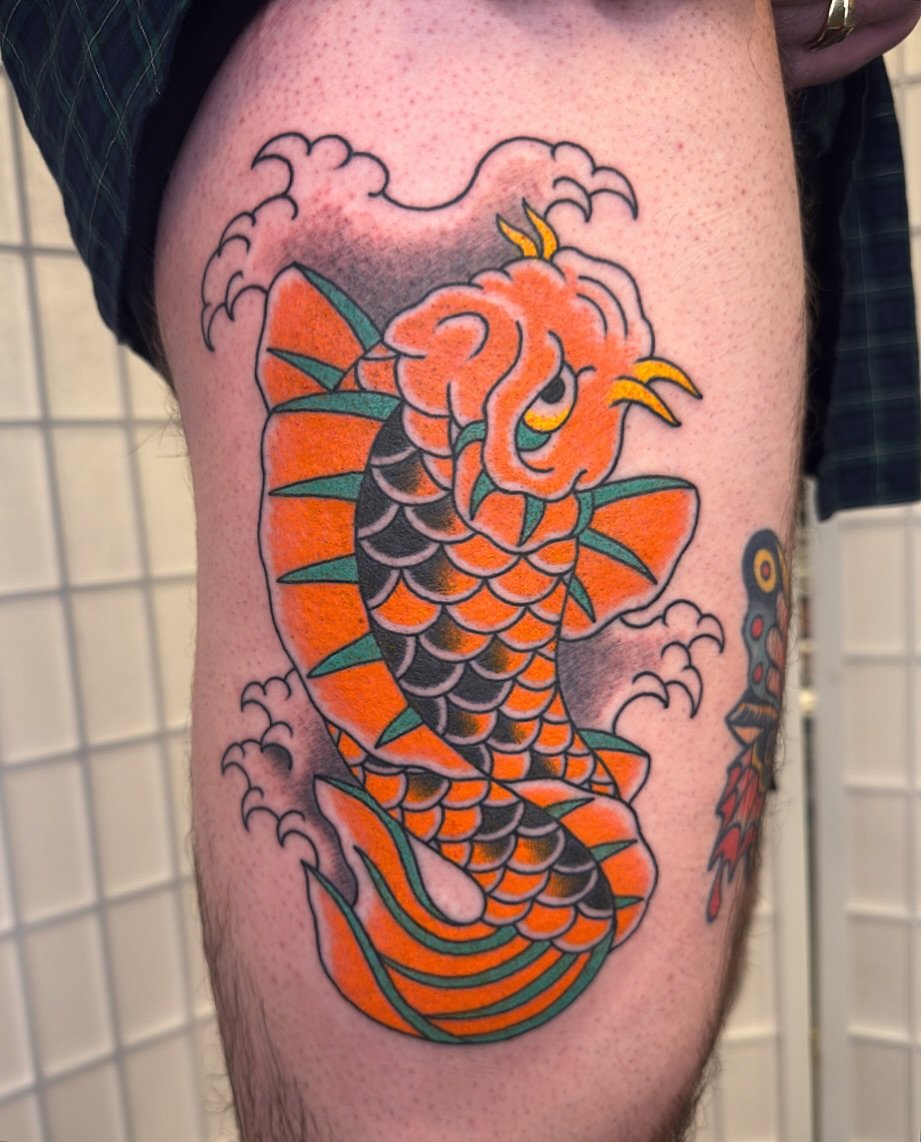
The photograph shows a bright orange koi on the thigh, swimming through bold grey-black wave-clouds. The koi’s vivid orange body and detailed scales contrast sharply with the dark, swirling cloud and wave forms around it, giving the piece a strong, dynamic movement.
Unlike a muted, restrained version, this tattoo uses saturated colour and high contrast: the orange fish is the unmistakable focal point, while the dark waves curl around it like both water and sky. The thigh gives the curved composition plenty of room to flow.
12. Lavender Sprig Becoming Smoke
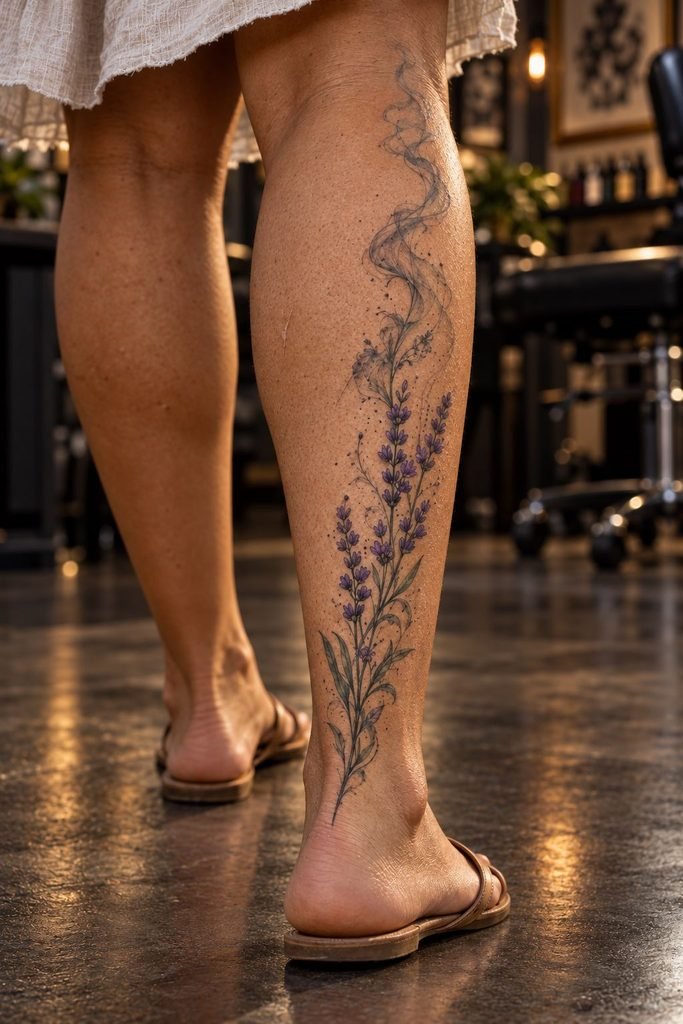
Beginning above the ankle, a realistic lavender sprig gradually loses its botanical structure and becomes a ribbon of smoke around the calf. The lower flowers use fine purple, dusty green, and charcoal details; higher up, the color desaturates into translucent grey wash smoke, fine linework, gradual stippling and open negative space. A few separated buds bridge the transition between recognizable plant and abstraction.
This design offers a gentler alternative to fully celestial imagery. Lavender can be chosen simply for its shape and subdued palette, or connected to a personal memory without assigning it a fixed symbolic definition. The transition needs enough vertical space to look intentional, so the calf is more suitable than a tiny wrist placement. If color longevity is a concern, a black-and-grey version can preserve the same transformation through shifts in line density and shading.
13. Tiny Doorway Into the Stars
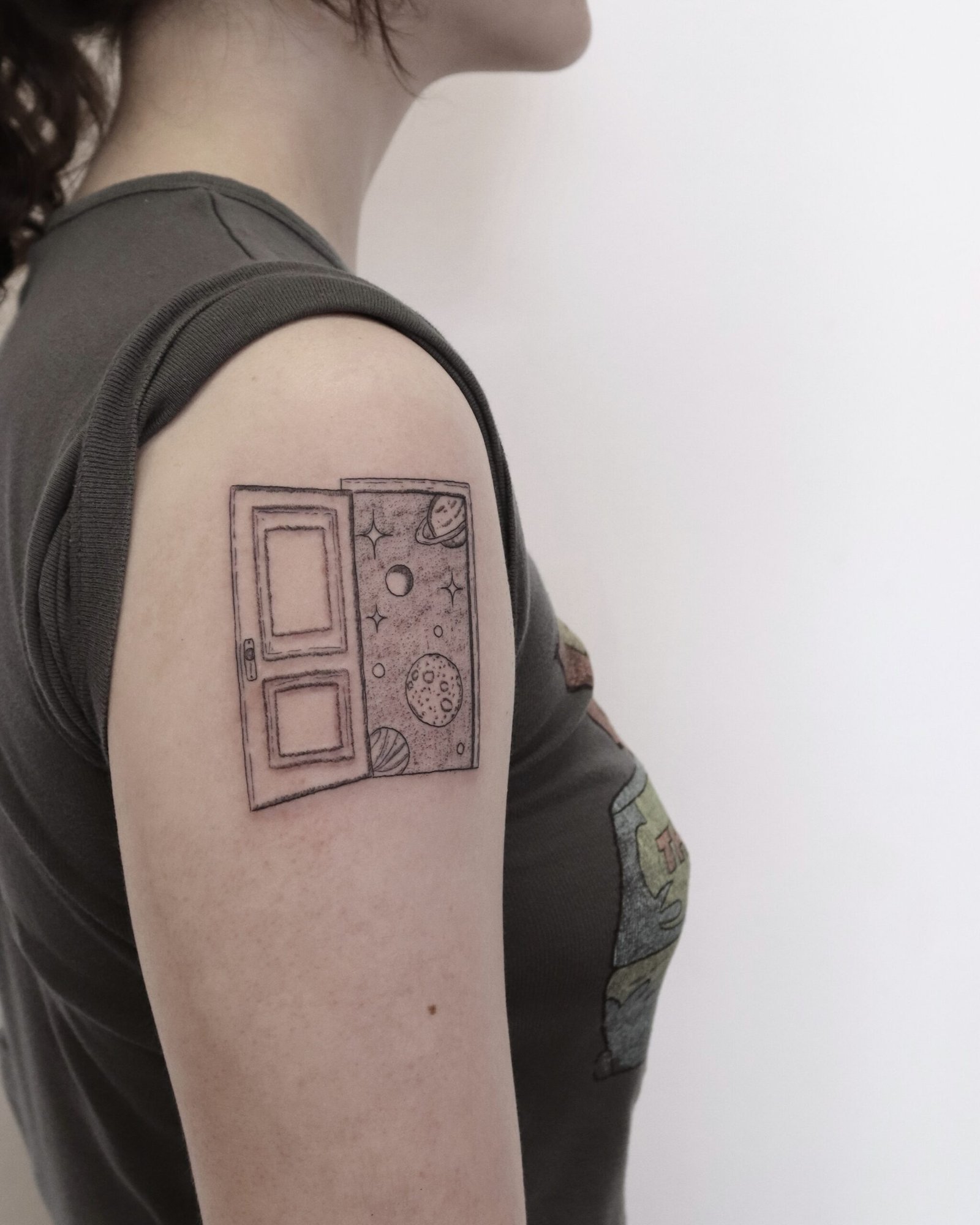
The photograph shows an open doorway on the upper arm, and through it a view of space that is more than a dense field of stars: a crescent moon and ringed planets appear inside the doorway, giving the small opening a clear, otherworldly destination.
The doorway frame anchors the fantasy, so the eye reads the tattoo as a passage rather than a floating pattern. On the upper arm, the compact scene works like a miniature portal, with the moon and planets making the space beyond feel specific and inviting.
14. Swan Reflected as a Constellation
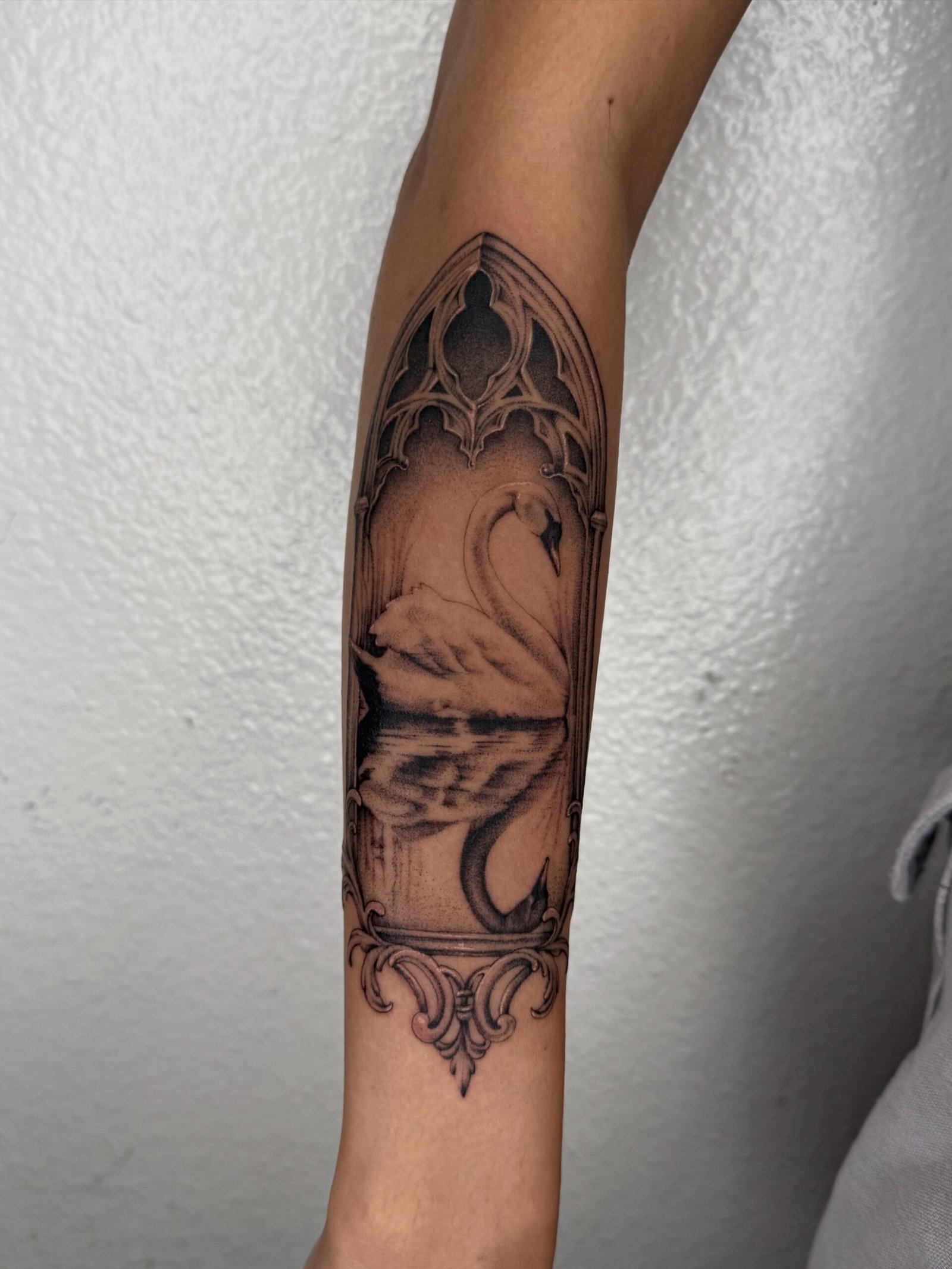
The photograph shows a swan on water inside a pointed, Gothic cathedral-window frame, and its reflection below is an ordinary reflection of the swan, not a constellation. The swan’s elegant neck and body sit calmly above the waterline, with the mirrored shape directly beneath it.
The cathedral-window frame gives the scene a reverent, storybook feeling, while the honest, normal reflection keeps it grounded in the water rather than turning it into a star map. The result is dreamlike because of the framing and the swan’s stillness, not because the reflection has been transformed.
15. Moon Garden Shoulder Cap
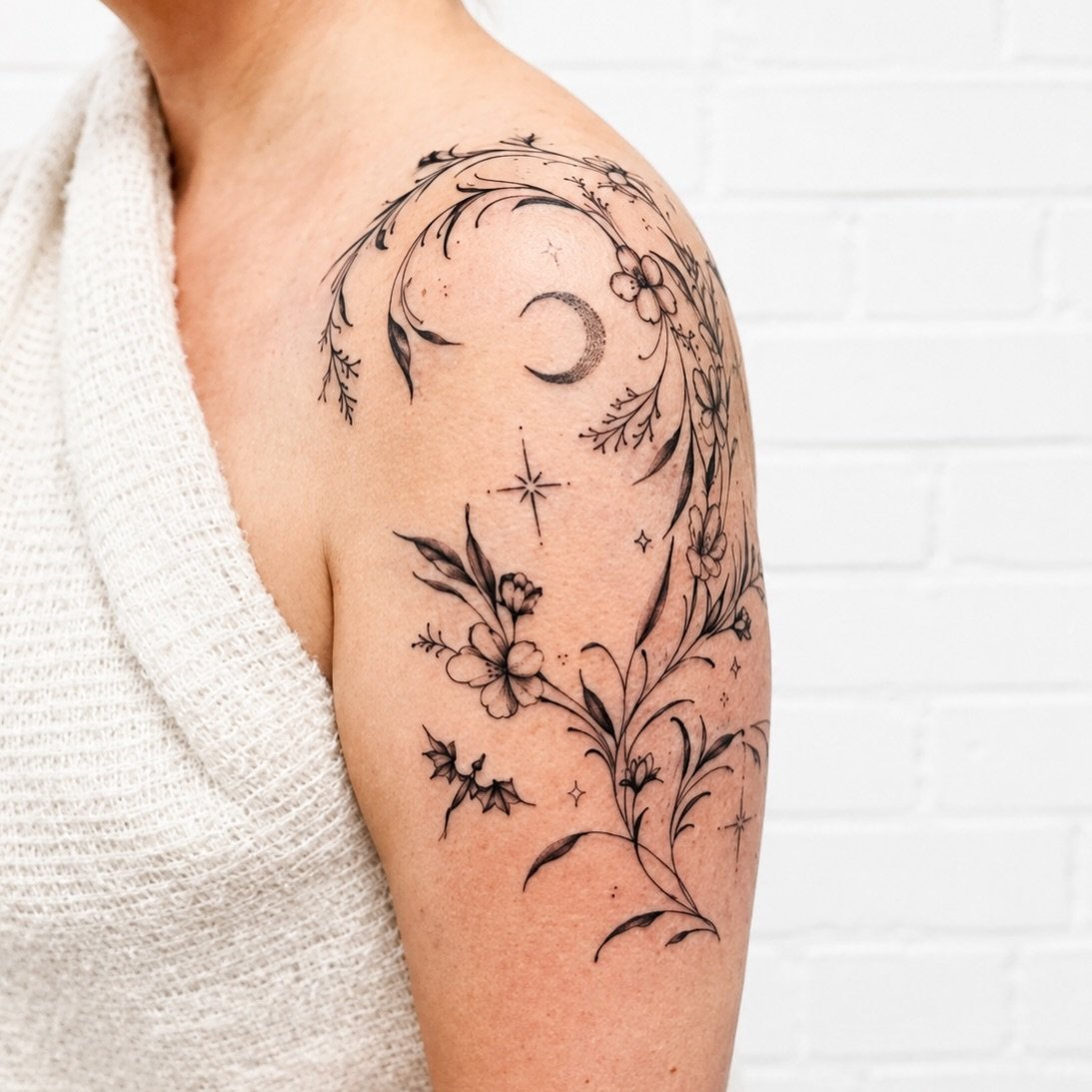
The photograph shows a crescent moon with a floral wreath on the shoulder cap. Flowers and leaves gather around the curve of the moon, forming a garden-like halo that follows the rounded shape of the shoulder.
The shoulder cap placement is ideal for this crescent-and-wreath combination, because the curve of the moon can echo the curve of the joint. The florals soften the celestial shape and make the tattoo feel like a small, wearable garden rather than a bare astronomical symbol.
16. Astral Whale Beneath the Collarbone
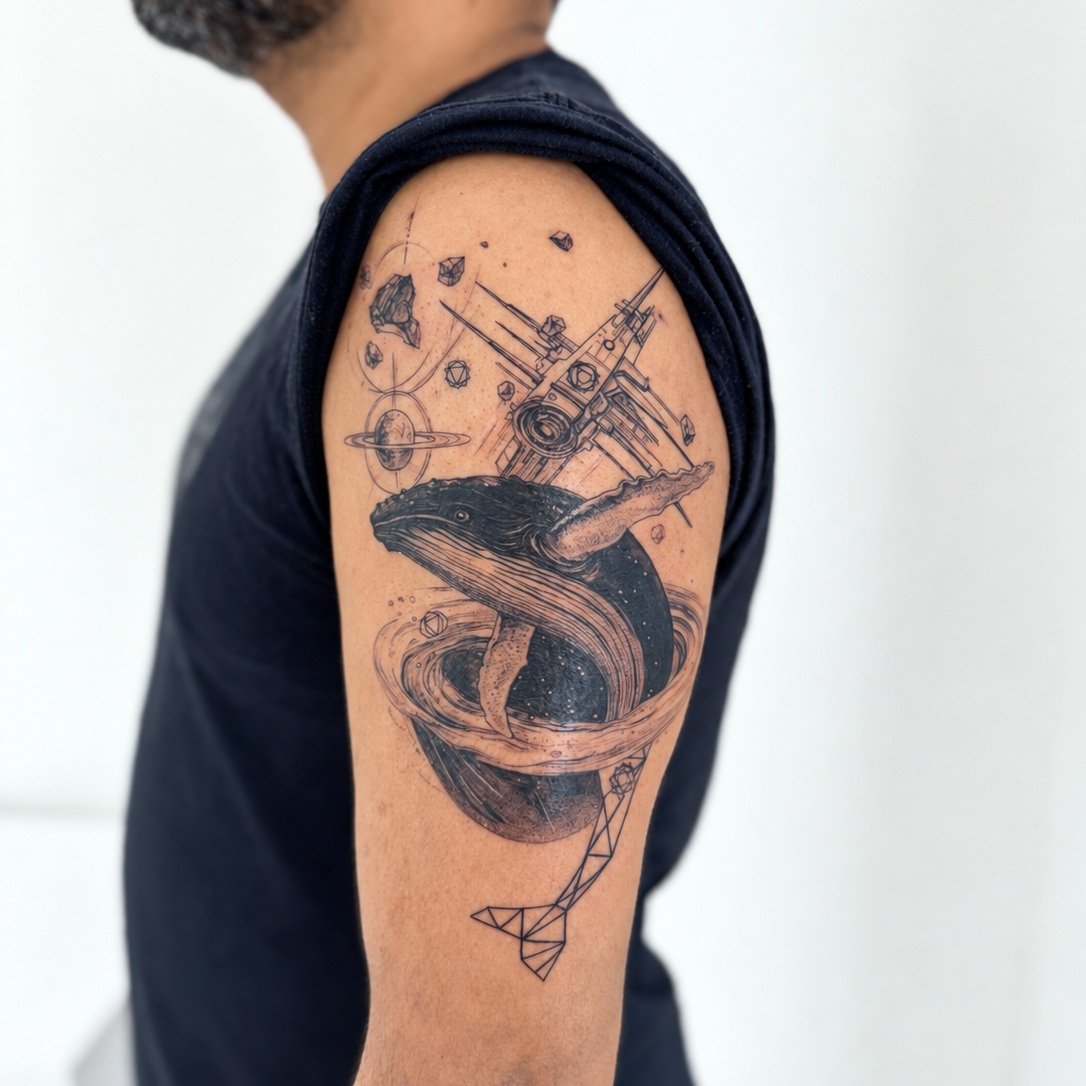
The photograph shows a whale on the shoulder and upper arm, not beneath the collarbone. The whale’s body is filled with a galaxy of stars and nebula-like colour, and a small spaceship appears with it, reinforcing the sense that the animal is swimming through space rather than water.
The shoulder placement gives the whale room to curve naturally, while the galaxy filling turns its silhouette into a miniature universe. The spaceship adds a playful, science-fiction touch that keeps the design from feeling like a straightforward animal portrait.
17. Floating Castle Above the Knee
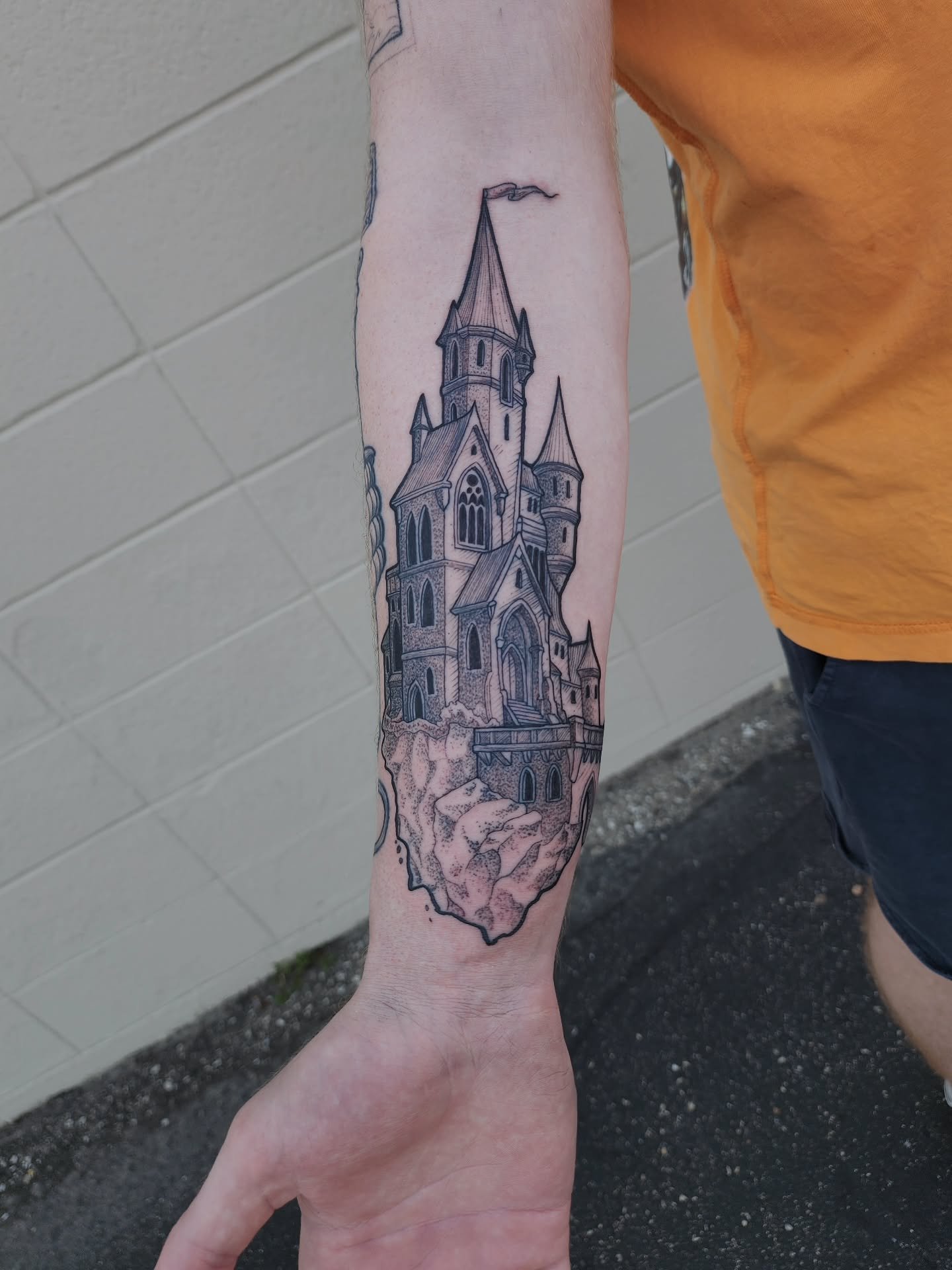
The photograph shows a floating castle on the inner forearm, not above the knee. The castle hovers as a self-contained structure, with towers and architectural details drawn in fine black linework that keeps the fantasy building legible at a small scale.
The inner forearm is a fitting place for a floating subject, because the flat, visible surface lets the castle read clearly without being distorted by a joint. Its suspended, weightless quality is what gives the tattoo its dreamlike character.
18. Eclipse With Botanical Shadow
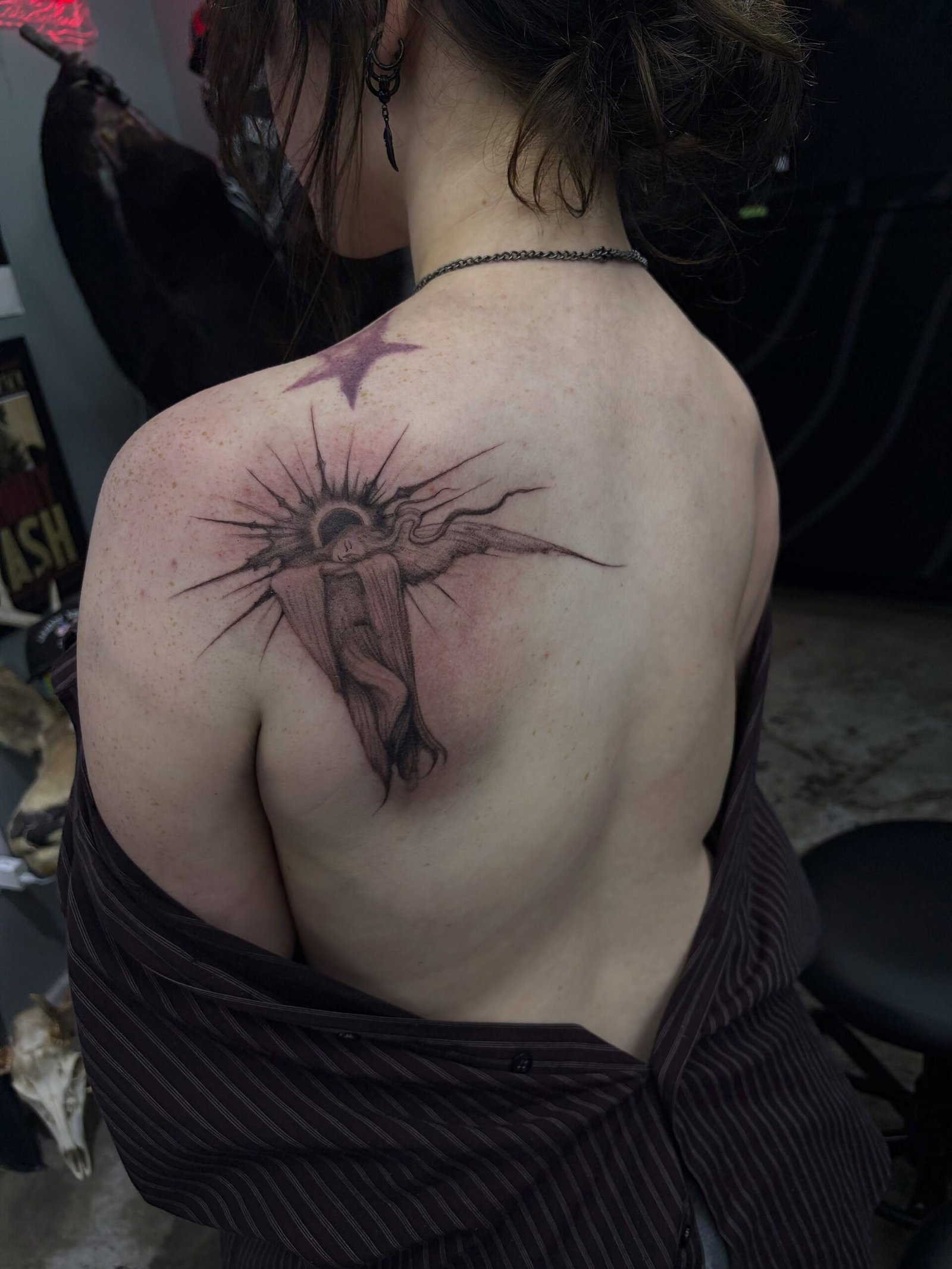
The photograph shows a rayed eclipse with a winged figure on the right shoulder blade, and the tattoo looks fresh. Rather than a plain eclipse with leaf shadows, the design pairs a bold, rayed disc with a winged, siren-like figure, giving the celestial event a mythic companion.
The shoulder blade gives the rayed composition room to spread, while the winged figure adds movement and personality to the eclipse. Together they read as a dramatic, freshly inked emblem rather than a quiet botanical shadow study.
19. Dandelion Seeds Becoming Planets
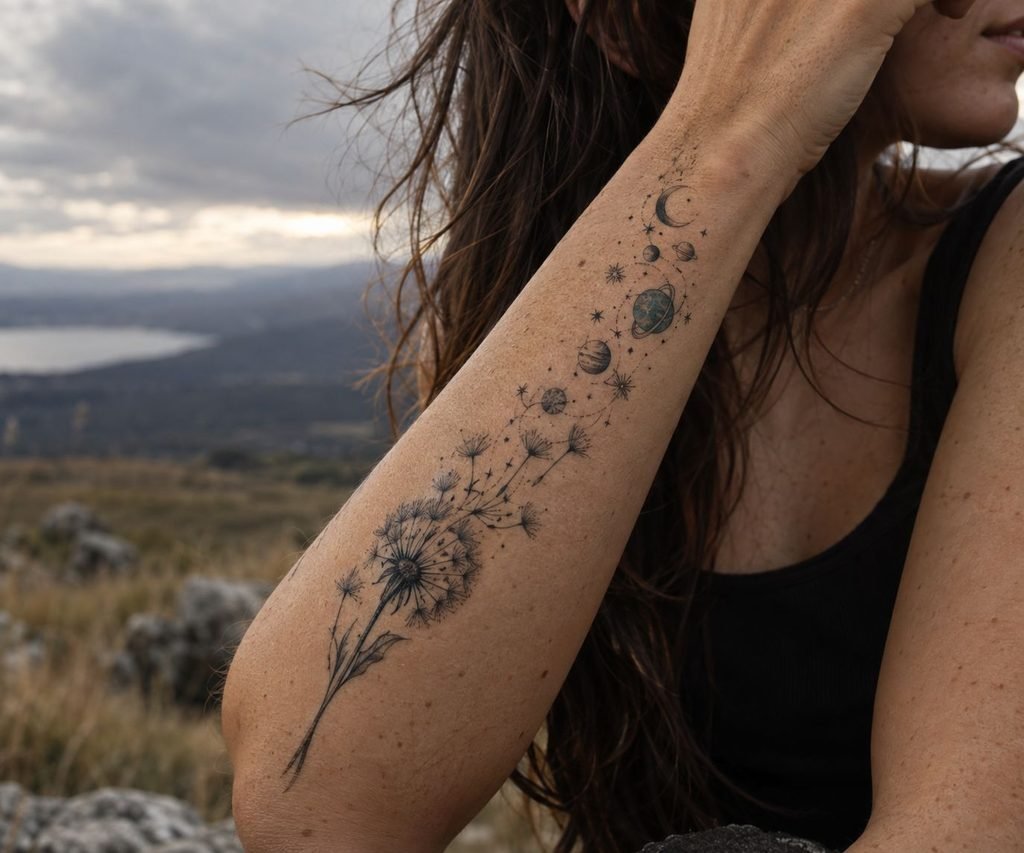
A dandelion bends along the outer forearm, but its escaping seeds gradually turn into tiny planets and orbiting moons. The flower uses crisp botanical linework near the wrist, while the upper elements become increasingly abstract toward the elbow. Dot shading and small pockets of grey establish depth without making the miniature planets excessively detailed.
This transformation feels whimsical while remaining visually coherent: both seeds and planets share simple circular forms. Keep the planetary imagery fictional unless you specifically want an astronomically accurate arrangement. A few well-spaced bodies will age more clearly than a crowded solar system. The design also provides an adaptable framework for personal details, such as a subtle birth flower at the base or a color accent on one imagined planet.
20. Veiled Woman With a Starless Face
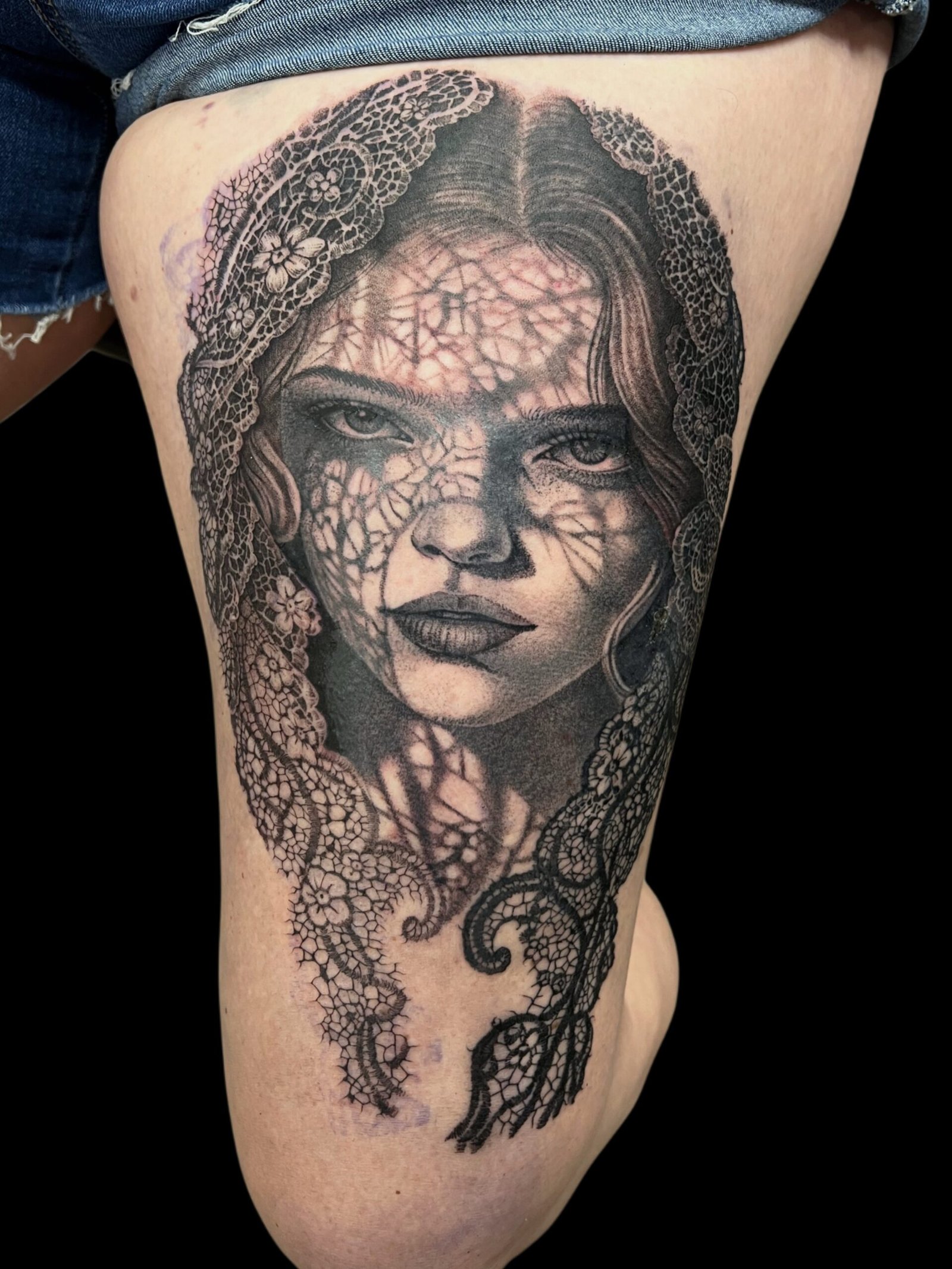
The photograph shows a black-and-grey realistic veiled face on the thigh, with the face clearly visible through the lace pattern rather than replaced by dark ink. The lace veil is rendered as a delicate, patterned layer over the features, so the eyes, nose and lips remain readable beneath it.
This visibility changes the mood completely: instead of an empty, starless void, the tattoo presents a person glimpsed through fabric. The realism of the face, combined with the intricacy of the lace, gives the thigh piece a haunting but human quality.
21. Dragonfly With Opal-Toned Wings
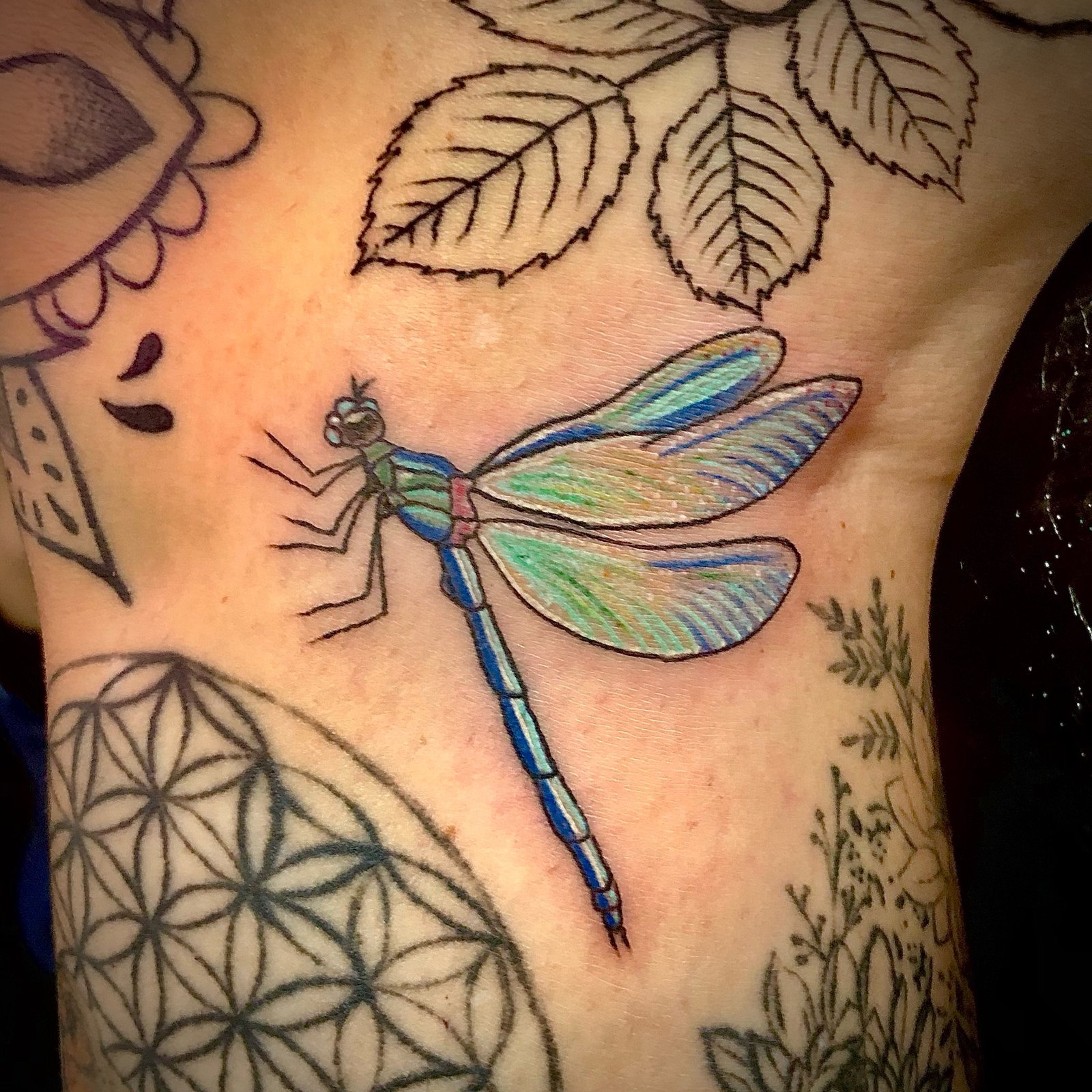
The photograph shows a dragonfly on the upper arm with blue and green iridescent wings and a blue segmented body, rather than pink or violet opal tones. The wings shimmer between blue and green, and the slender, segmented body anchors the design in a clear, natural dragonfly shape.
The cool, aquatic colour palette gives the tattoo a fresh, jewel-like quality, while the upper-arm placement lets the wings spread to their full effect. It is iridescent in the blue-green range, not in the soft pink-violet range suggested by the heading’s original concept.
22. Cloud-Borne Staircase
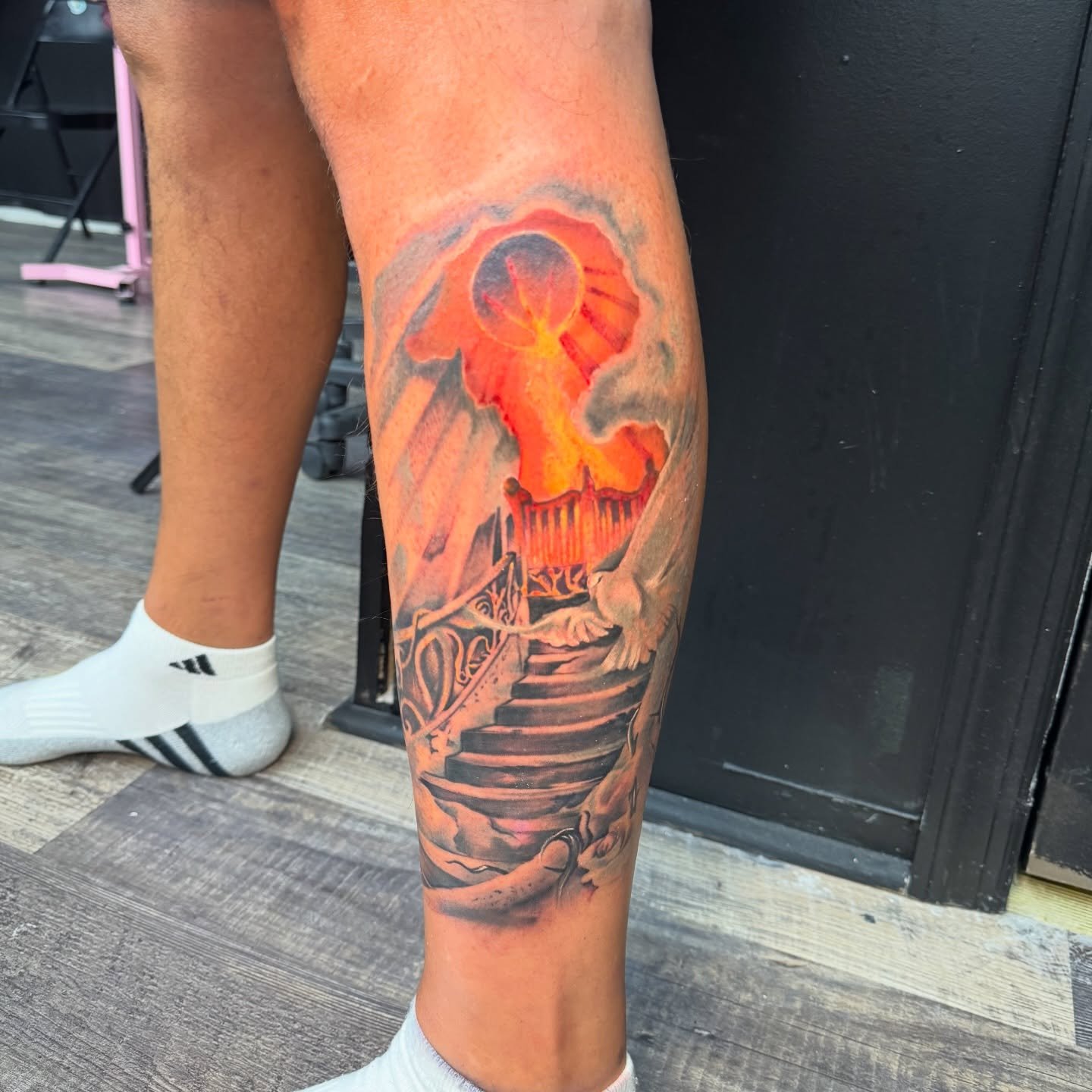
The photograph shows a colourful staircase on the calf, rising toward a gate, with a sun or eclipse and a dove as part of the composition. Rather than narrow black-and-grey steps fading into clouds, the tattoo uses colour and symbolic imagery to make the ascent feel like a journey toward a definite destination.
The calf gives the vertical staircase a natural, upright canvas, and the gate at the top provides a clear endpoint for the climb. The sun or eclipse and the dove add a spiritual, hopeful layer that turns a simple staircase into a story about progress and arrival.
23. Dream Map Across the Shoulder Blade
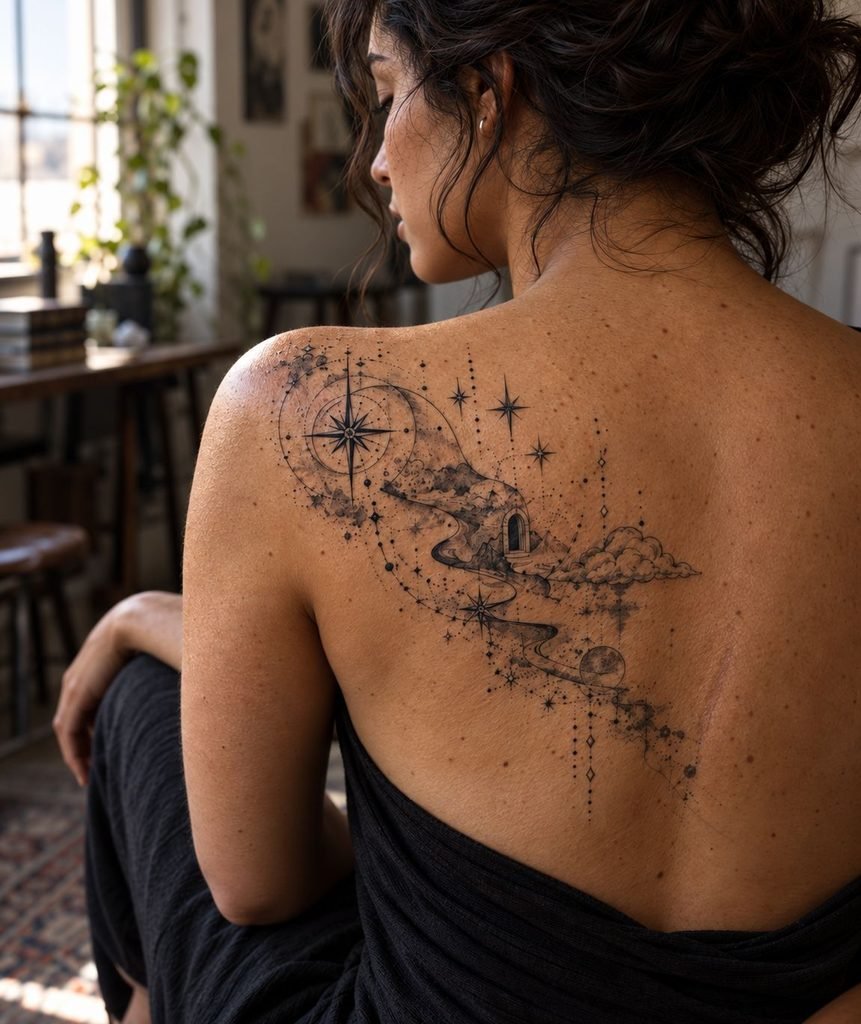
A collection of visual fragments—an unlabelled compass circle, a winding path, three stars, a tiny doorway, and a drifting cloud—forms an abstract map over one shoulder blade. Fine black lines connect some elements, while others remain deliberately isolated. Soft grey wash gathers near the center, creating a focal area without suggesting a real geographic location.
This larger composition suits someone who likes several ethereal motifs but wants them to function as one piece. Limiting the visual vocabulary prevents it from becoming a random collection of symbols. Bring your artist a mood board showing line quality, spacing, movement, and atmosphere rather than asking to combine multiple finished tattoos. The map can remain self-contained or later expand across the upper back through additional paths and cloud forms.
What Makes a Tattoo Look Ethereal?
“Ethereal” is a visual mood rather than one strictly defined tattoo technique. It can appear in fine-line tattooing, black-and-grey realism, dotwork, watercolor-inspired color, ornamental work, or surreal illustration. The common thread is usually a sense of lightness: open compositions, floating elements, softened transitions, restrained contrast, or recognizable forms that dissolve into something unexpected.
Delicacy should not be confused with a lack of structure. The most convincing designs often contain a clear silhouette or darker focal point beneath their softer effects. A moth needs a readable body; a portrait needs enough tonal separation to hold its expression; a watercolor composition benefits from intentional edges. Without that foundation, an atmospheric tattoo may look indistinct rather than dreamlike. When saving references, identify the specific qualities you want—such as faded edges, elongated movement, translucent color, or celestial imagery—instead of relying on “ethereal” as the entire creative brief.
Choosing a Placement That Supports the Design
Match the composition to the body area rather than shrinking or stretching an existing drawing until it fits. Long, narrow designs such as staircases, smoke trails, and lunar sequences naturally suit the spine, calf, forearm, or ribs. Rounded motifs can use the shoulder cap, upper arm, or thigh, while horizontal scenes often sit comfortably beneath the collarbone or across the upper back.
Movement matters as much as available space. An image crossing an elbow, knee, wrist, or ankle will change as the joint bends, so important faces, architecture, and symmetry usually benefit from sitting clear of the deepest crease. Consider everyday visibility as well: clothing necklines, watch straps, shoes, and jewelry may repeatedly conceal or interrupt certain placements. During consultation, have the artist assess the stencil while you stand and move naturally. A tattoo is viewed on a living body, not only as a flat image.
Choosing and Briefing the Right Tattoo Artist
Find an artist whose existing work demonstrates the actual skills your concept requires. A specialist in fine botanical linework may not be the right match for a soft microrealist portrait, while an accomplished blackwork artist may not regularly work with translucent pastel color. Review complete portfolios for healed examples, anatomically appropriate placement, clean linework, and consistent results—not merely a few heavily edited close-ups.
Prepare a concise mood board containing references for atmosphere, motif, palette, line weight, scale, and placement. Label what you like in each image so the artist understands the direction rather than assuming you want a copy. Include photographs of natural textures, clouds, plants, architecture, or lighting alongside tattoo references. A reputable professional can then translate those ingredients into an original composition that fits your body and leaves enough contrast and negative space to remain visually coherent.
Final Thoughts
The most memorable ethereal tattoos do not depend on adding every dreamy symbol to one design. Their atmosphere often comes from editing: one form dissolves, one edge remains unfinished, or one pocket of open skin makes the entire composition feel lighter. That restraint is what separates a considered tattoo from a crowded collection of celestial decorations.
Save the ideas that share the mood you want, then compare them by placement, scale, visibility, color, and technical complexity. A misty mountain window asks for different expertise than an opal dragonfly or a microrealist portrait. Use your references to begin a conversation with a professional artist, not to request an exact duplicate of someone else’s tattoo. With an original composition and enough room for each detail, ethereal tattoos can retain their strange, suspended quality without losing the structure that makes them readable.