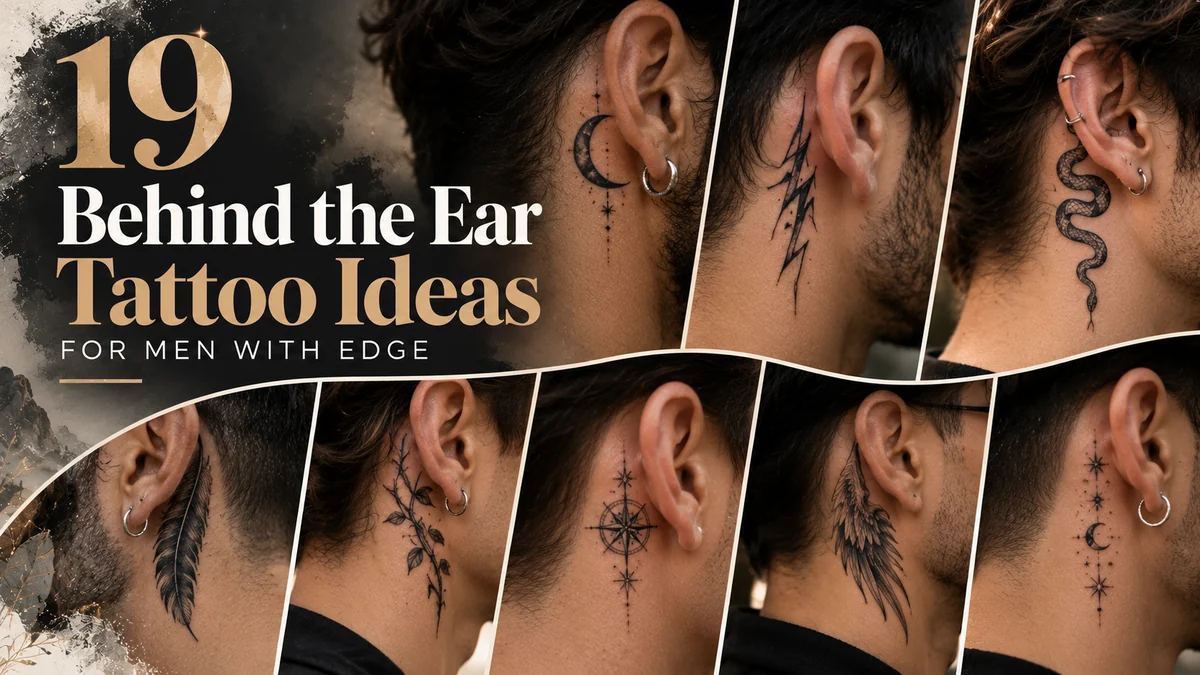
19 Behind the Ear Tattoo Ideas for Men With Edge
The best behind the ear tattoos are designed for the space, not shrunk down from a larger idea. A successful design should read clearly from a short distance, follow the curve of the ear and jaw, and avoid details so fine that they blur together. Small does not mean simple; it means every line has a job. The ideas below focus on that principle, with strong silhouettes, controlled detail, and placement choices that suit the shape of the ear.
Behind the ear is one of the most useful small tattoo placements available, especially for men who want a design with edge but not a large statement piece. The area is naturally narrow, curved, and easy to conceal, yet it becomes visible the moment hair is tucked back or cut short. That balance makes it ideal for bold symbols, sharp lines, and compact creatures that would lose impact if stretched across a larger area.
1. Offset Black Crescent Tattoo
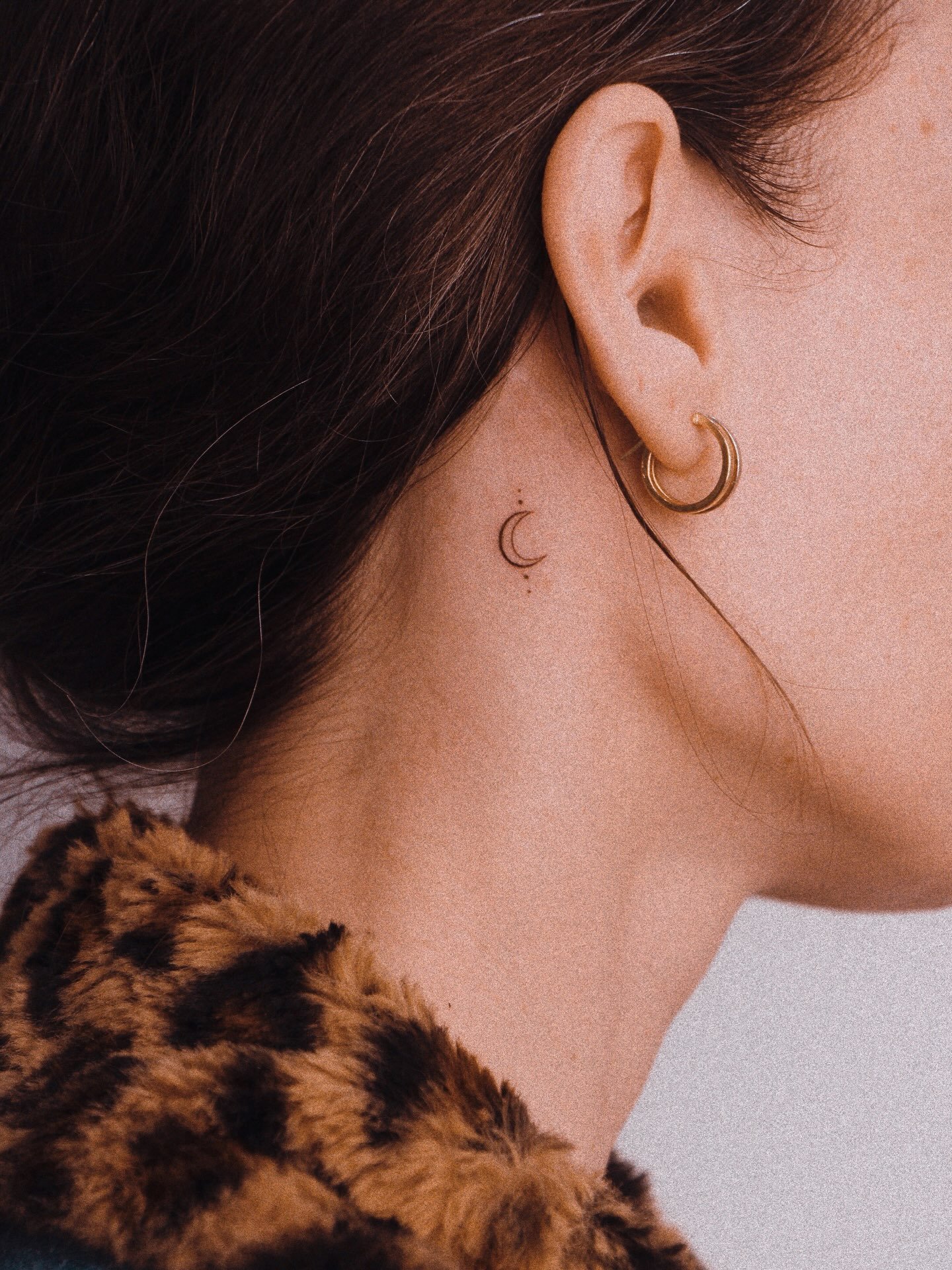
An offset black crescent Tattoo is a strong choice for the space behind the ear because it uses negative space as part of the design. Instead of centering the moon, the crescent is shifted slightly toward the back of the ear, leaving the open side to echo the curve of the ear itself. In the photo, a small fine-line crescent with small dots, placed low behind and below the ear, makes the shape readable at a glance, while a slight asymmetry keeps it from looking like a generic symbol. This design works well on its own or as a quiet anchor for a larger neck piece.
Keep the crescent compact, roughly the size of a thumbnail, and avoid adding stars or dots unless they serve a clear purpose. Too many small elements will crowd the area and make the tattoo look busy from a distance. A clean edge is essential; any wobble in the curve will be noticeable because the shape is so simple. For a sharper finish, ask the artist to check the stencil from both the side and the front, since the ear’s curve can distort a flat design.
2. Forked Lightning Bolt Tattoo
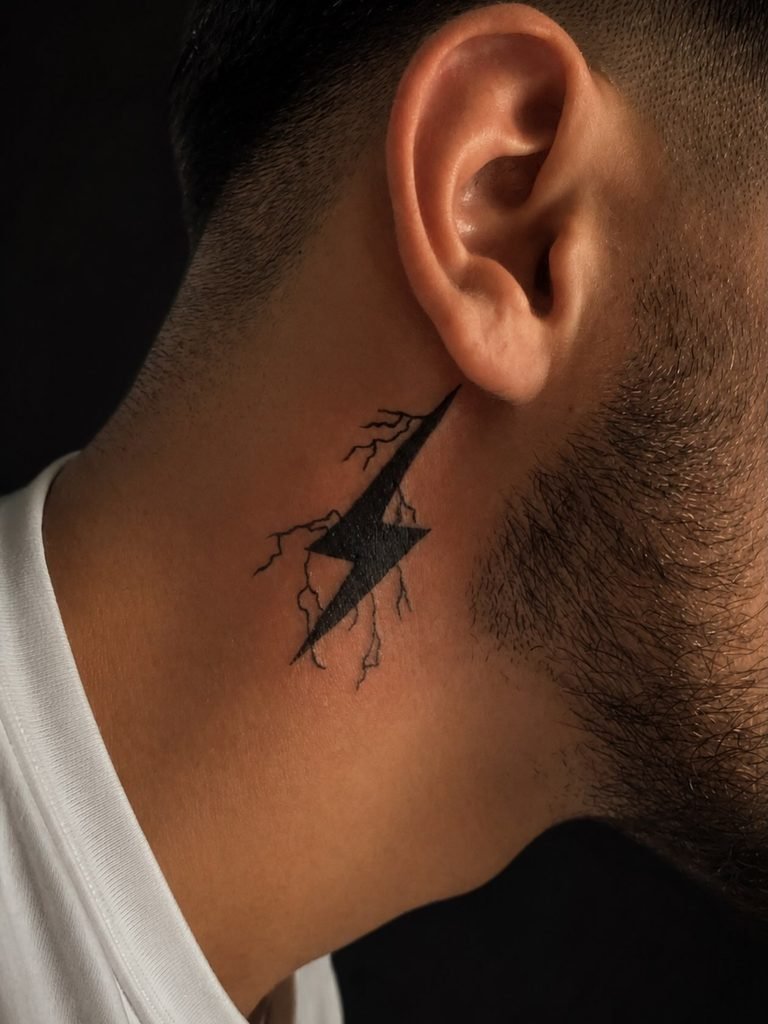
A lightning bolt Tattoo is a classic symbol of energy and speed, but a standard bolt can look flat when placed behind the ear. A forked version solves that problem by splitting the lower point into two uneven branches, giving the design movement without adding width. The main bolt should run vertically, with the fork breaking toward the neck rather than the ear, so the shape does not compete with the ear’s outline. This version feels sharper and more intentional than a generic bolt.
Keep the bolt narrow and avoid filling it with solid black unless the wearer wants a very bold look. A black outline with a clean interior will age better and stay readable as lines soften. The fork should be limited rather than breaking into tiny electrical veins. The design should be no taller than the ear itself, and the upper point should sit just below the hairline to avoid disappearing under hair.
3. Coiled Micro Serpent Tattoo
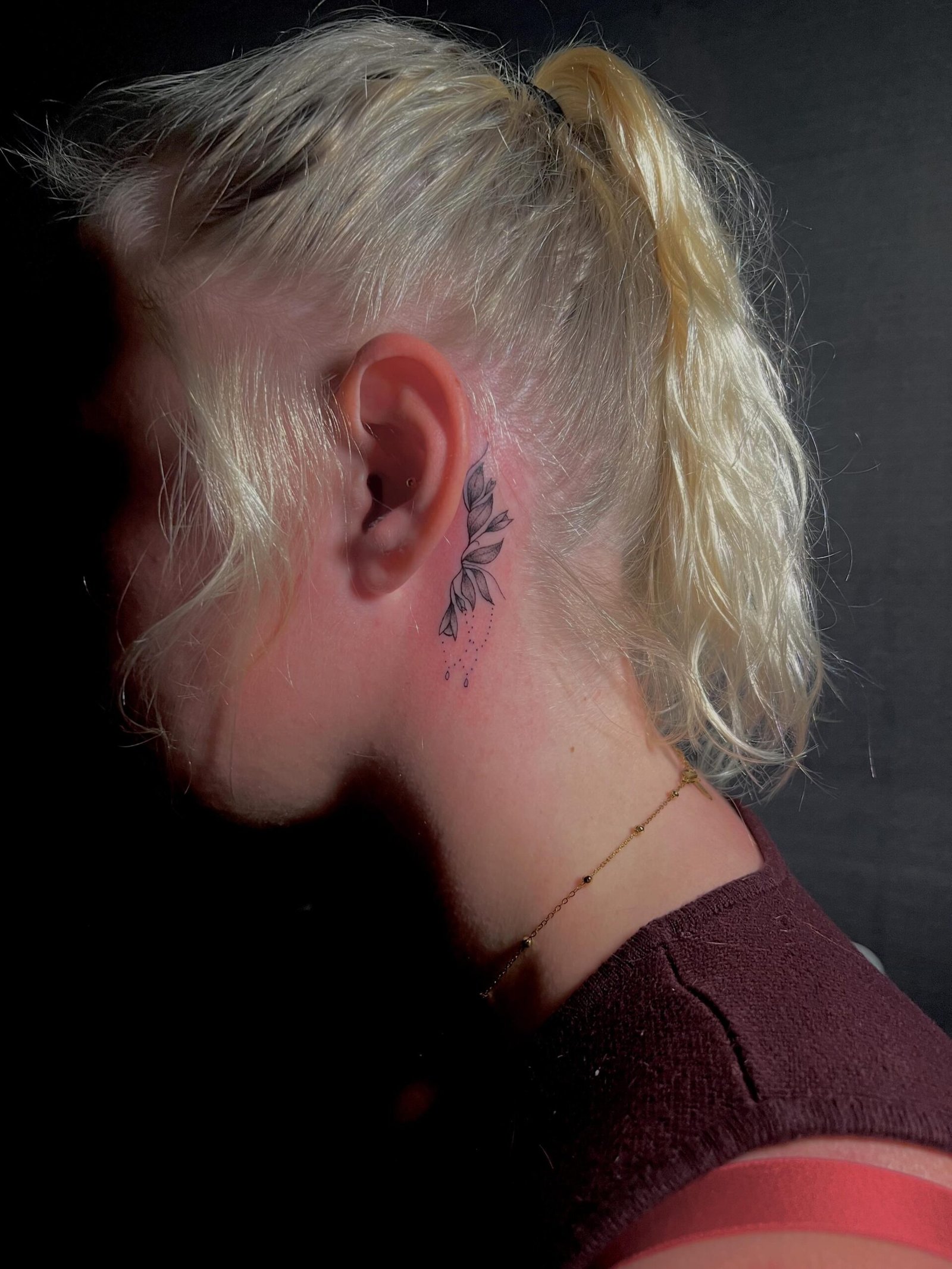
A micro serpent Tattoo is one of the most effective behind-the-ear designs because its natural shape fits the curve of the area. The snake should coil loosely, forming a compact S-shape that follows the back of the ear rather than wrapping around it. A small head with a forked tongue adds character without requiring fine detail, while a thin body keeps the design from looking heavy. This approach works well for men who want a design with movement but not aggression.
Scale detail should be suggested rather than drawn in full, since individual scales will blur at this size. Use a single line for the belly and a few short marks for texture, and keep the tail tapering to a clean point. In the photo, the serpent descends behind the ear in a wavy vertical line toward the neck, rather than sitting entirely in a tight coil behind the ear, so it remains a discreet accent rather than a larger piece. A blackwork finish will keep the design sharp and avoid color fading.
4. Raven Feather Tattoo Following the Hairline
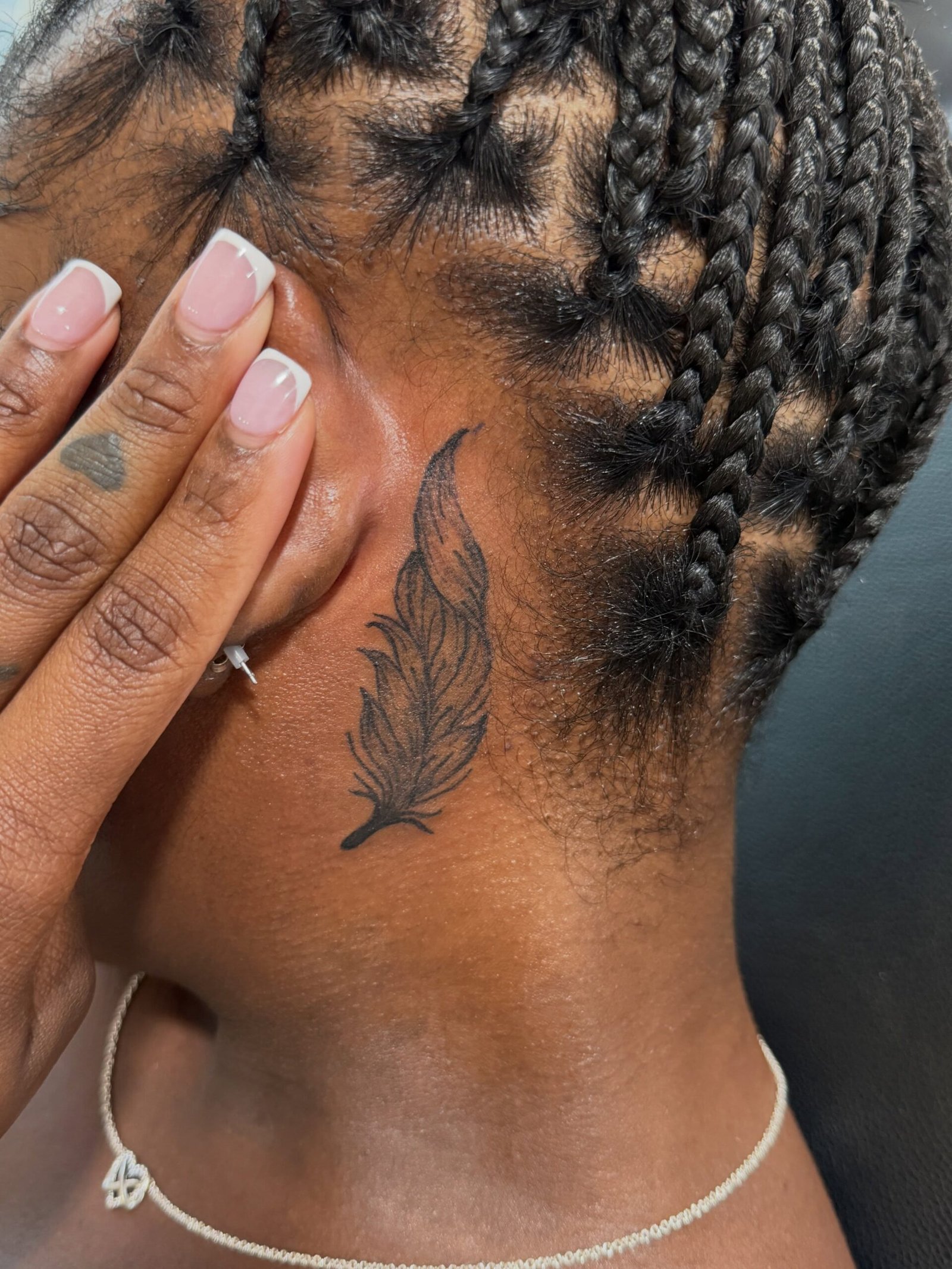
A raven feather Tattoo is a natural fit for the area behind the ear because its long, narrow shape can follow the hairline without taking up much width. The feather should be drawn in a slightly curved position, with the quill at the top near the hairline and the vane tapering downward toward the neck. In the photo, a more solid, detailed black feather descends vertically behind the ear toward the neck, giving the design depth without making it look heavy. The key is to keep the feather slim, roughly 3 inches long, so it does not overwhelm the space.
This shape can fill more vertical space without projecting far onto the neck. Its curve should follow the wearer’s hairline instead of being copied from a flat drawing. Raven feathers may evoke personal, literary, or visual associations, but avoid claiming a universal cultural meaning. Use genuine feather references and keep the vane slightly uneven; perfect bilateral symmetry would make the subject feel manufactured rather than natural.
5. Thorn Stem Tattoo Around the Ear Base
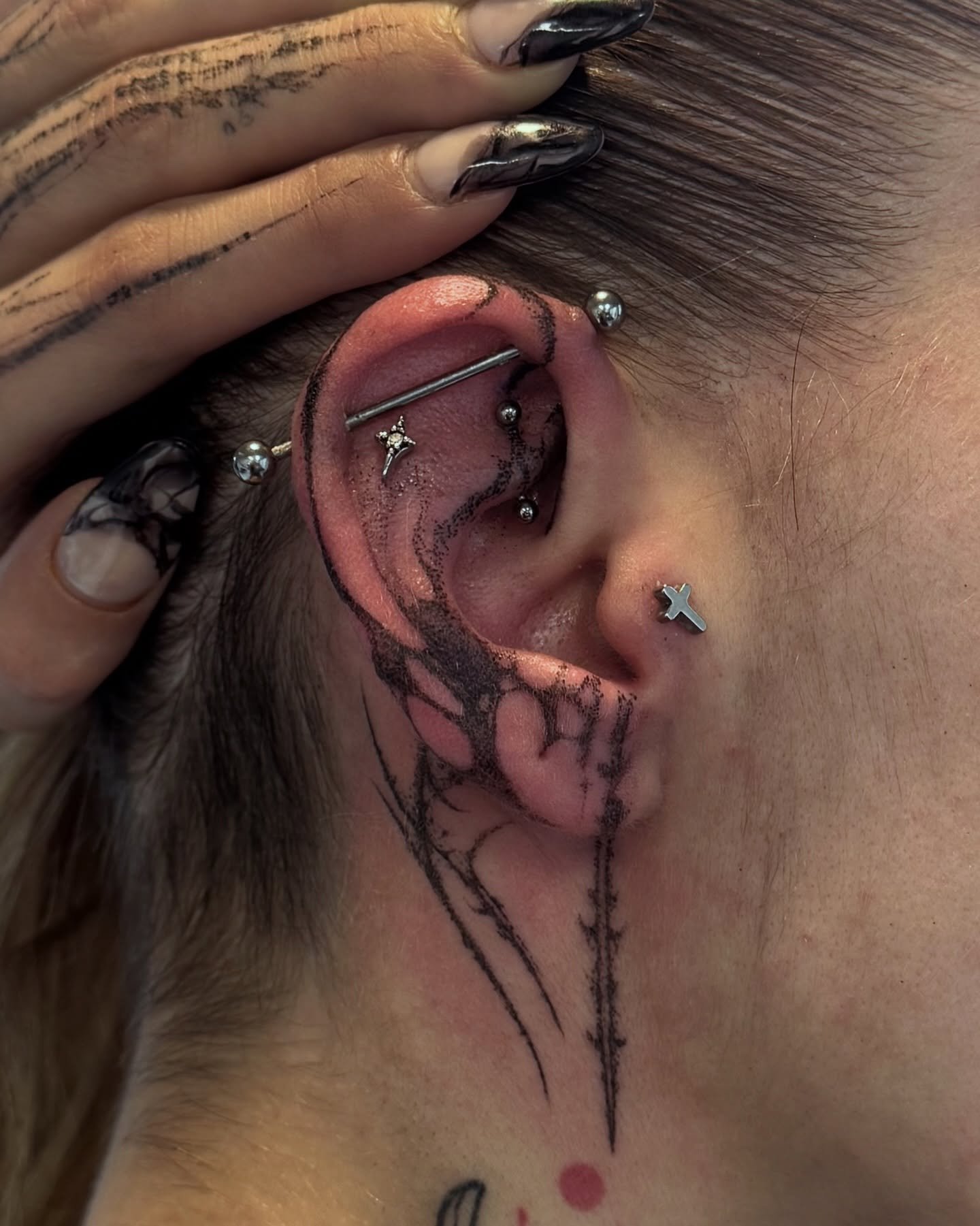
A thorn stem Tattoo is a sharp, understated design that wraps naturally around the base of the ear. The stem should be thin and dark, with thorns that point outward rather than toward the skin, creating a sense of protection without aggression. In the photo, the thorn vine is more extensive and wraps around the ear base, rather than a spare stem with about four thorns, and the stem curves gently behind the ear rather than forming a tight circle. This restraint keeps the tattoo from looking like a vine or a bracelet.
The thorns should be short and triangular, not long and curved, so they read as thorns rather than spikes or flames. A blackwork finish works best, with the stem slightly thicker than the thorns to give the design structure. Place the stem just behind the ear’s edge, not on the ear itself, and avoid adding leaves or flowers unless they are part of a larger piece. The result is a clean, edgy accent that suits the narrow space.
6. Moth Tattoo in Side Profile
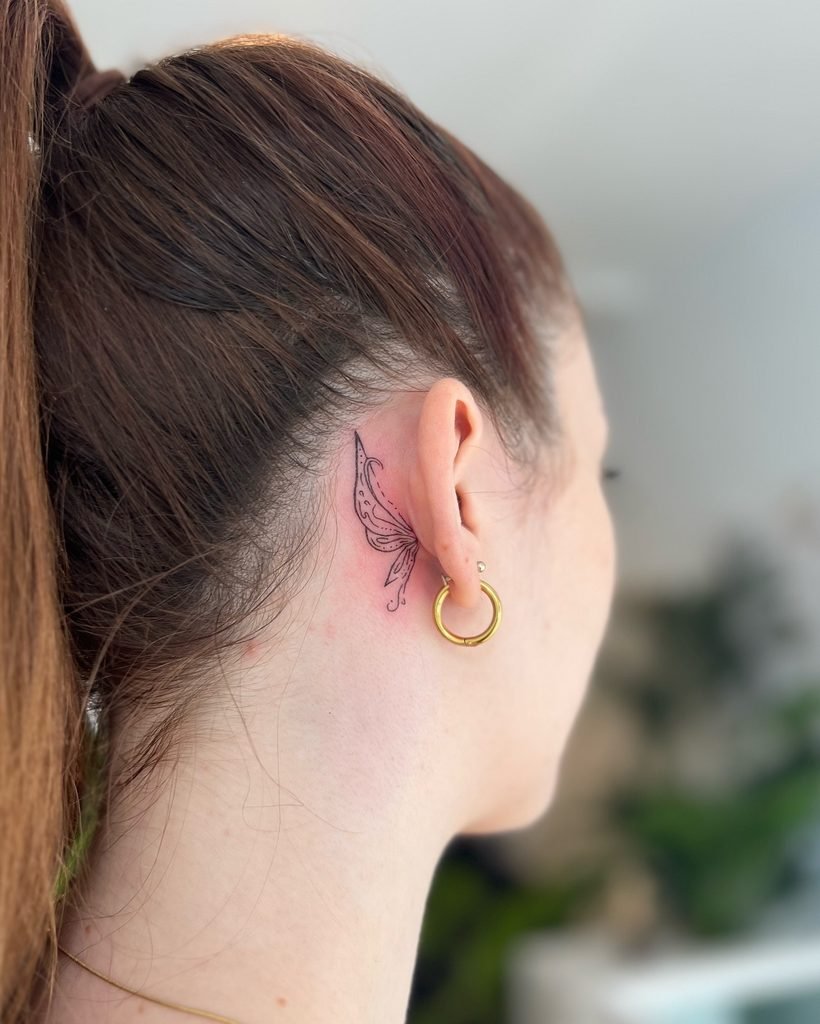
A moth Tattoo in side profile is a striking choice for the space behind the ear because its wing shape can be compressed without losing its identity. The moth should be drawn facing forward, with one wing visible in full and the other suggested behind it, creating depth in a small area. A dark body with detailed wing patterns will give the design texture, while a slightly asymmetrical wing shape keeps it from looking like a butterfly. This design works well for men who want a natural motif with a darker edge.
Keep the moth small, no wider than the ear, and avoid adding too much detail to the wings. Fine lines for the wing veins will be enough, and the body should be solid black to anchor the design. Place the moth just behind the ear, with its head pointing upward, so it follows the natural curve of the area. If a particular species matters, choose one whose profile remains recognizable at small scale rather than compressing elaborate patterns into hairline detail.
7. Descending Scorpion Tattoo
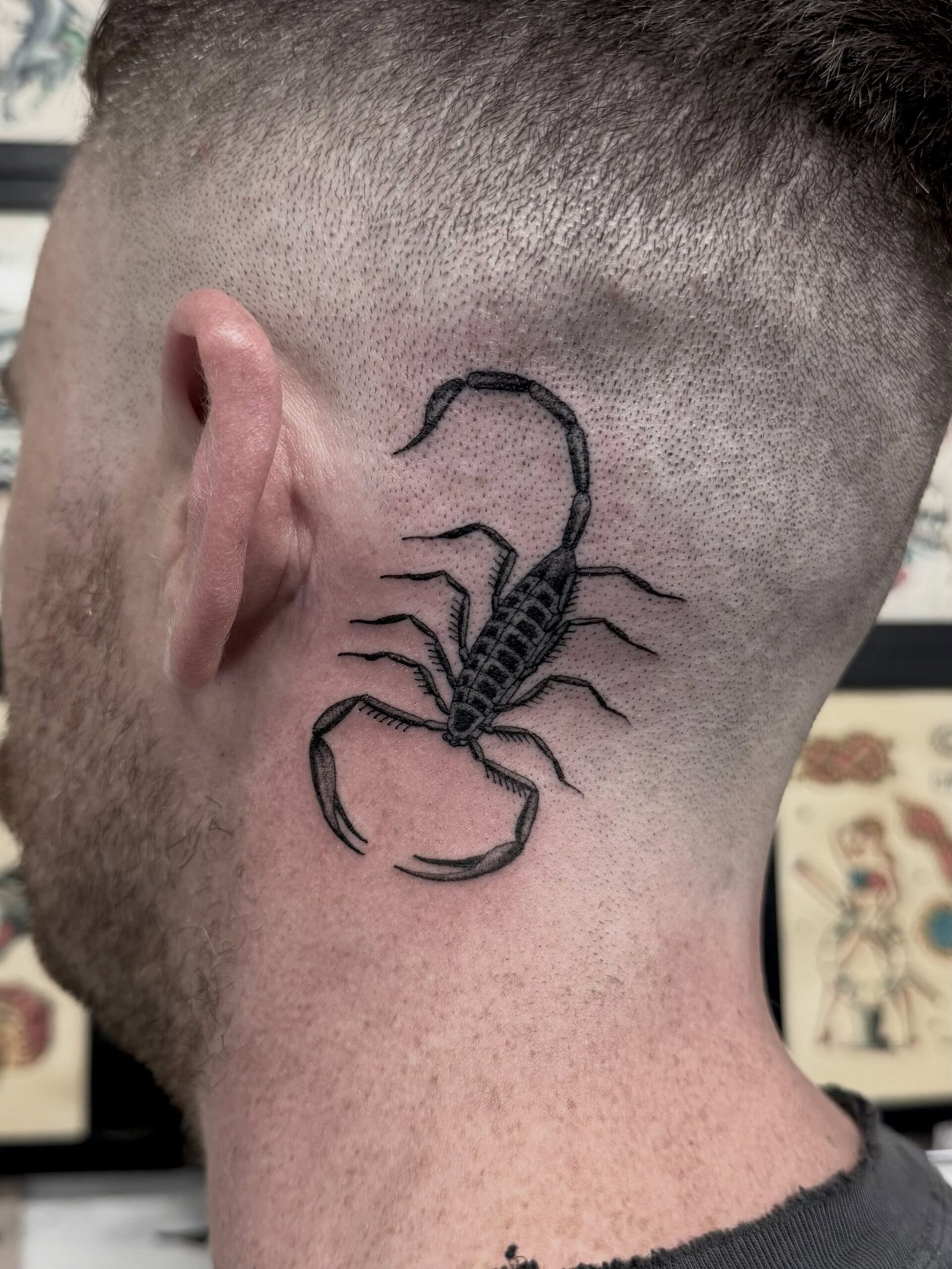
A descending scorpion Tattoo is a bold choice for the area behind the ear because its vertical shape fits the narrow space. The scorpion should be drawn with its body vertical, its tail arched over its back, and its pincers pointing downward toward the neck. A blackwork finish with detailed segmentation will give the design texture, while a slightly curved tail keeps it from looking stiff. This design works well for men who want a symbol of resilience and protection.
Keep the scorpion compact, no longer than the ear, and avoid adding too much detail to the legs. The tail should retain a clear, open curve instead of coiling tightly, so the shape remains readable from a distance. Place the scorpion just behind the ear, with its body following the curve of the jaw, and avoid extending it onto the neck. A clean outline is essential; any wobble in the tail will be noticeable because the shape is so distinctive.
8. Broken Halo Tattoo
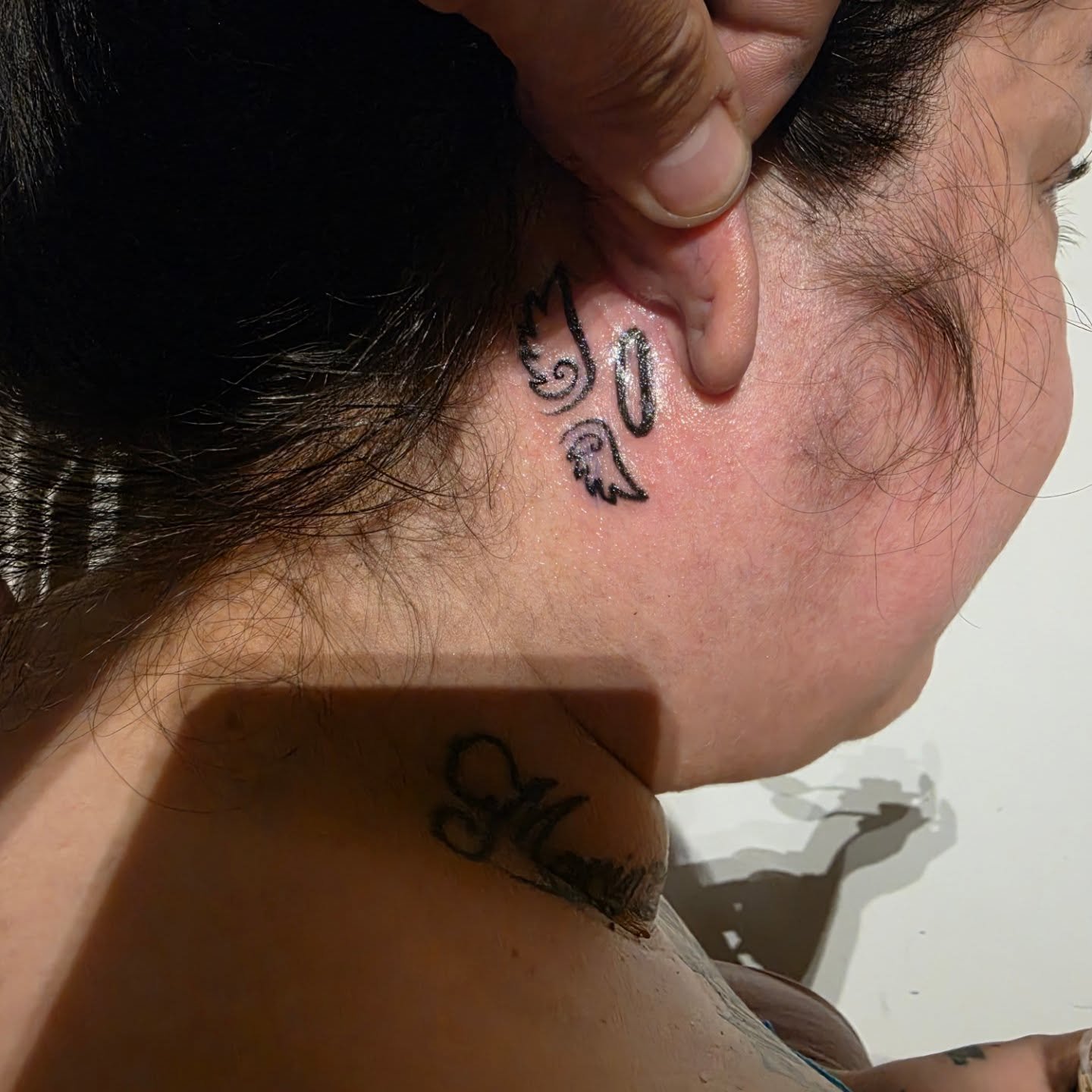
A broken halo Tattoo is a subtle, symbolic design that works well behind the ear because its circular shape can be scaled down without losing impact. The halo should be drawn as a thin black oval with wing-like detached segments, creating a sense of imperfection without looking incomplete. Small, detached segments floating just above the break will add movement and suggest that the halo is in motion. This design works well for men who want a symbol with personal meaning but not an overt statement.
Keep the halo small, no larger than a coin, and avoid adding rays or other elements that would crowd the area. The break should be clean and deliberate, not a gap caused by poor linework, and the detached segments should be positioned so they appear intentional. Ask the artist to check how the circle looks from the side, since the neck’s curve can make an accurate stencil appear oval from some angles.
9. Dry-Brush Blackwork Slash Tattoo
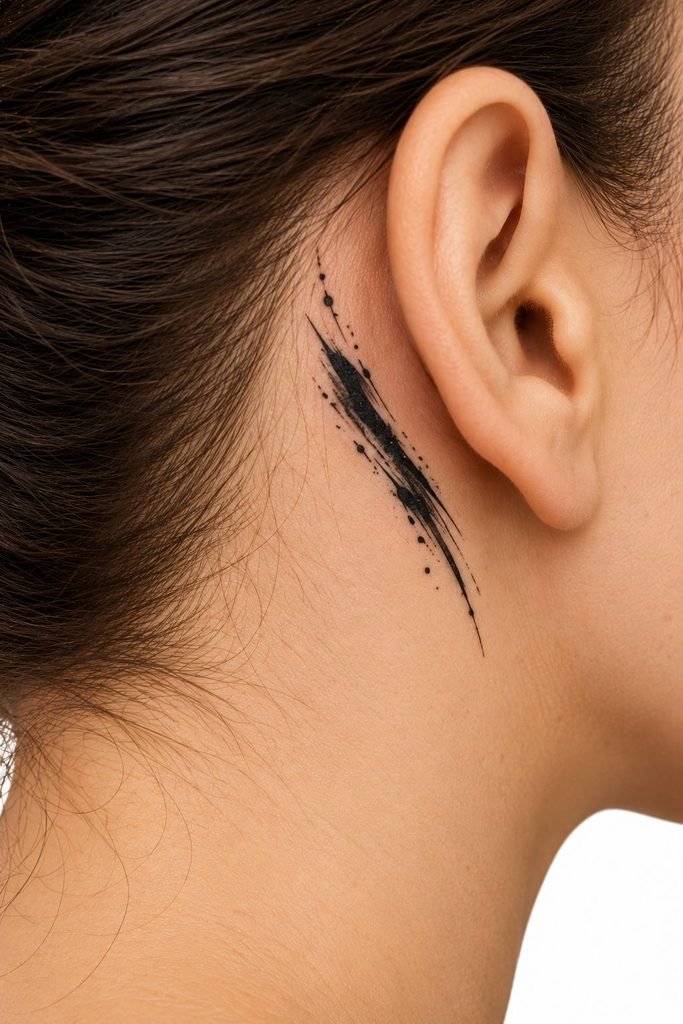
A dry-brush slash Tattoo is one of the most striking behind-the-ear designs because it uses texture rather than a recognizable symbol. The slash should be drawn as a single, bold stroke that runs diagonally behind the ear, with a rough, dry-brush edge that suggests movement and energy. A blackwork finish with varying line weight will give the design depth, while a slightly uneven edge keeps it from looking like a simple line. This design works well for men who want an abstract, edgy accent.
Keep the slash short, no longer than the ear, and avoid adding multiple strokes that would make the design look like a scratch. A single, confident stroke will have more impact than several thin lines. Place the slash diagonally, with the upper end near the hairline and the lower end toward the neck, so it follows the natural angle of the area. The dry-brush texture should be subtle, not heavy, so the design remains readable as a deliberate mark rather than a mistake.
10. Miniature Dagger Tattoo
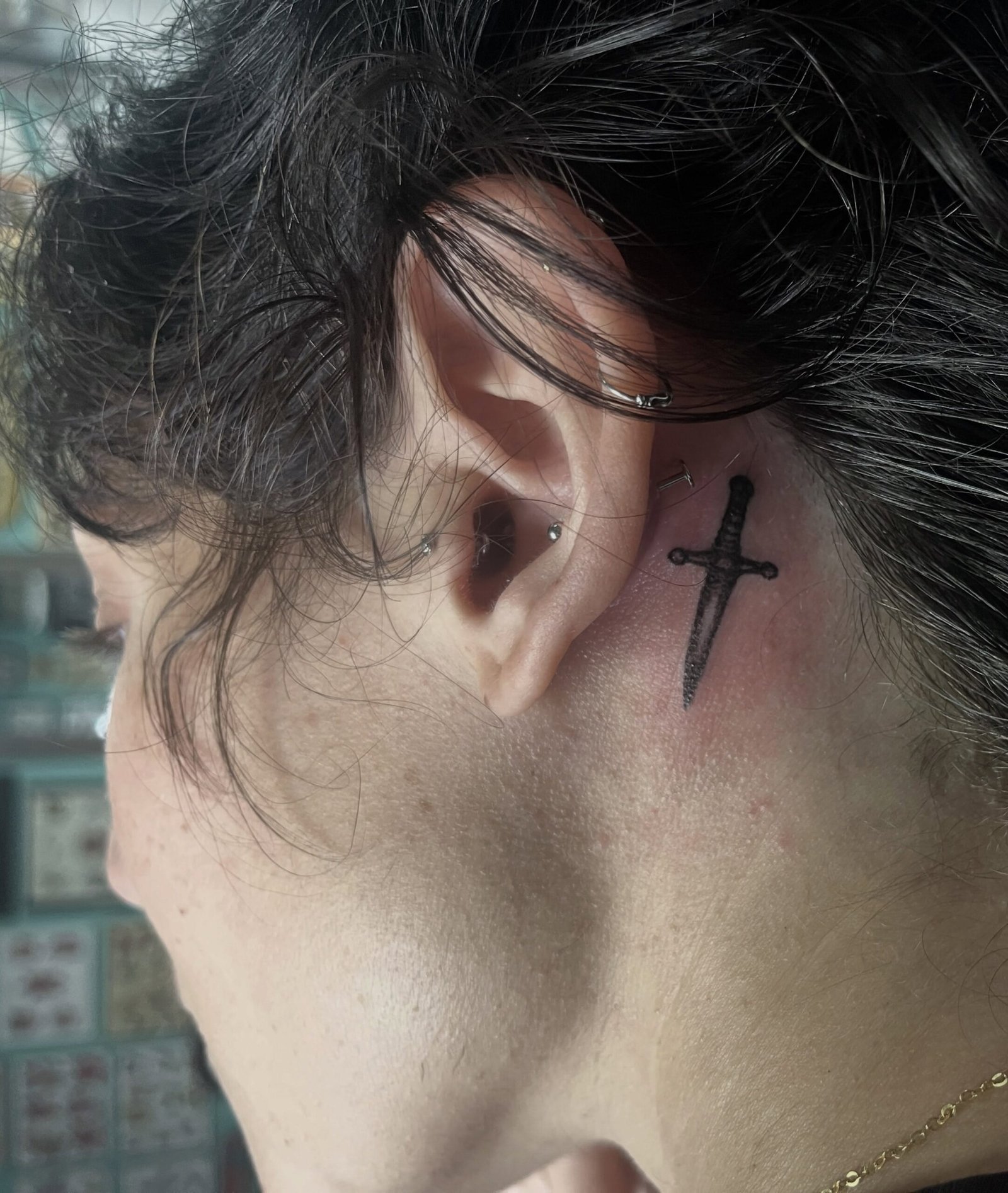
A miniature dagger is a classic symbol of protection and precision, and it fits the space behind the ear because its narrow shape can be placed vertically without taking up much width. The dagger should be drawn with a sharp point, a simple crossguard, and a short handle, with the blade pointing down. A solid black finish will give the design depth, while a clean outline keeps it readable at small scale. This design works well for men who want a bold symbol with a clear silhouette.
Keep the dagger small, no longer than the ear, and avoid adding elaborate details to the handle or blade. A simple design will age better and stay readable as lines soften. Place the dagger vertically, with the point down and the handle near the hairline, so it follows the natural angle of the area. Check the stencil from the front as well as the side so the point does not appear to enter the ear or jaw from another viewing angle. A dagger can carry personal or historical associations, so choose the style intentionally and avoid accidental associations.
11. Three Open Chain Links Tattoo
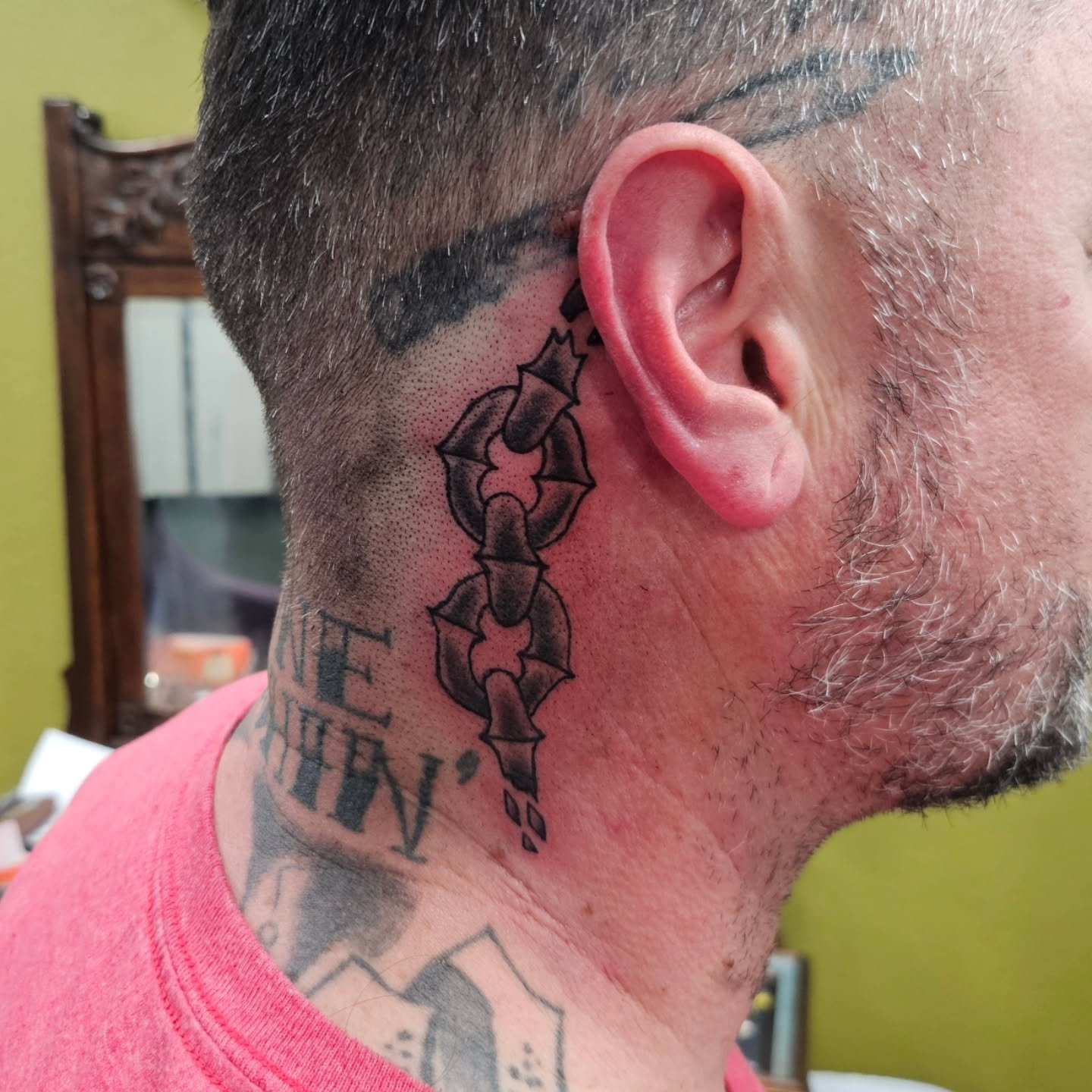
Three open chain links Tattoo are a strong, industrial design that works well behind the ear because the links can be arranged vertically without taking up much width. Each link should be drawn as an open oval, with a small gap at one end, creating a sense of movement and connection. In the photo, the chain is a traditional, shaded, interlinked chain descending behind the ear and down the neck, with a consistent line weight that keeps the design clean, while a slightly uneven spacing between links adds a handmade feel. This design works well for men who want a symbol of strength and connection without a literal image.
Keep the links small, each no larger than a fingernail, and avoid closing them completely. Open links suggest flexibility rather than constraint, and they will remain readable even as lines soften. Place the links vertically behind the ear, with the top link near the hairline and the bottom link toward the neck, so they follow the natural line of the area. A clean, consistent outline is essential; any variation in link size will be noticeable because the design is so simple.
12. Eclipse and Orbit Tattoo
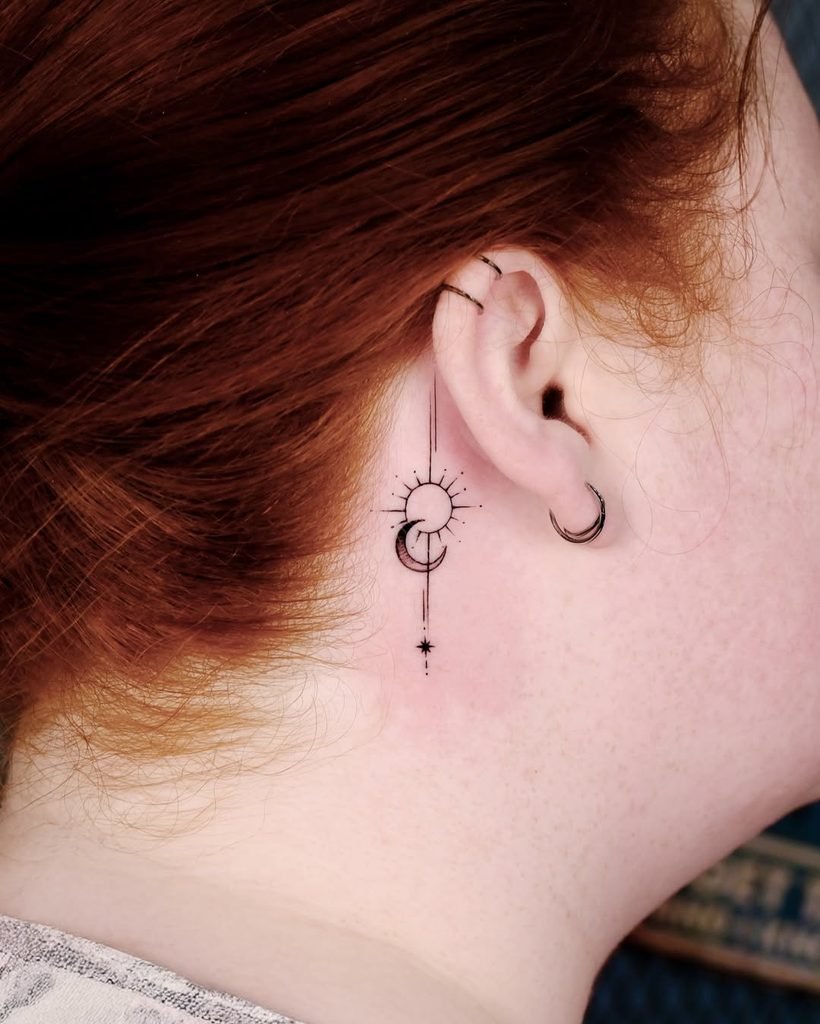
An eclipse and orbit Tattoo design is a compact, celestial motif that fits the space behind the ear because it uses a small circle and a thin ring to create depth. The eclipse should be drawn as a solid black circle, with a thin orbit ring crossing it diagonally and a tiny dot representing a planet or star. A blackwork finish will keep the design sharp, while the orbit ring adds movement without requiring much space. This design works well for men who want a cosmic symbol with a clean, modern feel.
Keep the eclipse small, no larger than a coin, and avoid adding multiple orbits or stars that would crowd the area. A single orbit ring with one dot is enough to suggest motion and scale. Place the design just behind the ear, with the orbit ring angled to follow the curve of the jaw, so it does not compete with the ear’s outline. A clean edge on the black circle is essential; any wobble will be noticeable because the shape is so simple.
13. Wolf Tooth Tattoo With Etched Ridge
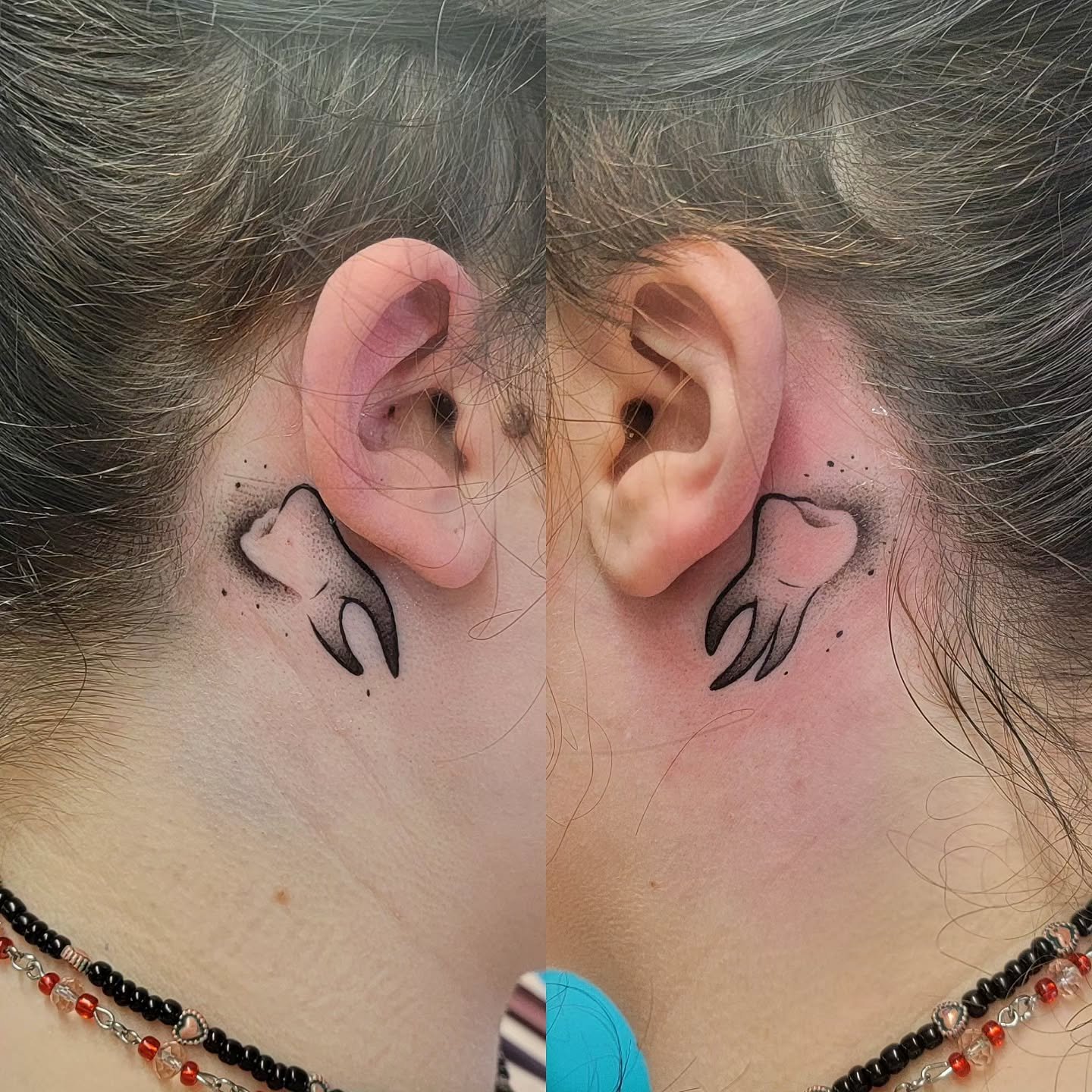
A wolf tooth Tattoo is a sharp, natural design that works well behind the ear because its pointed shape can be placed vertically without taking up much width. The tooth should be drawn with a clean, tapered point and a thin etched ridge running down the center, giving it texture without requiring fine detail. In the photo, the tooth is shown behind the ear in paired views, with dark shading, while a slightly irregular edge keeps the design from looking like a generic fang, and a solid black tip adds weight. This design works well for men who want a symbol of strength and instinct.
Keep the tooth small, no longer than the ear, and avoid adding multiple teeth that would make the design look like a jaw. A single tooth has more impact and remains readable at small scale. Place the tooth vertically behind the ear, with the point downward toward the neck, so it follows the natural line of the area. The etched ridge should be subtle, not deep, so it does not split the design visually. A wolf tooth can carry personal associations, so choose it intentionally rather than as a generic animal symbol.
14. Topographic Ear Contours Tattoo
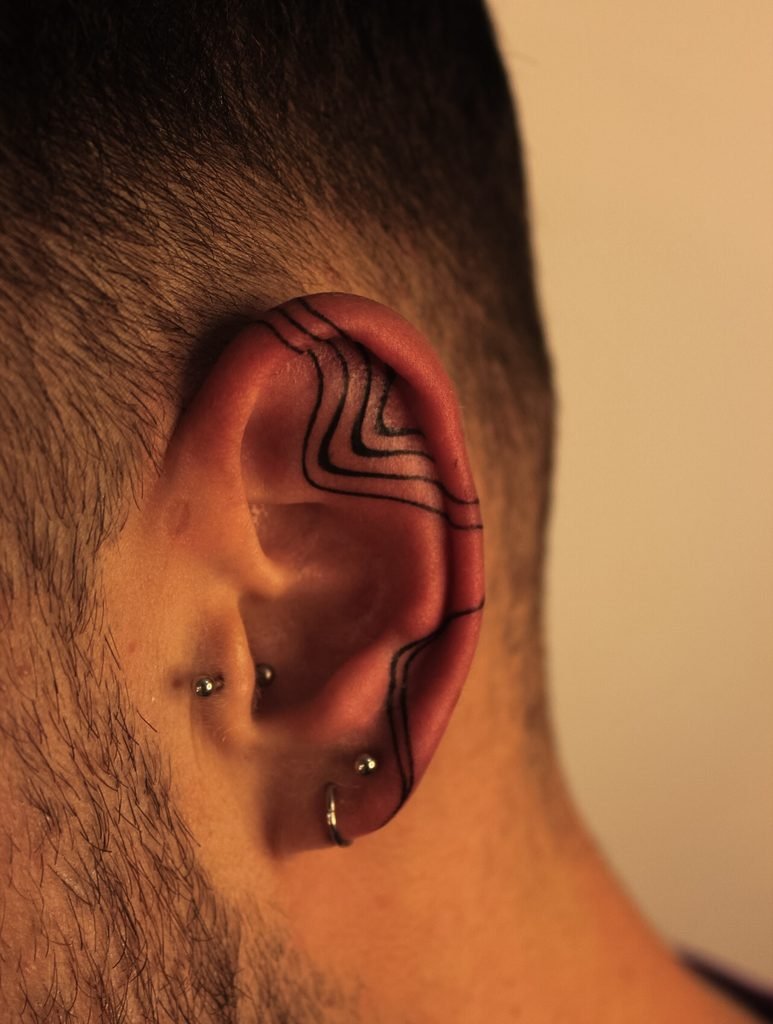
Topographic contours Tattoo are an abstract, modern design that works well behind the ear because the curved lines can follow the shape of the ear itself. The design should consist of three or four thin, wavy lines that echo the contours of the ear, creating a sense of depth and movement. A blackwork finish with consistent line weight will keep the design clean, while a slightly irregular spacing between lines adds a natural feel. This design works well for men who want an abstract accent with a technical edge.
Keep the lines thin and avoid adding labels or numbers that would make the design look like a map. The contours should be suggestive, not literal, and they should follow the ear’s shape rather than forming a rigid pattern. Place the design just behind the ear, with the lines curving gently toward the neck, so they do not compete with the ear’s outline. A clean, consistent line weight is essential; any variation will be noticeable because the design is so minimal, especially close to the hairline.
15. Burned Match Tattoo
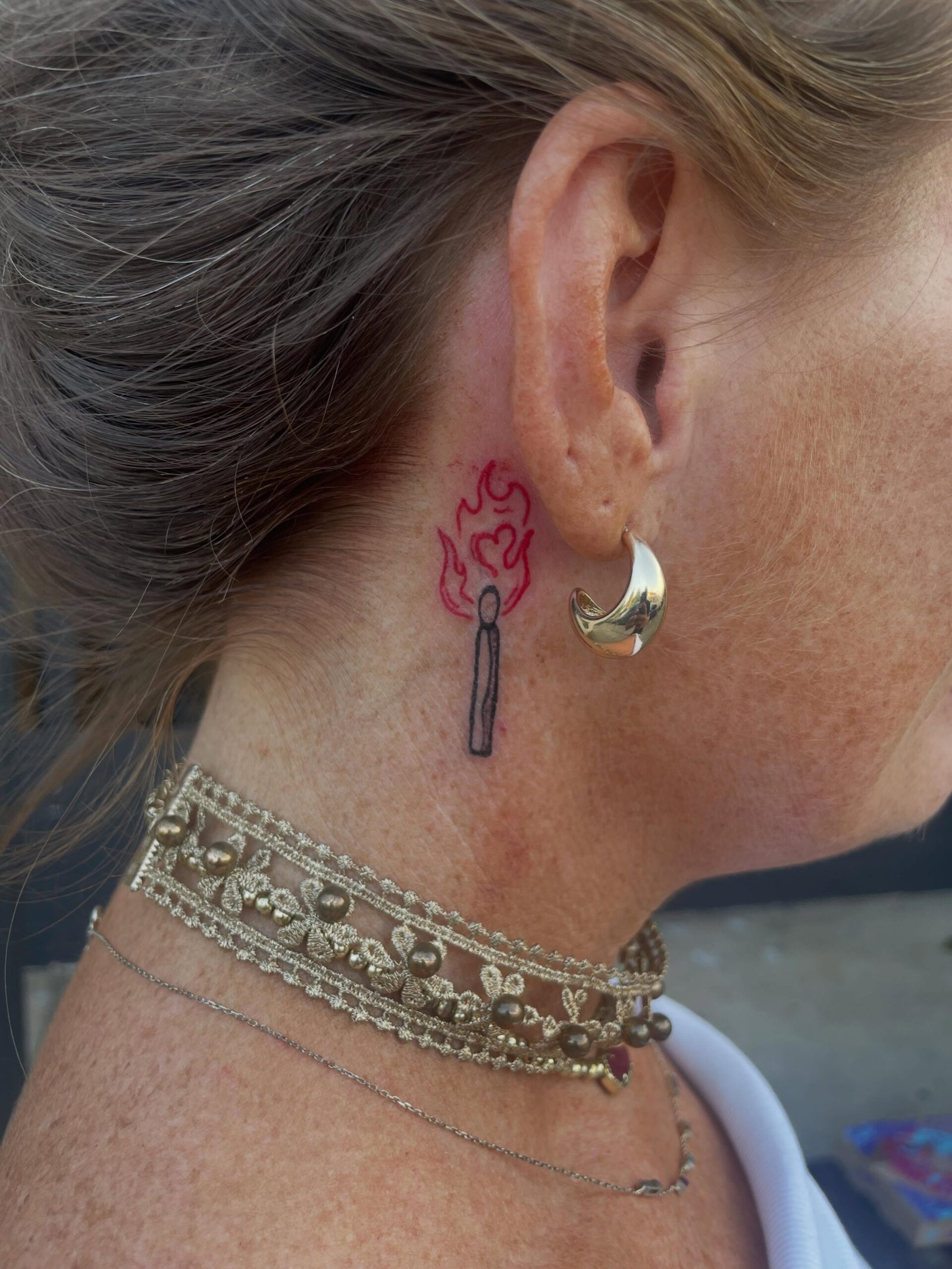
A burned match Tattoo is a small, symbolic design that works well behind the ear because its vertical shape fits the narrow space. The match should be drawn with a thin black stick and a red flame outline at the top, creating a sense of a moment frozen in time. A blackwork finish will keep the design sharp, while the flame adds movement without requiring much space. This design works well for men who want a symbol of a spark, a memory, or a turning point.
Keep the match small, no longer than the ear, and avoid adding a flame that would make the design look like a candle. A red flame outline at the top is enough to suggest the story. Place the match vertically behind the ear, with the tip at the top and the flame curling toward the hairline, so it follows the natural line of the area. A clean outline on the stick is essential; any wobble will be noticeable because the design is so simple.
16. Stag Beetle Tattoo in Profile
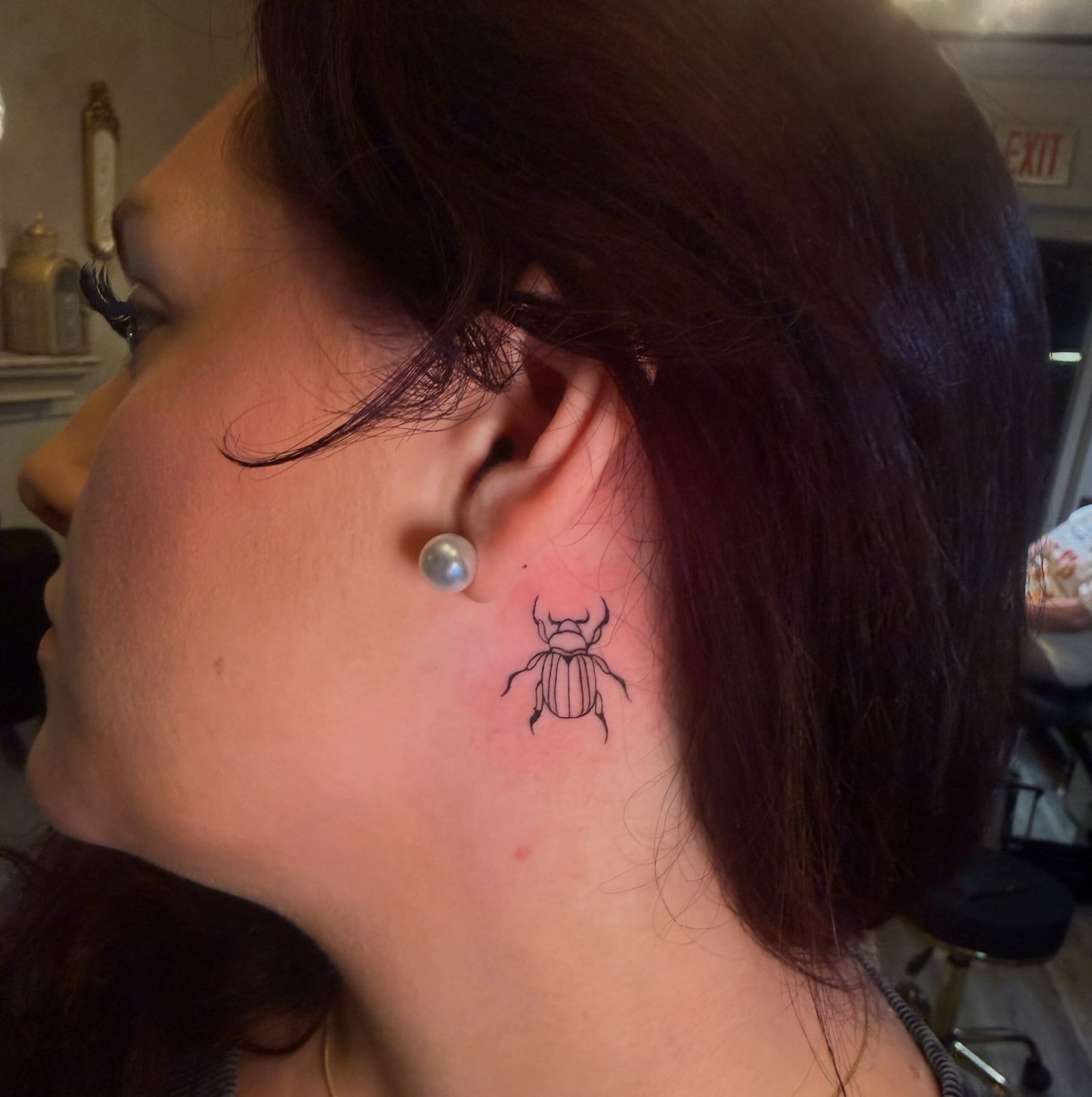
A stag beetle Tattoo in profile is a detailed, natural design that works well behind the ear because its compact body can be drawn without losing its distinctive shape. The beetle should be drawn facing sideways, with its large mandibles at the front, its segmented body in the middle, and its legs tucked underneath. In the photo, a small fine outline beetle sits behind the ear, with a slightly curved body that keeps it from looking stiff. This design works well for men who want an insect motif with a strong silhouette.
Keep the beetle small, no wider than the ear, and avoid adding too much detail to the legs. A few clean lines for the legs and antennae will be enough, and the shell is drawn in fine outline to anchor the design. Place the beetle just behind the ear, with its mandibles pointing forward, so it follows the natural curve of the area. A stag beetle can be a striking choice, but its details must be simplified to remain readable at small scale.
17. Skeletal Leaf Tattoo
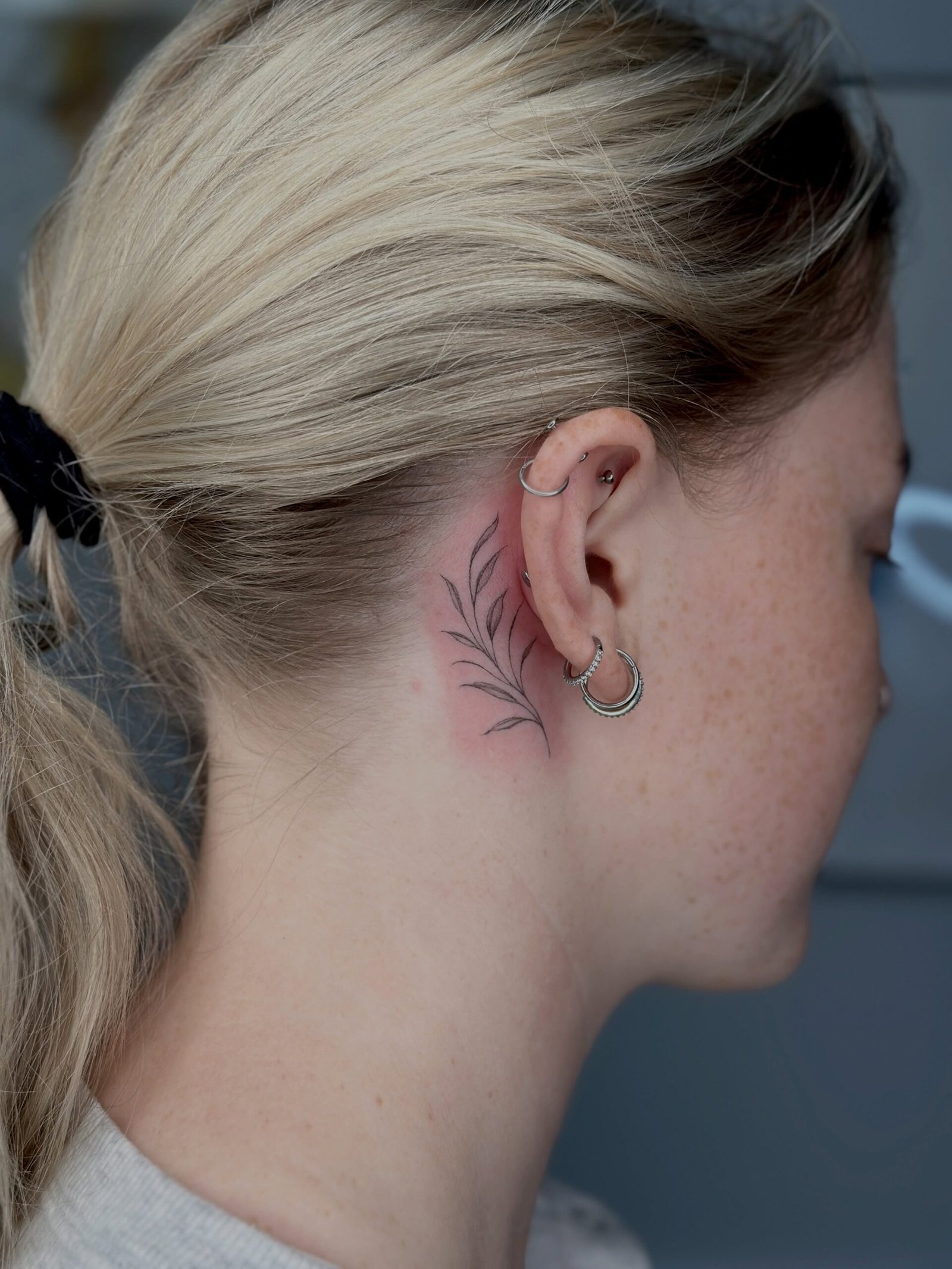
A skeletal leaf Tattoo is a delicate, natural design that works well behind the ear because its thin veins can be drawn without taking up much width. The leaf should be drawn with a central stem and a network of fine veins, creating a sense of structure without requiring solid fill. In the photo, a small sprig with solid leaflets along a stem sits vertically behind the ear, while a slightly asymmetrical shape adds a natural feel. This design works well for men who want a botanical motif with a darker, more structural edge.
Keep the leaf small, no longer than the ear, and avoid adding too many veins that would make the design look busy. A few clean lines for the main veins will be enough, and the outline should be thin to keep the design light. Place the leaf vertically behind the ear, with the stem at the top and the tip pointing downward, so it follows the natural line of the area. A skeletal leaf can be a subtle choice, but its veins must be spaced carefully to remain readable as they age.
18. Tidal Wave Line Tattoo
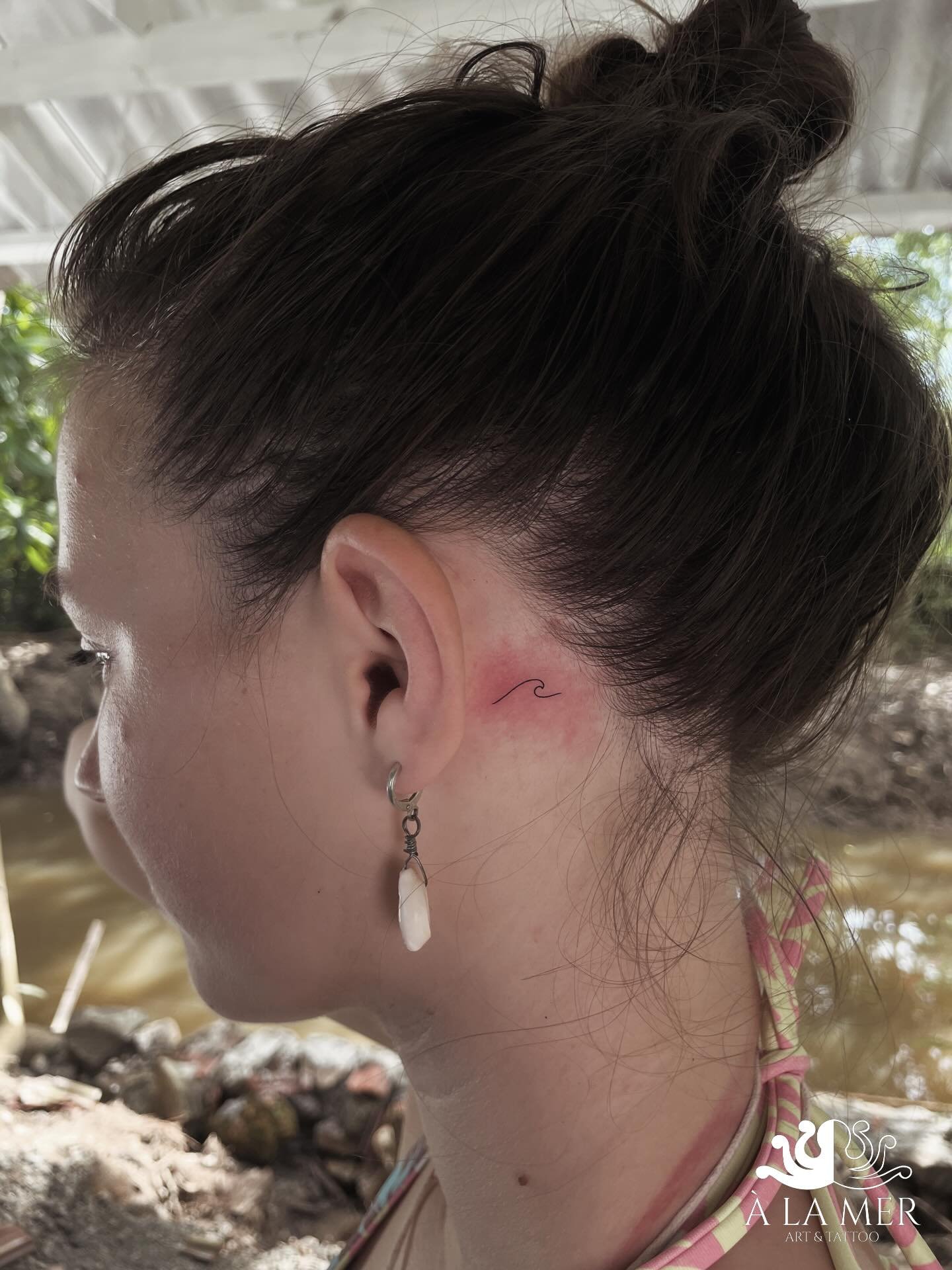
A tidal wave line Tattoo is a fluid, minimalist design that works well behind the ear because its curved shape can follow the area’s natural line. The wave should be drawn as a single, continuous black line that rises, curls, and tapers, creating a sense of motion in a small space. In the photo, a very small, simple fine wave line sits behind the ear, with a clean curl at the tip that keeps it from looking like a simple curve. This design works well for men who want a symbol of power and movement without a literal image.
Keep the wave small, no wider than the ear, and avoid adding multiple waves that would make the design look like water. A single wave line has more impact and remains readable at small scale. Place the wave horizontally behind the ear, with the curl pointing toward the neck, so it follows the natural line of the area. A clean, confident line is essential; any hesitation in the curve will be noticeable because the design is so minimal.
19. Geometric Descent Tattoo Into the Neck
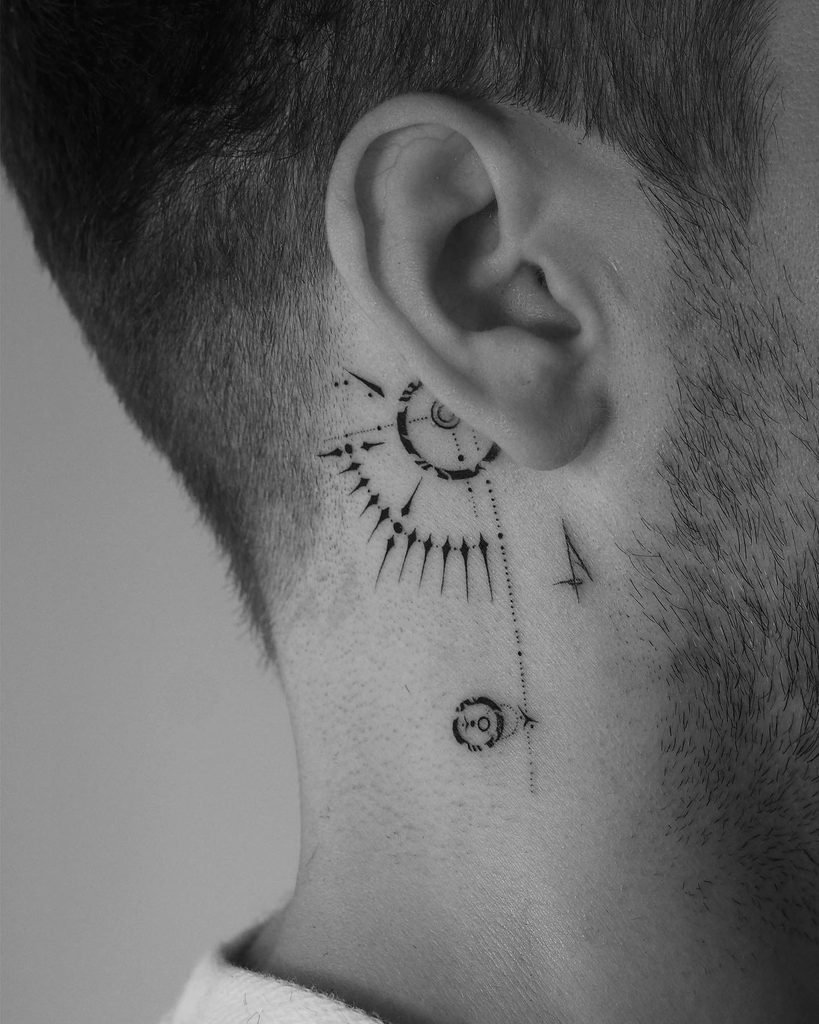
A geometric descent Tattoo is a modern, structured design that works well behind the ear because its angular shapes can extend down into the neck without losing coherence. The design should consist of a series of triangles, lines, and dots that decrease in size as they move downward, creating a sense of movement and depth. A blackwork finish will keep the design sharp, while a consistent line weight adds a technical feel. This design works well for men who want a contemporary accent with a clear structure.
Keep the descent narrow, no wider than the ear, and avoid adding too many elements that would make the design look cluttered. A few well-placed shapes will have more impact than a dense pattern. Place the design vertically behind the ear, with the largest shape at the top near the hairline and the smallest shapes toward the neck, so it follows the natural line of the area. A clean, precise line is essential; any variation in angle will be noticeable because the design is so geometric.
Designing for a Small, Curved Placement
The space behind the ear is not flat, and a good design must account for that curve. The skin folds slightly where the ear meets the head, and it stretches when the jaw moves or the head turns. A design that looks perfect on paper may distort when placed, so the artist should draw directly on the skin or use a stencil that is checked in multiple positions. Vertical designs tend to work better than horizontal ones because they follow the natural line from the hairline to the neck, while wide designs can feel cramped.
Size is a trade-off. A design that is too small may lose detail as it ages, while a design that is too large may extend onto the neck or jaw and lose its discreet quality. A good rule is to keep the design within the area that is visible when hair is tucked back, but not so large that it dominates the side of the head. The artist should also consider the wearer’s hairline, since hair that falls over the area will partially conceal the tattoo and affect how it is perceived.
Haircuts, Jewelry, and Visibility
Haircuts play a major role in how a behind-the-ear tattoo is seen. A short cut or an undercut will expose the design fully, while longer hair can conceal it completely. Men who want the tattoo to be visible should consider a cut that keeps the area clear, such as a fade or a taper that ends above the ear. Those who need to conceal the tattoo for work can let hair grow slightly longer or use a style that falls over the ear. The design’s placement should be chosen with the wearer’s usual haircut in mind, not just how it looks in the studio.
Jewelry can also affect visibility and healing. Earrings, especially hoops or studs that sit close to the area, may rub against a fresh tattoo and cause irritation. It is best to remove or avoid jewelry that touches the area during healing, and to choose pieces that do not overlap the design once it is healed. A tattoo that sits too close to a piercing may also be distorted by swelling or movement, so the artist should leave a small buffer between the tattoo and any jewelry.
Keeping Small Designs Readable
Small tattoos age differently from large ones, and behind-the-ear designs are no exception. Lines that are too thin may fade or blur, while details that are too close together may merge into a solid shape. To keep a design readable, the artist should use a line weight that is slightly bolder than the design might suggest on paper, and leave enough negative space between elements. Blackwork designs tend to age better than fine-line designs in this area, but both can work if the spacing is sensible.
Color should be used sparingly behind the ear, since small areas of color may fade unevenly and become difficult to touch up. Black and grey are the most reliable choices, and they will maintain contrast against most skin tones. If color is used, it should be limited to a single accent rather than a full palette. The design should also be checked at conversational distance. A tattoo does not need to reveal every detail from across a room, but it should not depend entirely on a magnified photograph to make sense.
Choosing an Artist and Planning Aftercare
Choosing the right artist is essential for a behind-the-ear tattoo, since the area is small, curved, and close to cartilage. Look for an artist with experience in small, precise work and a portfolio that includes behind-the-ear or other small placements. Ask to see healed examples, not just fresh photos, since a design that looks crisp when new may blur as it heals. A good artist will also discuss placement, size, and line weight openly, rather than simply copying a reference image.
Aftercare for this area requires attention to hair, headphones, and sleeping position. Hair products, sweat, and friction from headphones or a pillow can irritate a fresh tattoo, so it is important to keep the area clean and avoid pressure during the first two weeks. Follow the artist’s aftercare instructions, which will typically include gentle washing, a thin layer of ointment, and avoiding sun exposure. For general safety information, see the FDA’s tattoo safety information. If redness, swelling, or pain increases after the first few days, contact the artist or a healthcare professional rather than trying to treat it alone.
Final Thoughts
Behind-the-ear tattoos offer a rare combination of discretion and edge. They can be hidden in an instant, yet they make a clear statement when revealed. The best designs are those that respect the space — small, sharp, and intentional — rather than those that try to pack too much detail into a tiny area. Whether the choice is a symbol, a creature, or an abstract line, the design should feel like it belongs behind the ear, not like it was placed there by default.
Take time to choose a design that will still feel right in five or ten years, not just on the day it is done. Consider how it will age, how it will be seen, and how it fits with other tattoos or future plans. A behind-the-ear tattoo is a small commitment with a visible impact, and the right design will reward that care. With the right artist, placement, and aftercare, it can be a lasting accent that adds edge without overwhelming the wearer’s style.