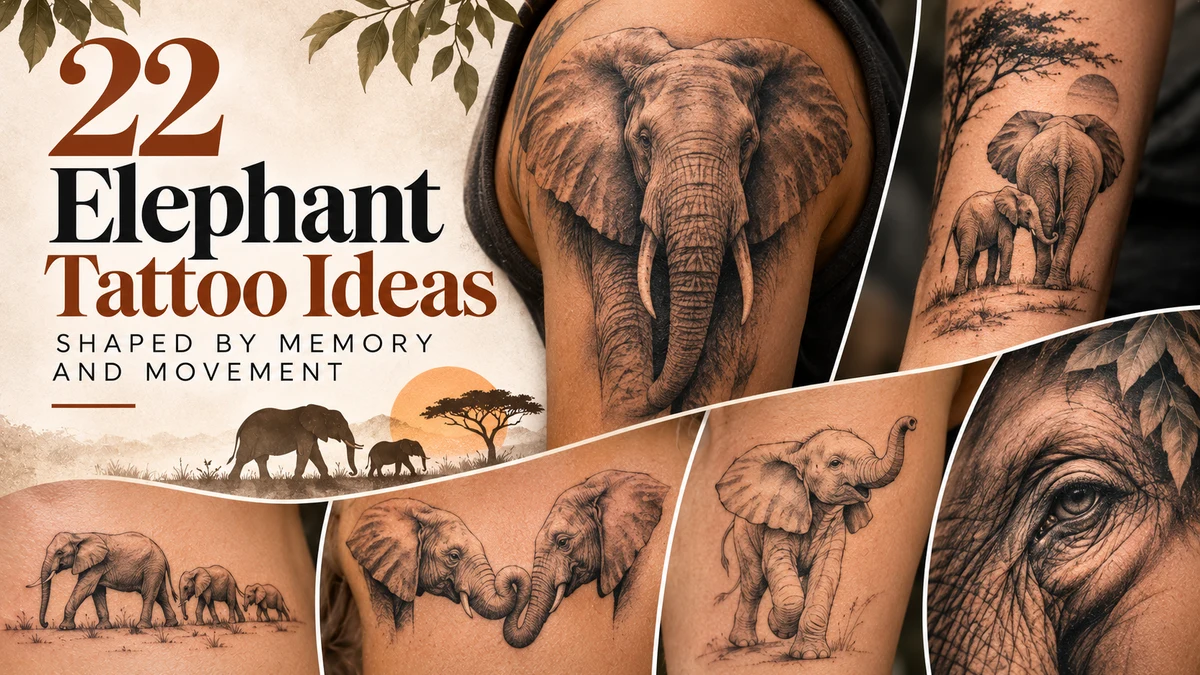
22 Elephant Tattoos Shaped by Memory and Movement
Elephant tattoos can hold a memory without spelling it out. An eye, a protective stance, or a few measured steps can suggest presence, kinship, and time passing. These 22 elephant tattoo ideas move from spare linework to atmospheric scenes, with attention to how each image will actually sit on skin.
Takeaways:
- Pose carries much of the meaning: a still portrait feels different from a calf keeping pace or an elephant crossing open ground.
- Fine lines suit small silhouettes; wrinkles, multiple animals, and layered scenery need more room.
- Decide whether you want an African or Asian elephant before the artist draws its ears, forehead, and trunk tip.
- Each idea includes a direct Instagram post to study and a separate prompt for a custom interpretation.
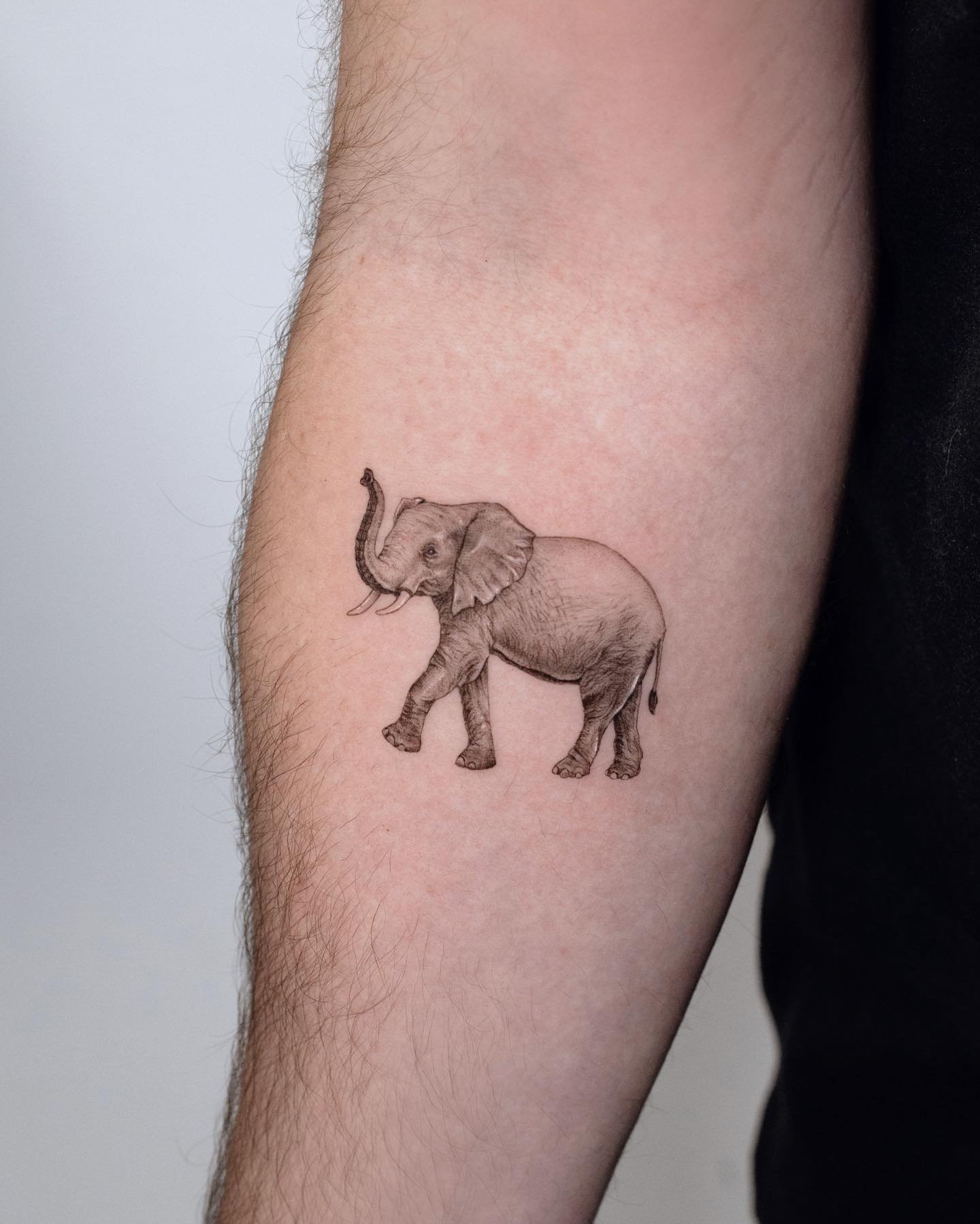
1. Fine-Line Elephant Tattoo Following the Forearm
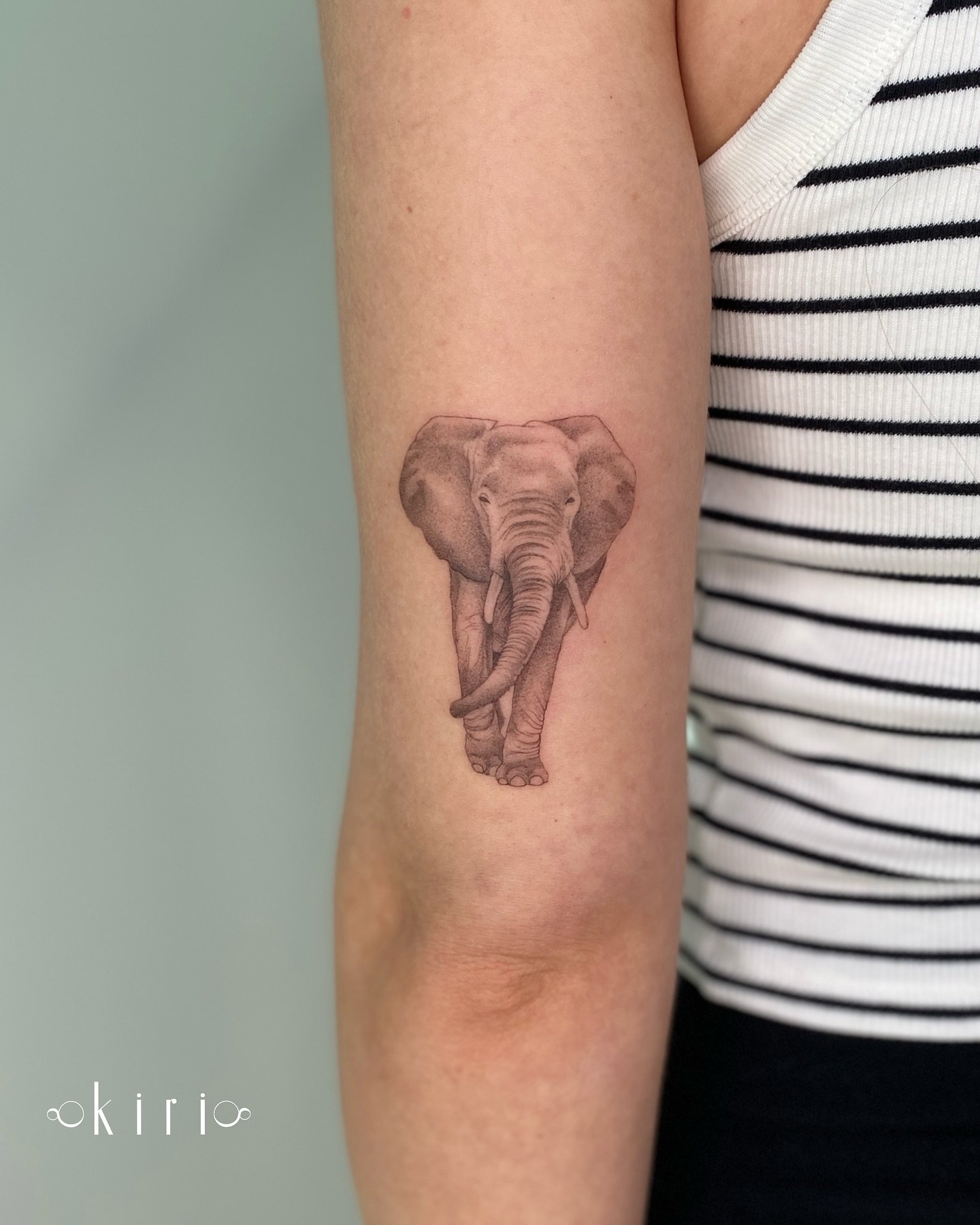
A side view needs surprisingly little ink: a domed forehead, one ear, the sweep of a trunk, and four legs placed far enough apart to read. Let the walking line travel lengthwise down the inner forearm. The empty skin ahead of the trunk makes the animal seem to have somewhere to go.
Ask for a healed-work example before committing to very fine marks. At a small scale, keep the eye and ear fold simple; crowding both with wrinkles will turn the profile muddy. A slightly lifted front foot adds motion while leaving the drawing calm.
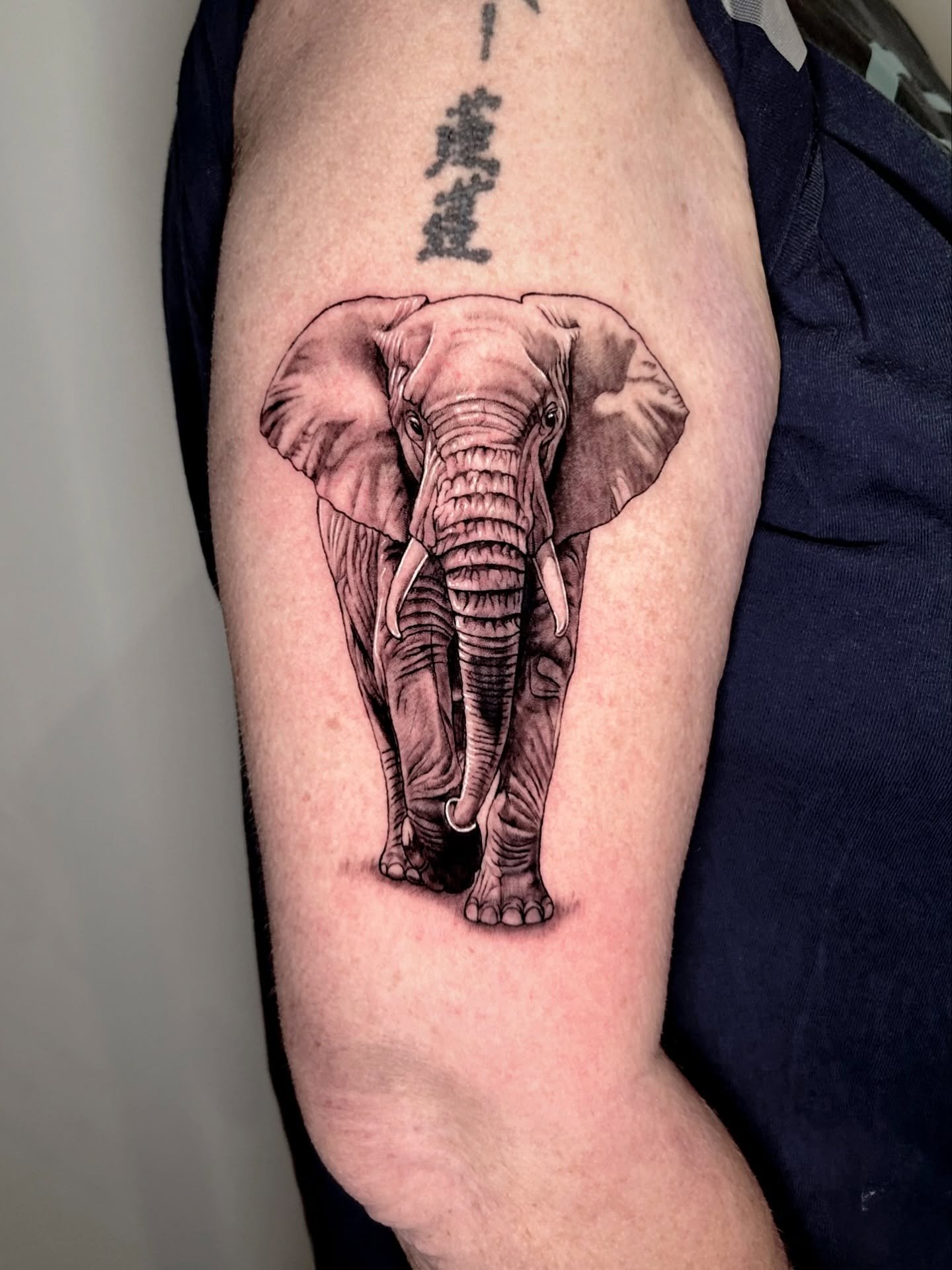
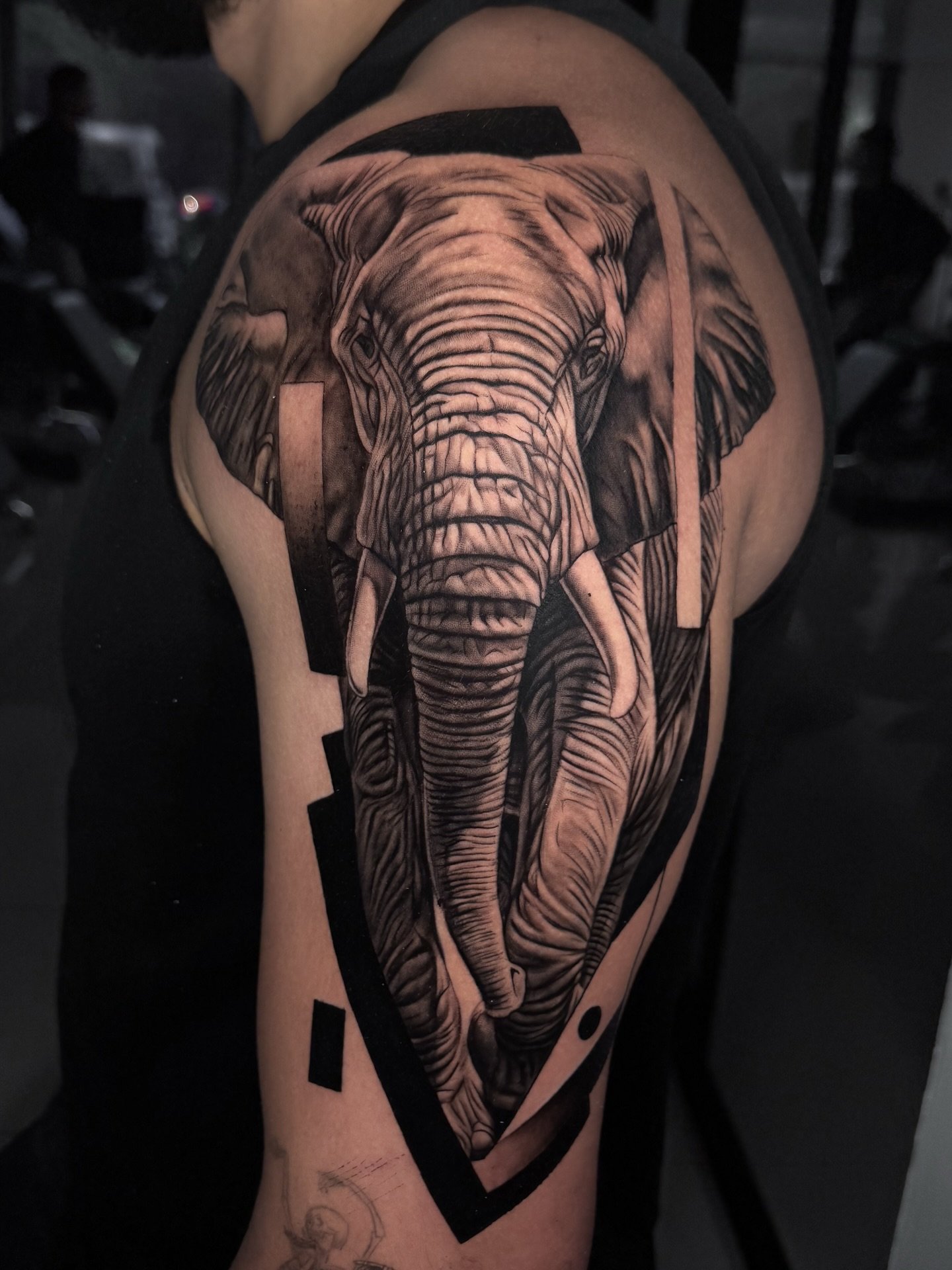
2. Front-Facing Elephant Portrait Tattoo With Open Ears
The frontal pose makes the ears the composition’s outer edges and the trunk its central spine. Give the face enough width that the ear contours do not wrap awkwardly out of sight. A calf, thigh, or upper arm can support the broad head without squeezing the details into a narrow strip.
Choose one focal point: the eyes, the folds above the trunk, or the contrast between lit forehead and dark ears. Symmetry should feel intentional without making both sides mechanically identical. In a realistic portrait, asymmetry in skin creases keeps the animal alive.
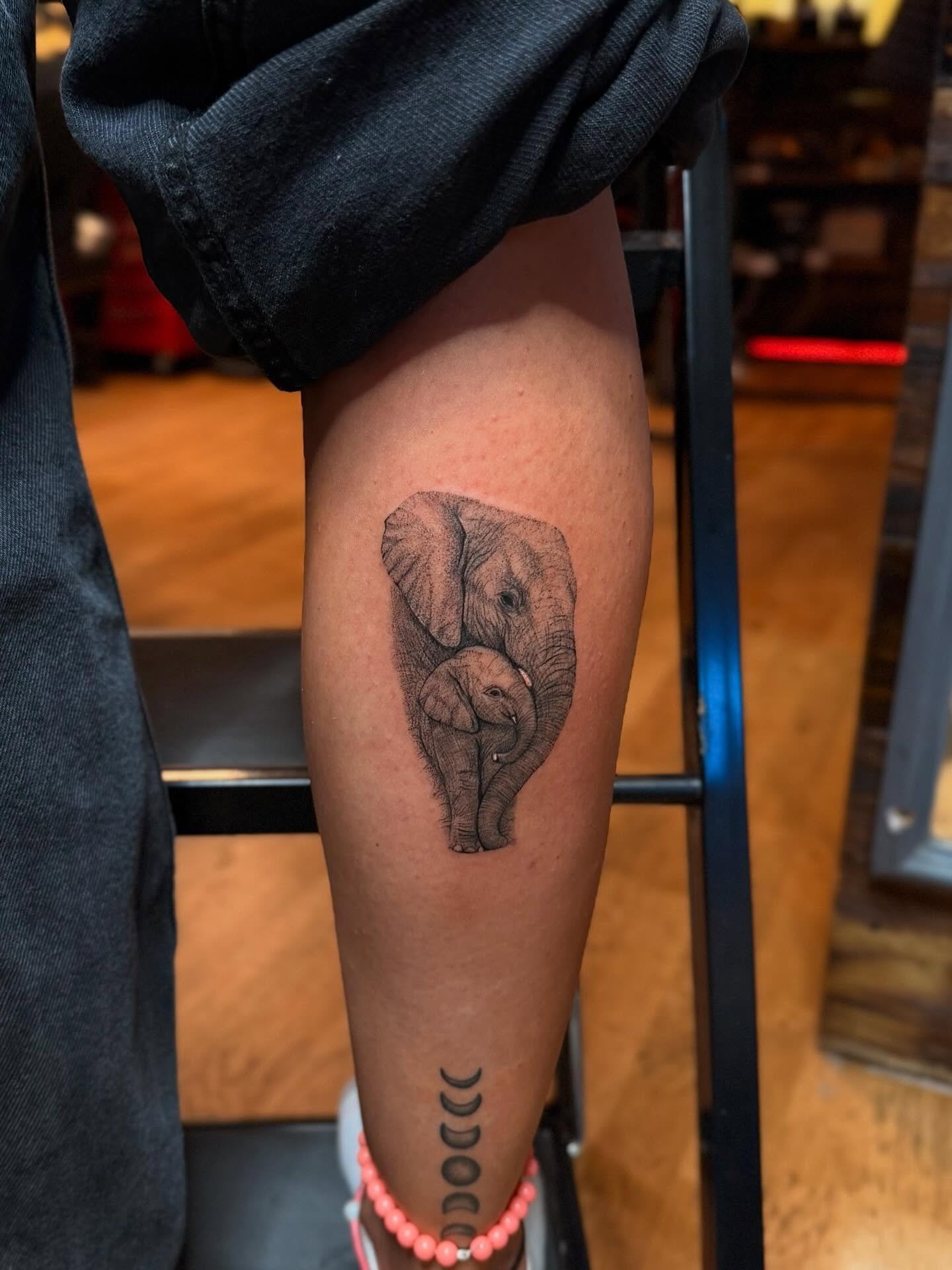
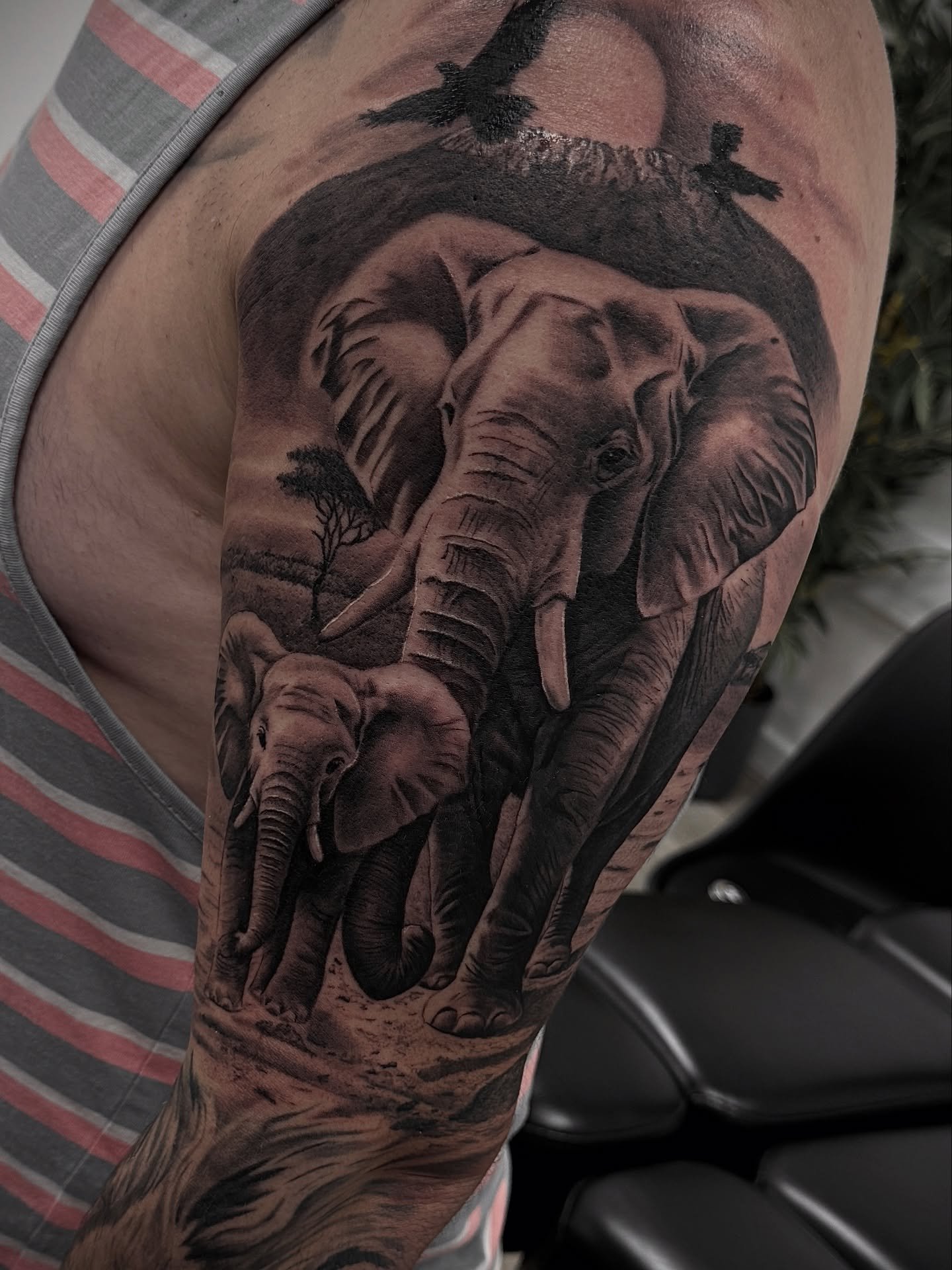
3. Matriarch Sheltering a Calf Tattoo Beneath Her Body
Put the adult elephant above and slightly behind the calf, with her nearer legs forming a loose shelter rather than a rigid arch. The calf should remain fully visible; its smaller head and inward stance tell the story more clearly than a heart or an inscription. A three-quarter view gives both bodies depth.
This is a wide composition, better on a thigh or shoulder blade than a wrist. Ask the artist to leave light between the calf’s back and the adult’s underside. That sliver of skin keeps the pair readable after the shading settles.
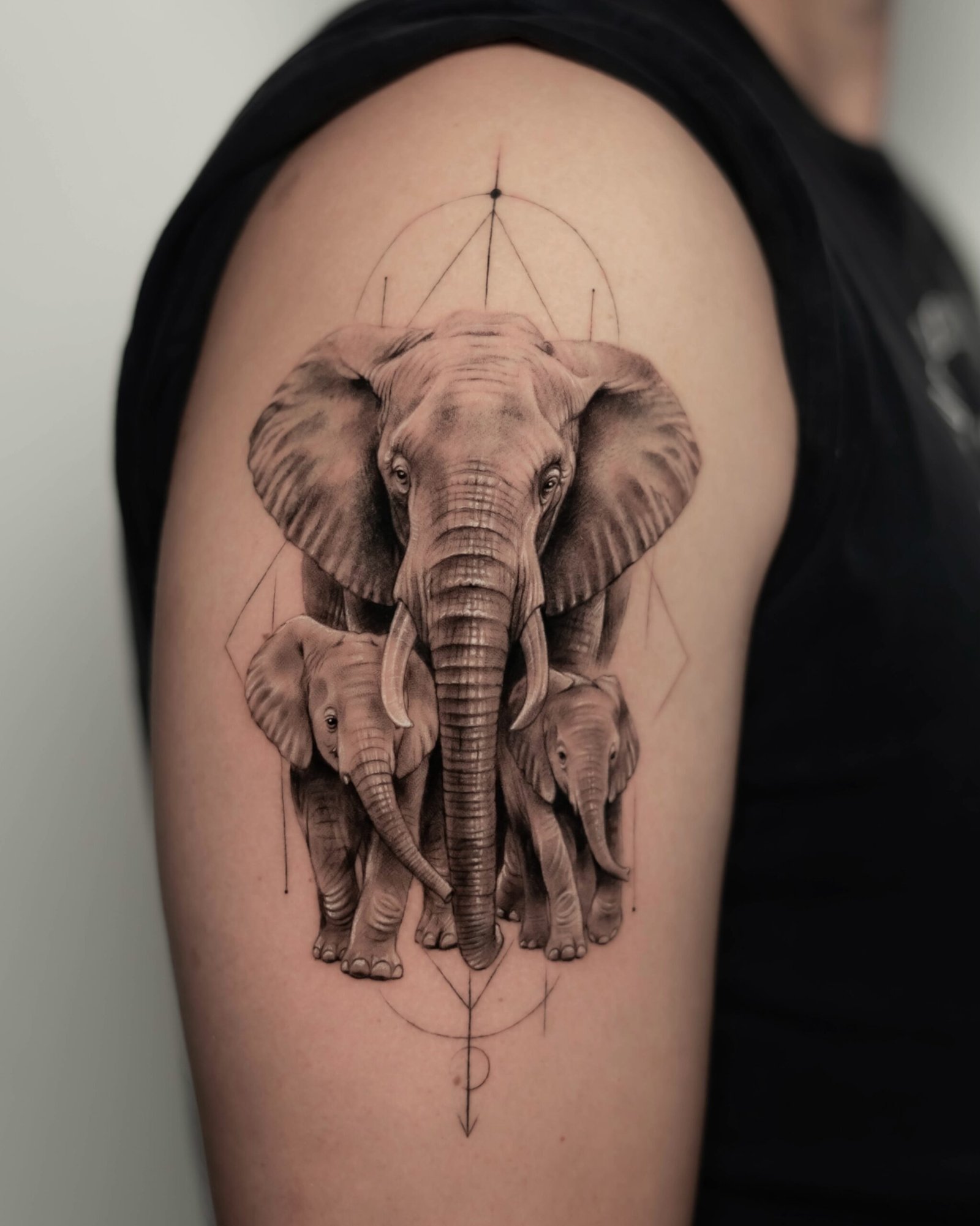
4. Three Elephants Walking in a Family Procession Tattoo
Three bodies give a family tattoo rhythm when their steps and sizes differ. Draw the largest in front, a smaller elephant in the middle, and a calf following at a slight delay. A shared ground line keeps the figures together; touching silhouettes can make their legs impossible to count.
The ribcage or long side of the forearm fits the procession. If each animal stands for a person, decide the order before sketching. Avoid reducing the last calf so much that its trunk, ear, and front legs merge into one dark spot.
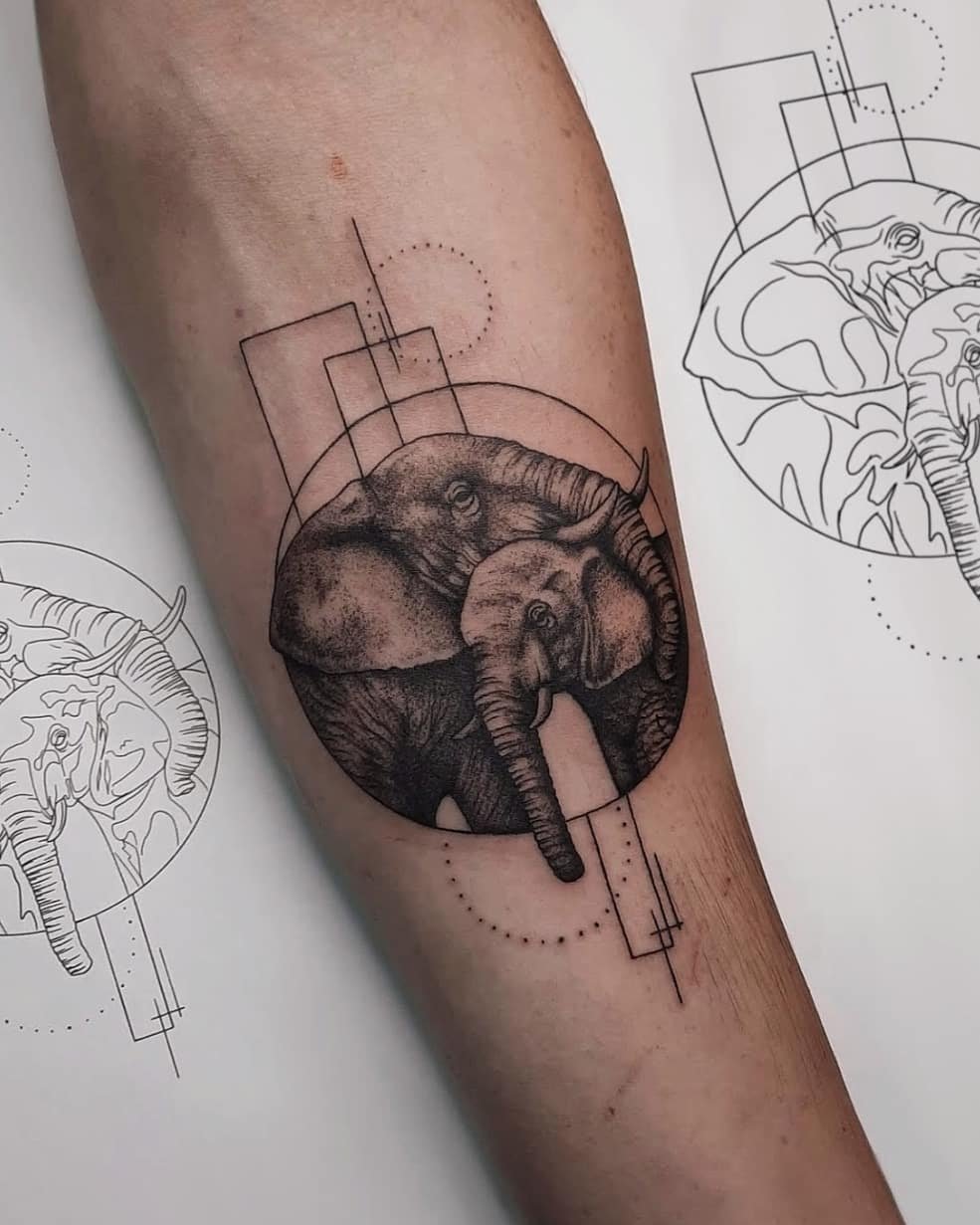
5. Two Elephants Meeting Trunk to Trunk Tattoo
Face two elephants inward and let the trunks meet at one small point. That contact should be the center of the piece, with enough space beneath it for both heads to read separately. Unequal sizes can suggest parent and child; equal sizes can make the encounter feel like a meeting of peers.
Try the design on the upper arm or across the shoulder blades where the mirrored shapes can breathe. Do not make the trunks into an unbroken knot. A tiny open curve at the meeting point lets both trunk tips remain visible.
6. Playful Calf Tattoo in a Loose Sketch Style
A calf can feel lively without becoming a cartoon. Give it a slightly oversized ear, one lifted foot, and a trunk curving toward something just outside the frame. Quick broken lines around the feet suggest the little shift of weight, while the eye remains small and believable.
The sketch effect needs a firm underlying silhouette. On a compact upper arm or ankle piece, keep the scribble marks outside the face and avoid dozens of tiny hairline strokes. A few deliberate marks convey spontaneity better than an unfinished-looking outline.
7. Realistic Elephant Portrait Tattoo Focused on the Eye and Ear
Crop close enough that the eye sits between the ridged forehead and the great plane of the ear. The viewer should feel the elephant’s presence before noticing individual wrinkles. Let some edges fade into skin rather than outlining a whole head inside a hard rectangle.
A portrait like this needs a generous thigh, shoulder, or upper arm. Ask the artist to reserve clean highlights around the eye and avoid shading every fold equally dark. That contrast draws attention to the gaze before the wrinkles.
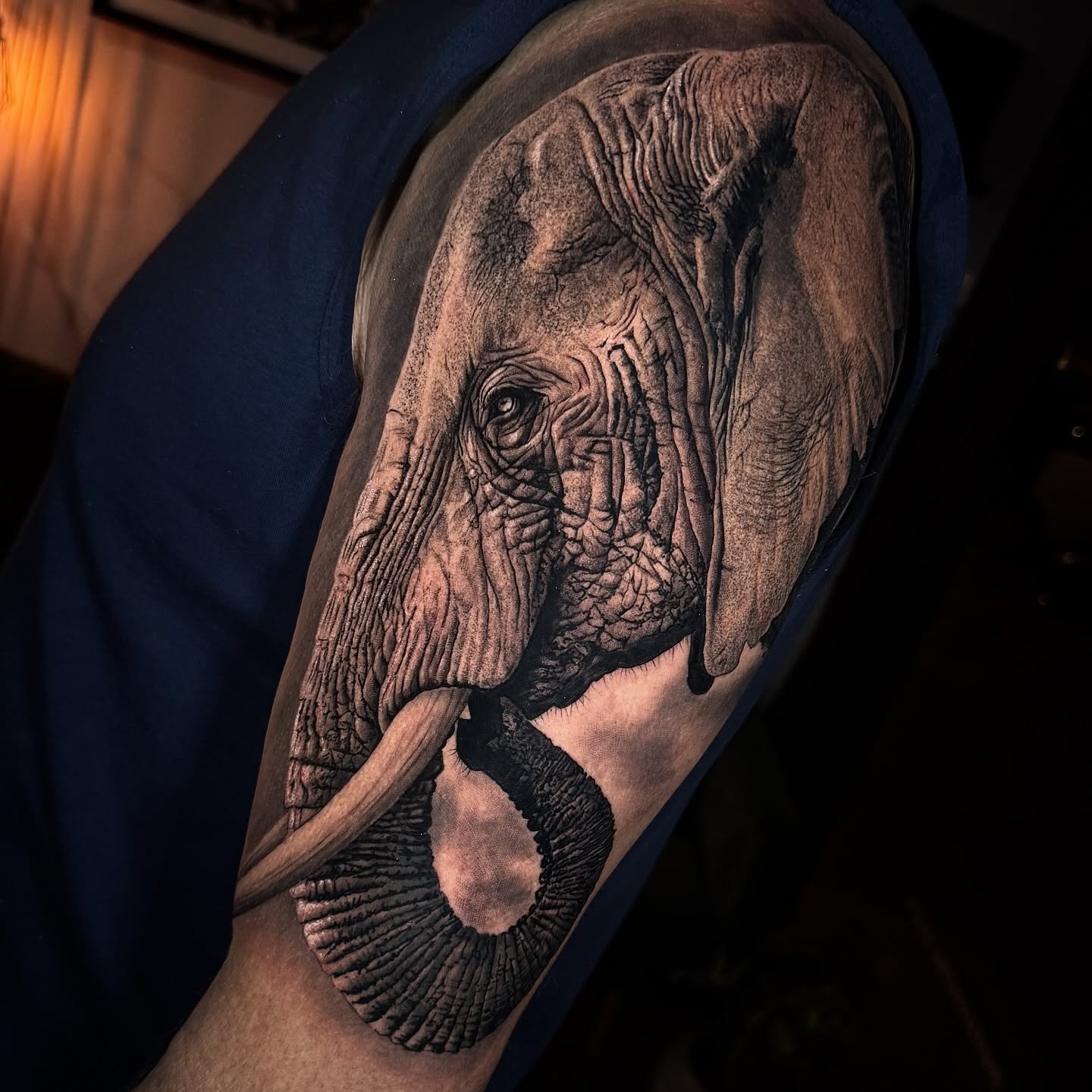
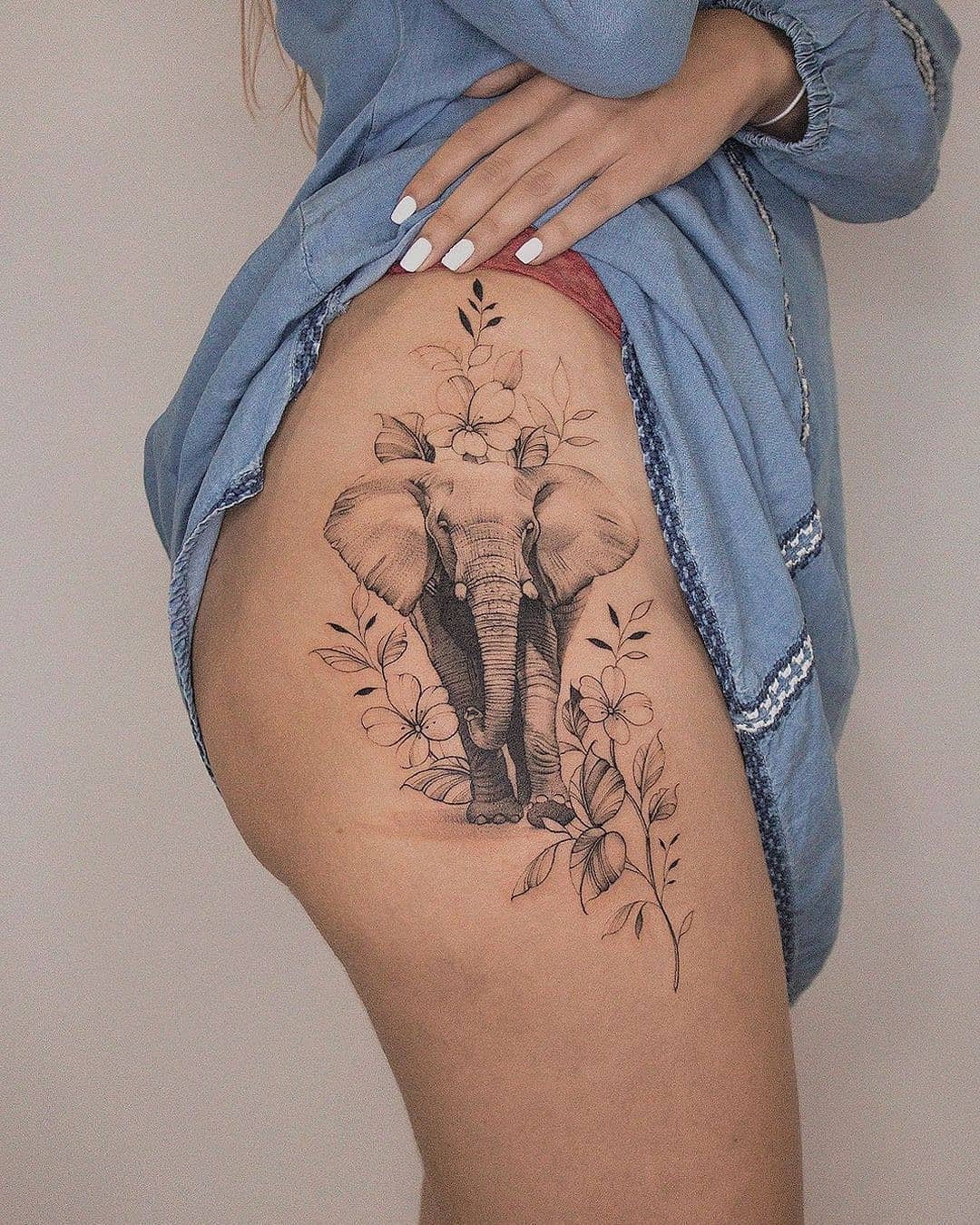
8. Forest Elephant Tattoo Beneath a Leafy Canopy
Place the elephant low in the composition and let broad leaves overlap the upper edge of its ears. The foliage should frame the animal, not camouflage it. A few deep shadows between leaves can create a sheltered forest feeling while the trunk remains unmistakable at a glance.
A vertical thigh or outer arm works well for the canopy. Choose plant shapes with different widths, and leave breathing room around the elephant’s face. If the animal is meant to be Asian, ask the artist to keep the smaller ears and twin-domed forehead rather than borrowing an African head from another reference.
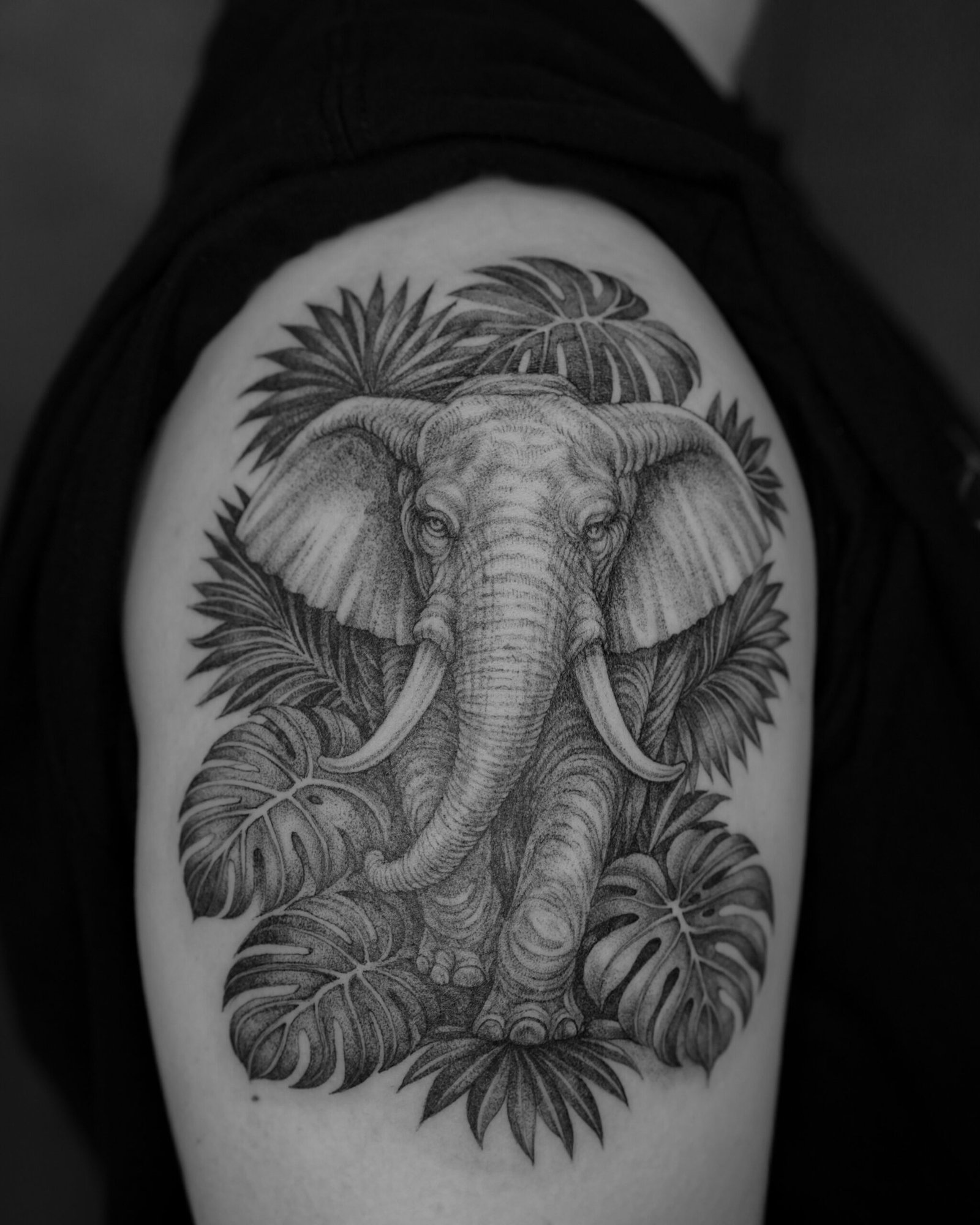
9. Elephant Silhouette Tattoo Emerging From a Dust Cloud
Keep the body almost solid and break its outline only where dust drifts past the hind legs. A visible ear, trunk, and front foot should anchor the animal; the cloud can then dissolve into lighter stippling. The result feels like a remembered sighting rather than a fully documented portrait.
Place it where there is room to fade the dust gradually, such as the calf or outer thigh. Ask the artist to test the silhouette at arm’s length. If the dust is as dark as the elephant, the whole piece loses its sense of depth.
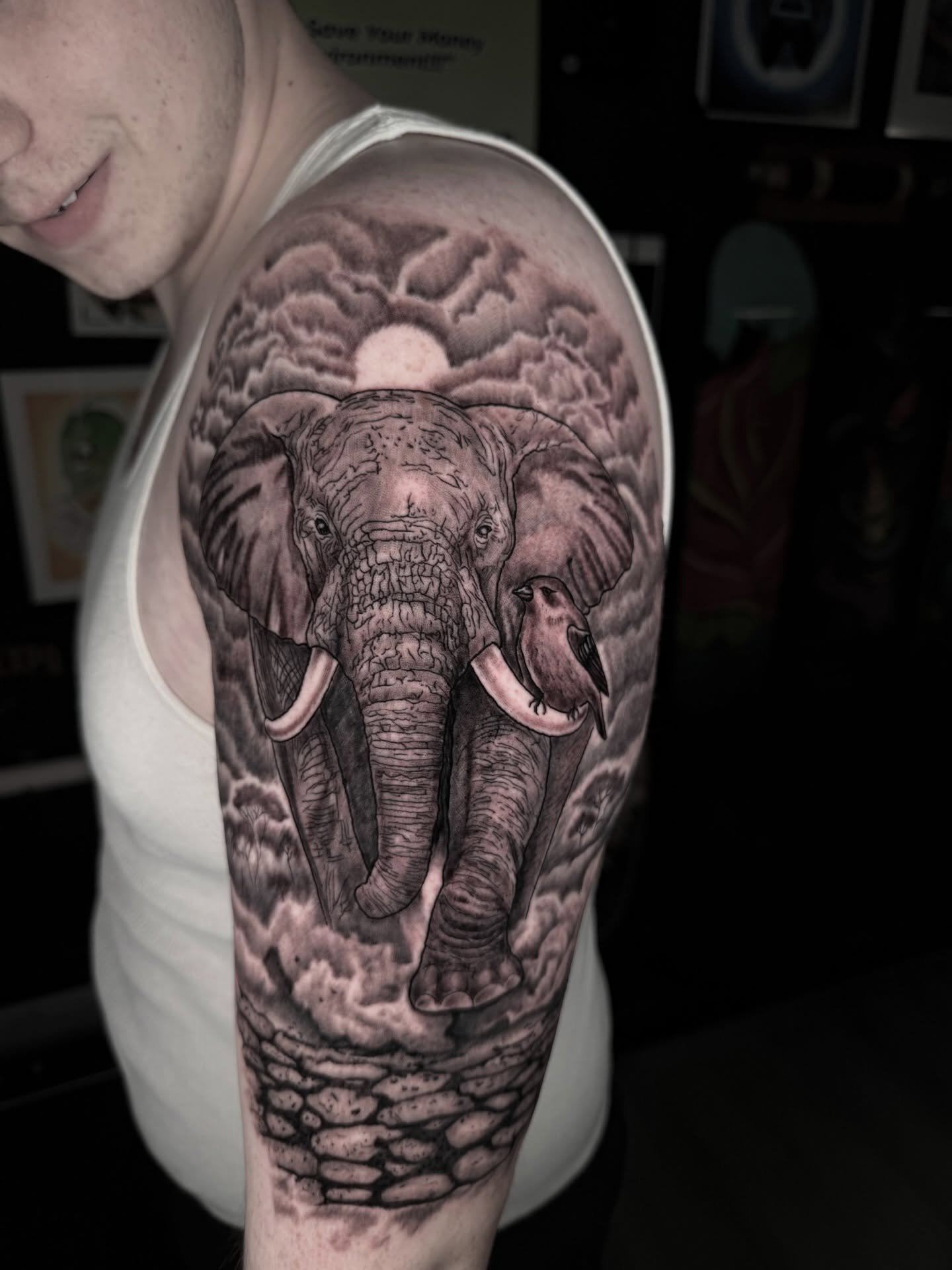
10. Faceted Geometric Elephant Tattoo in Side Profile
Build the head from a few large planes that follow actual anatomy: forehead, cheek, ear, and the bend of the trunk. Too many small triangles make the animal look like a puzzle rather than an elephant. A soft realistic eye can provide an effective counterpoint to the angular structure.
On a forearm, a compact rectangular field can hold the composition neatly. Keep the perimeter simple and allow one ear edge to cross the frame. That small interruption stops the geometry from feeling trapped inside a diagram.
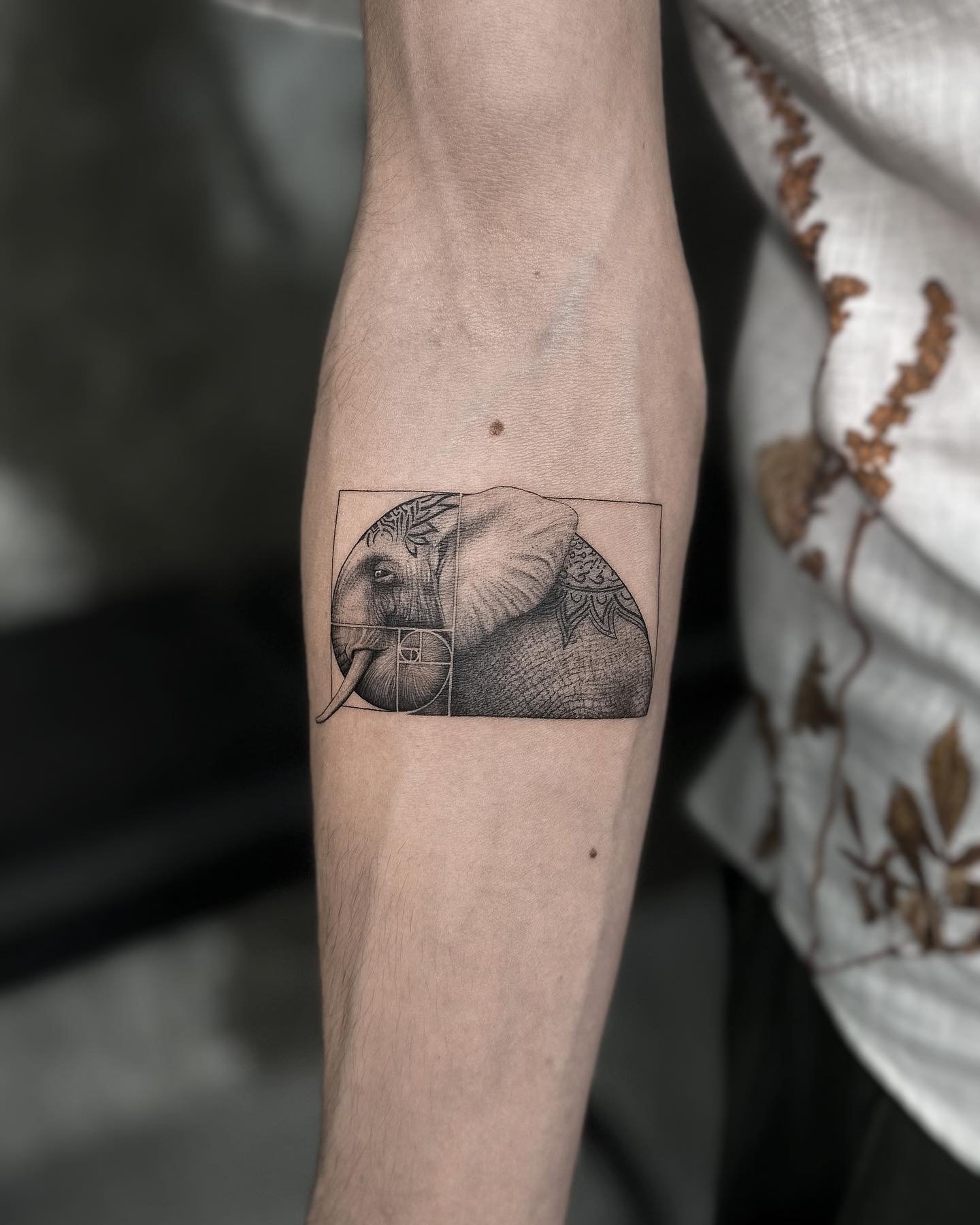
11. Blackwork Elephant Tattoo With a Negative-Space Ear
Fill the body in rich black, then let uninked skin carve the ear from inside. The open ear becomes the light source, so a separate bright eye or decorative pattern is unnecessary. A short raised trunk can break the solid mass and give the silhouette a clear direction.
This design depends on contrast more than micro-detail. The upper arm or thigh gives the ear opening enough width to stay visible. Have the artist show the stencil in solid black and white before adding any grey transitions; the basic read should already work.
12. Elephant Silhouette Tattoo Built From Botanical Shapes
Instead of placing flowers next to an elephant, use leaves and stems to describe its outer contour. A broad leaf can suggest the ear; a curved stem can become the trunk. Keep a small section of ordinary elephant outline around the forehead so the species does not disappear into a bouquet.
The idea needs moderate scale, perhaps on the thigh or shoulder blade. The negative spaces between stems matter as much as the plants themselves. Ask for a version seen from several feet away: it should read as an elephant first and as botanical construction second.
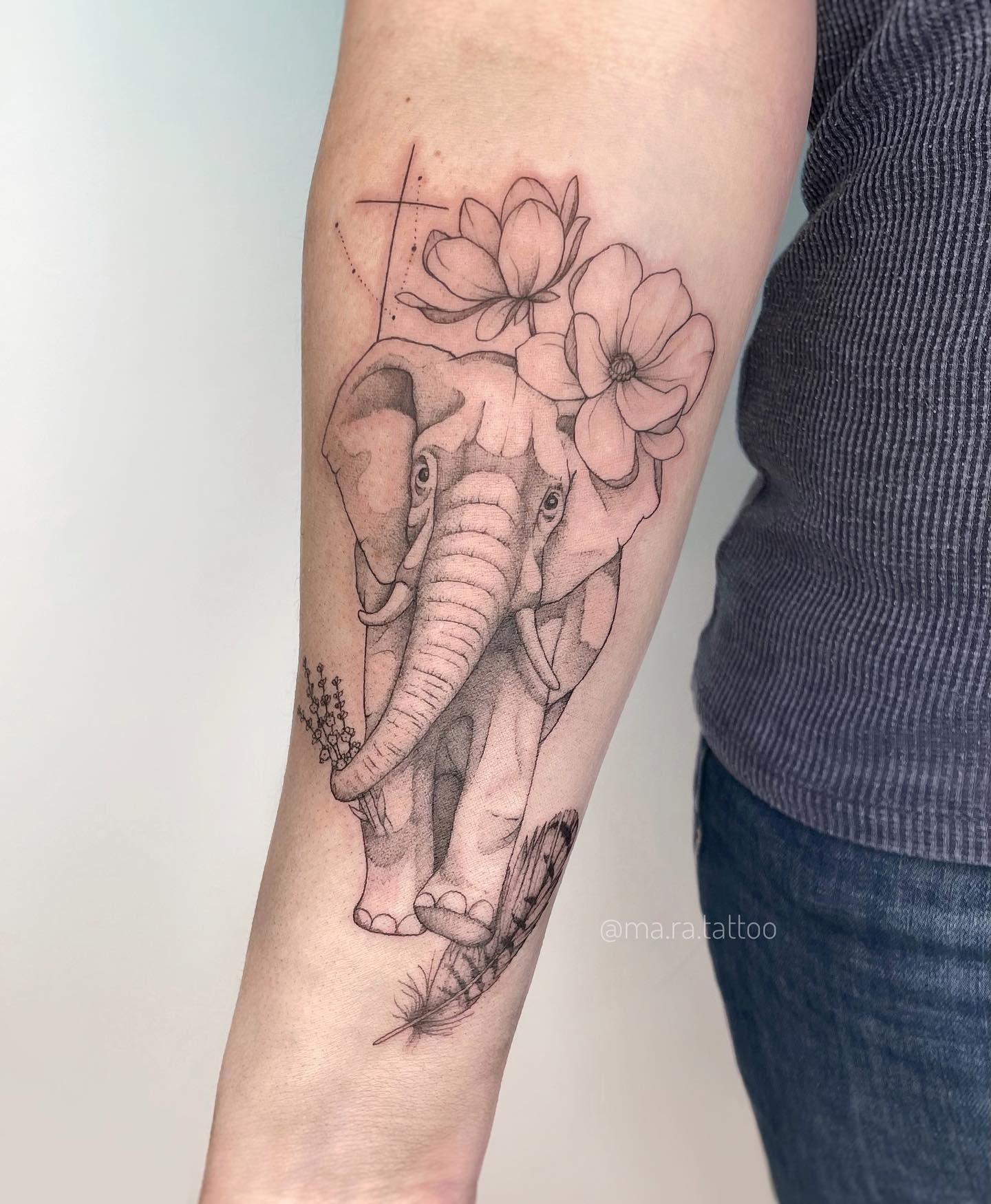
13. Wildflowers Growing Along an Elephant’s Back Tattoo
Let a low line of flowers rise from the elephant’s spine as though the body were a landscape. Vary stem heights and leave much of the flank open. One or two blooms near the shoulder are enough to draw the eye upward without turning the animal into a flower-filled outline.
This is particularly effective as a long upper-arm or thigh piece. Keep the legs more solid than the blossoms so the elephant has visual weight. Choose flowers for their actual shapes or personal connection, rather than assigning every blossom a generic meaning.
14. Elephant and Calf Tattoo Reflected at a Waterhole
Put the adult and calf close together at the water’s edge, then show only a broken suggestion of their reflection. A few interrupted horizontal marks beneath the trunks can carry the water without requiring a whole lake. The calf’s shorter mirrored shape will reinforce its scale.
This composition needs vertical room: the scene above and the reflection below should not compete. The outer thigh is a good canvas. Keep the horizon low and let the reflection fade quickly into skin; a sharp duplicate of the animals would feel like two separate tattoos.
15. Running Elephant Tattoo Captured in an Ink-Wash Study
Tilt the body forward and give the legs different positions so the animal is clearly moving, not simply standing with streaks behind it. Broad ink-wash marks can follow the direction of travel; finer marks around the ear and trunk hold the anatomy together.
The thigh offers space for this long, energetic pose. Ask for a crisp core drawing beneath the wash. If every edge dissolves, the image may read as a splash first and an elephant only after close study. One dark shoulder and a clean trunk line can solve that.
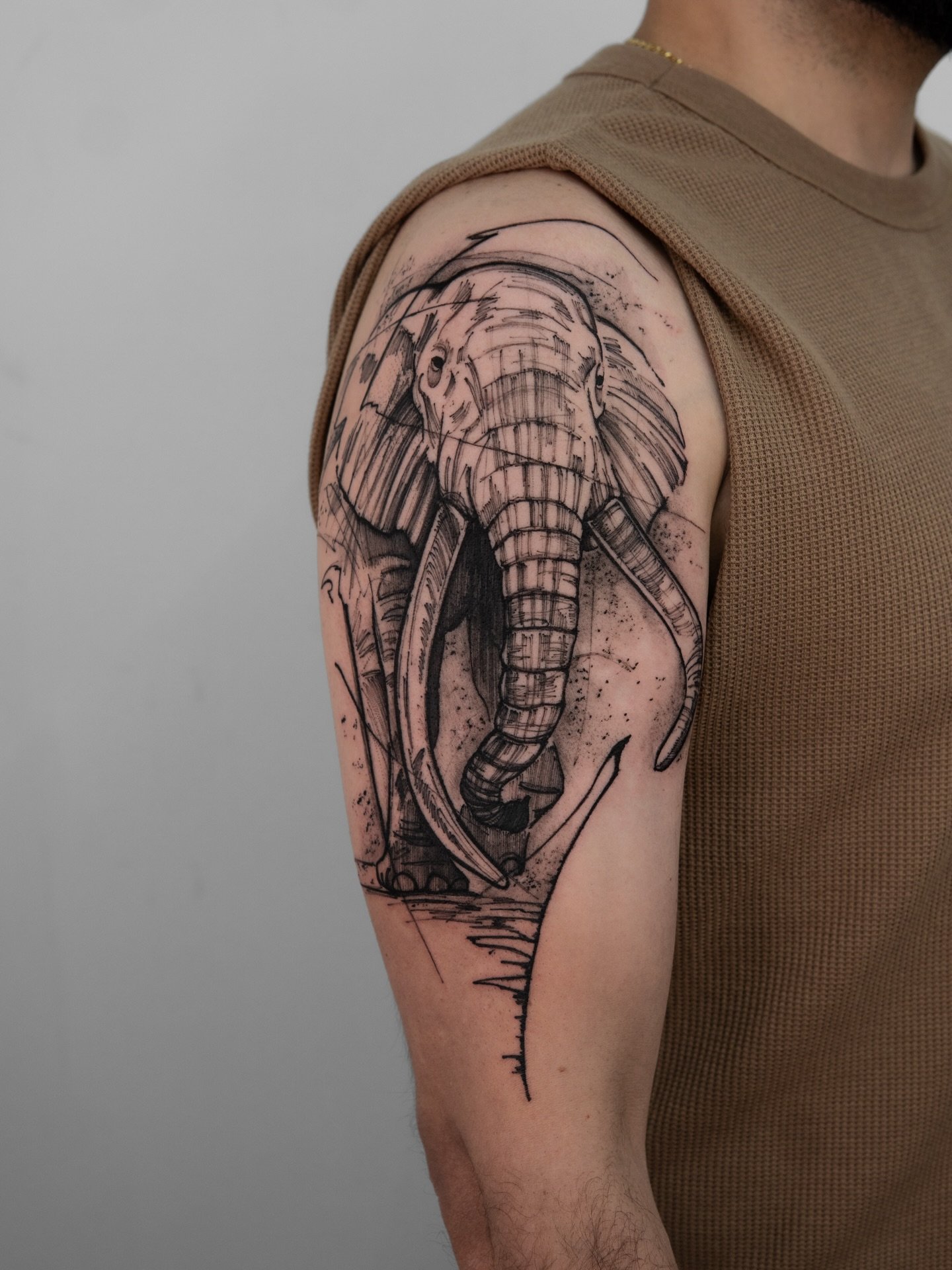
16. Elephant Tattoo Crossing a Wide Savanna Horizon
Make the elephant small enough to leave a true sense of distance, but large enough to read its feet and trunk. A long ground line, two uneven acacias, and a low horizon can suggest an expansive place without filling the sky. The animal’s position off-center gives it room to travel.
The upper back, thigh, or outer upper arm can hold the horizontal sweep. Resist a crowded sunset and multiple wildlife silhouettes. A sparse scene lets the walk carry the idea of endurance and progress without prescribing that meaning for everyone.
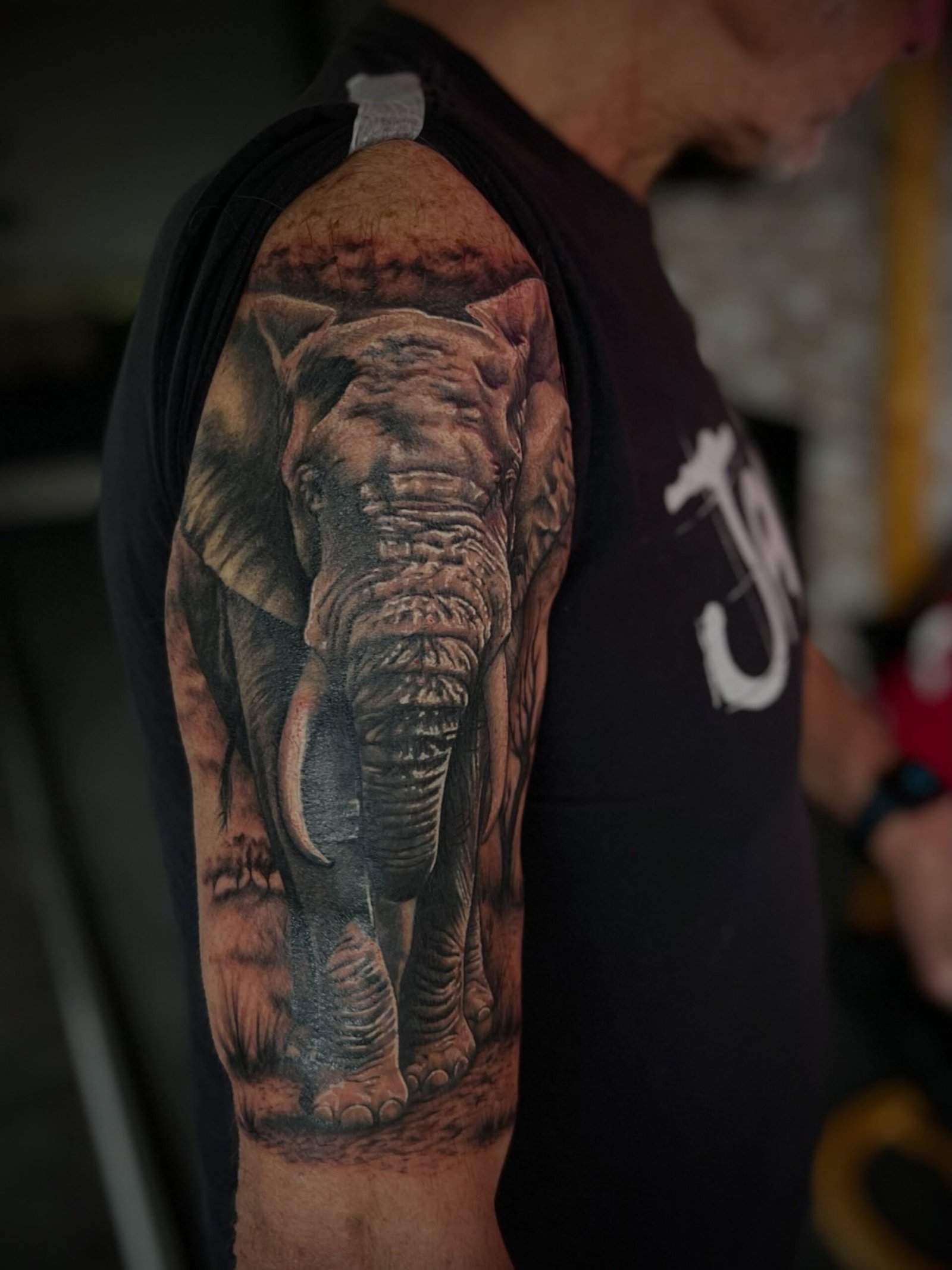
17. Elephant Tattoo Framed Inside a Landscape Window
Use a tall arch as a window rather than a decorative border. The elephant can cross the lower half while distant land and a strip of open sky sit behind it. Let the trunk or ear interrupt the arch slightly, connecting the animal to the viewer’s space.
A calf or forearm suits the tall shape. The frame should be broad and simple, with no heavy fill at its corners. Keep the far landscape lighter than the animal so the small scene has a clear foreground and does not flatten into one grey panel.
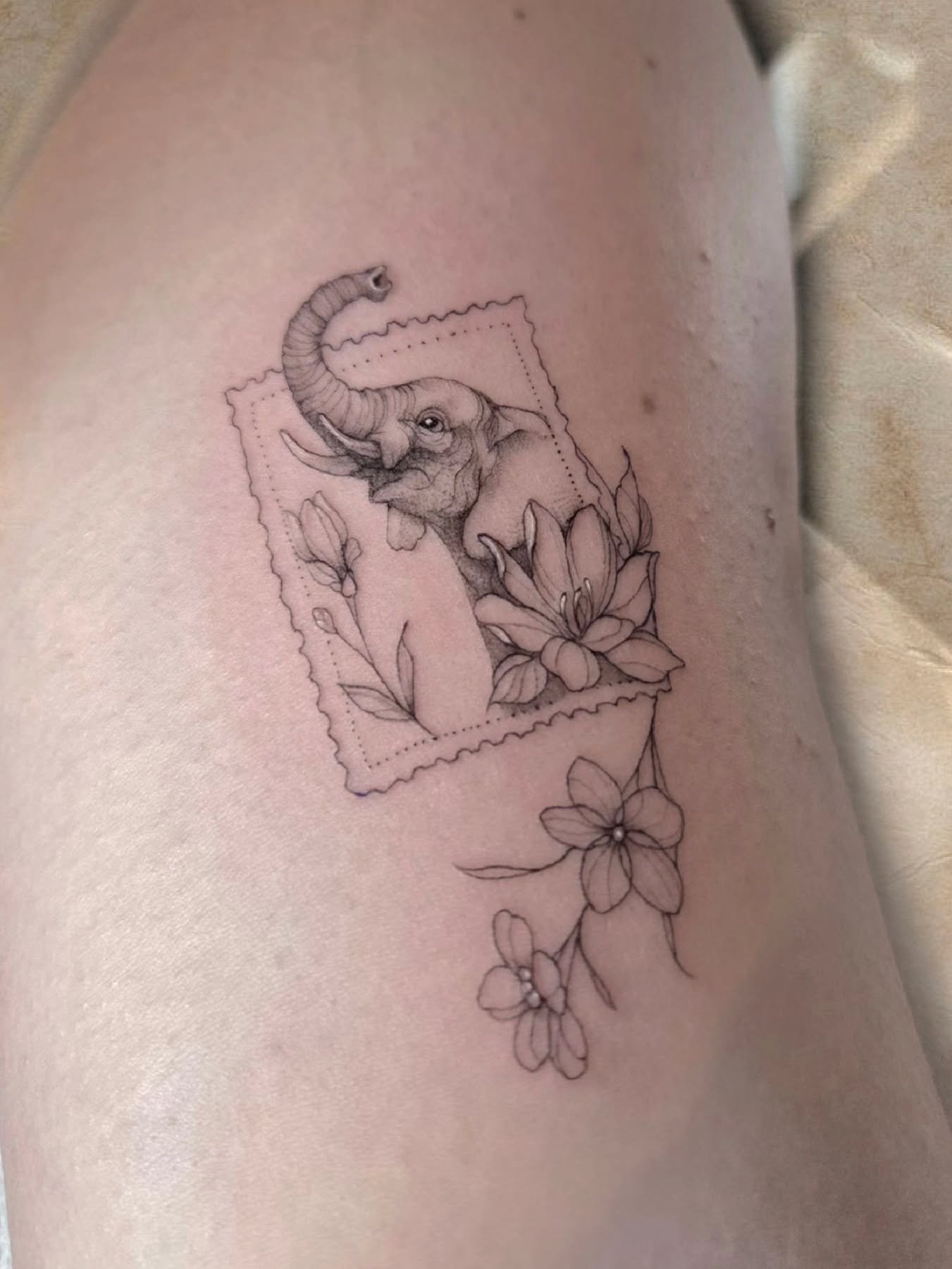
18. Elephant Tattoo Reaching Its Trunk Toward a Branch
A single branch gives the trunk a purpose. Angle the elephant’s head upward and let the trunk stop just short of leaves, preserving a small charged gap. The gesture should feel like browsing, not like the elephant is holding an ornamental stem for a photograph.
The vertical reach fits an outer arm or calf. Keep the branch above the animal rather than winding it around the body. That separation makes the direction of movement obvious and leaves space for the trunk’s natural curve.
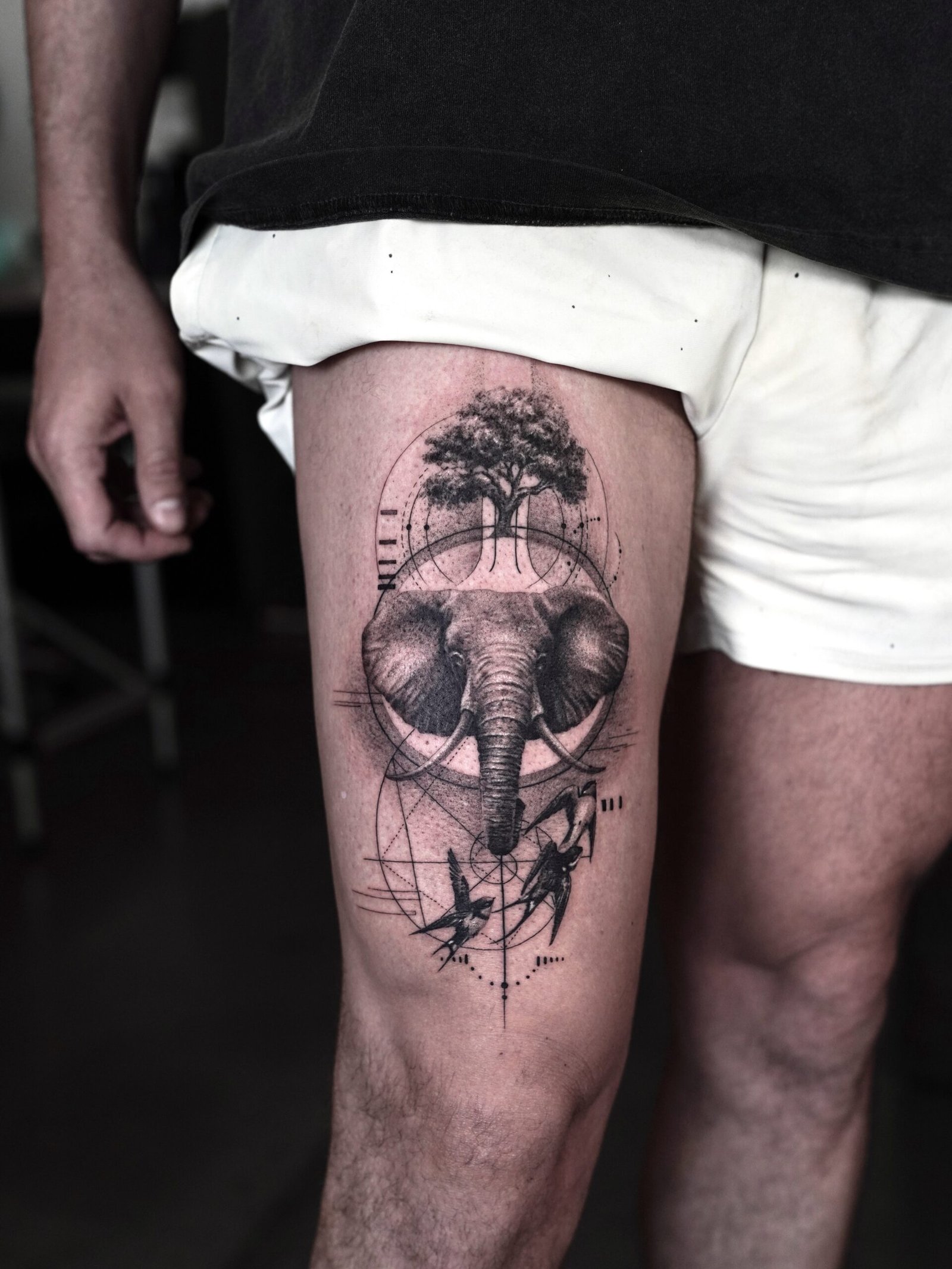
19. Elephant Tattoo With a Star Map Inside Its Silhouette
Treat the elephant as a dark outer shape and use small open stars and fine connecting lines inside the flank. The star map should occupy only part of the body, leaving the head and trunk clear. An arbitrary scattering of dots will look decorative; a sky chart from a place or date you remember gives the marks a specific source.
Ask the artist to simplify the selected constellation so the stars stay separate at tattoo scale. This works best on the thigh or upper arm. Avoid filling every leg with tiny dots: the body’s silhouette should remain the first read.
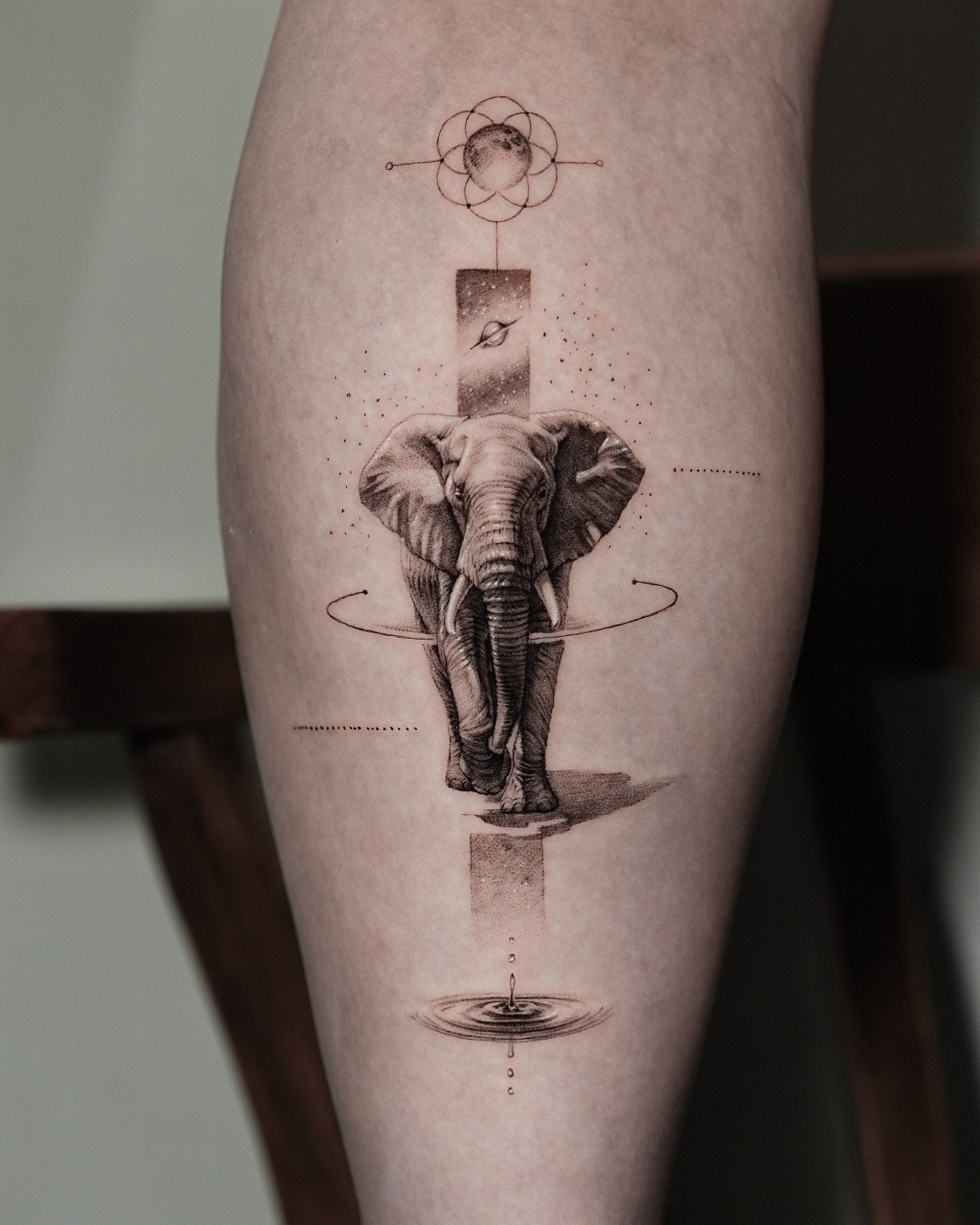
20. Woodcut Elephant Tattoo Among Acacia Branches
Use parallel hatching to build the elephant’s shoulder and forehead, leaving white slits between dark cuts. A few acacia branches can reach inward from the corners. The image should resemble a hand-printed wildlife plate, with intentional imperfections rather than perfectly smooth digital shading.
The engraving texture needs more than a tiny placement. A broad upper arm or thigh allows the lines to stay separate. Ask for thick enough gaps in the hatchwork, especially around the eye, where dense crossing marks can erase the animal’s expression.
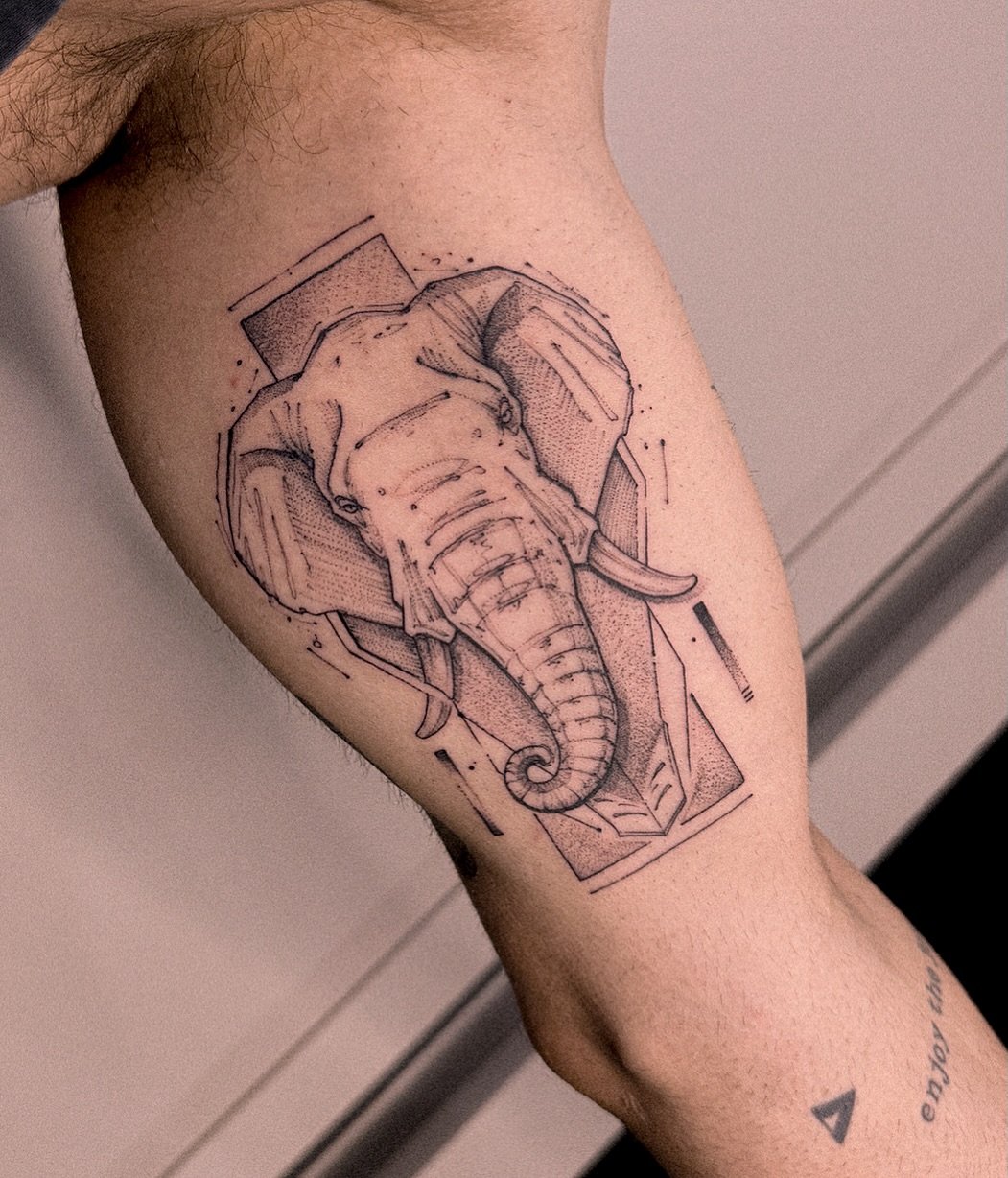
21. Calf Tattoo With a Restrained Watercolor Backdrop
Keep the calf drawn in black first, then place a soft wash behind the rear half of its body. One muted blue and one dusty ochre are enough to suggest sky and earth. Color should move around the silhouette without washing over the eye or erasing the trunk.
The outer forearm or calf gives the color room to fade. Ask to see the artist’s healed watercolor work: the black contour must still hold the animal if the pale tones soften with time. Keep the pigment wash small enough that the piece remains an elephant tattoo.
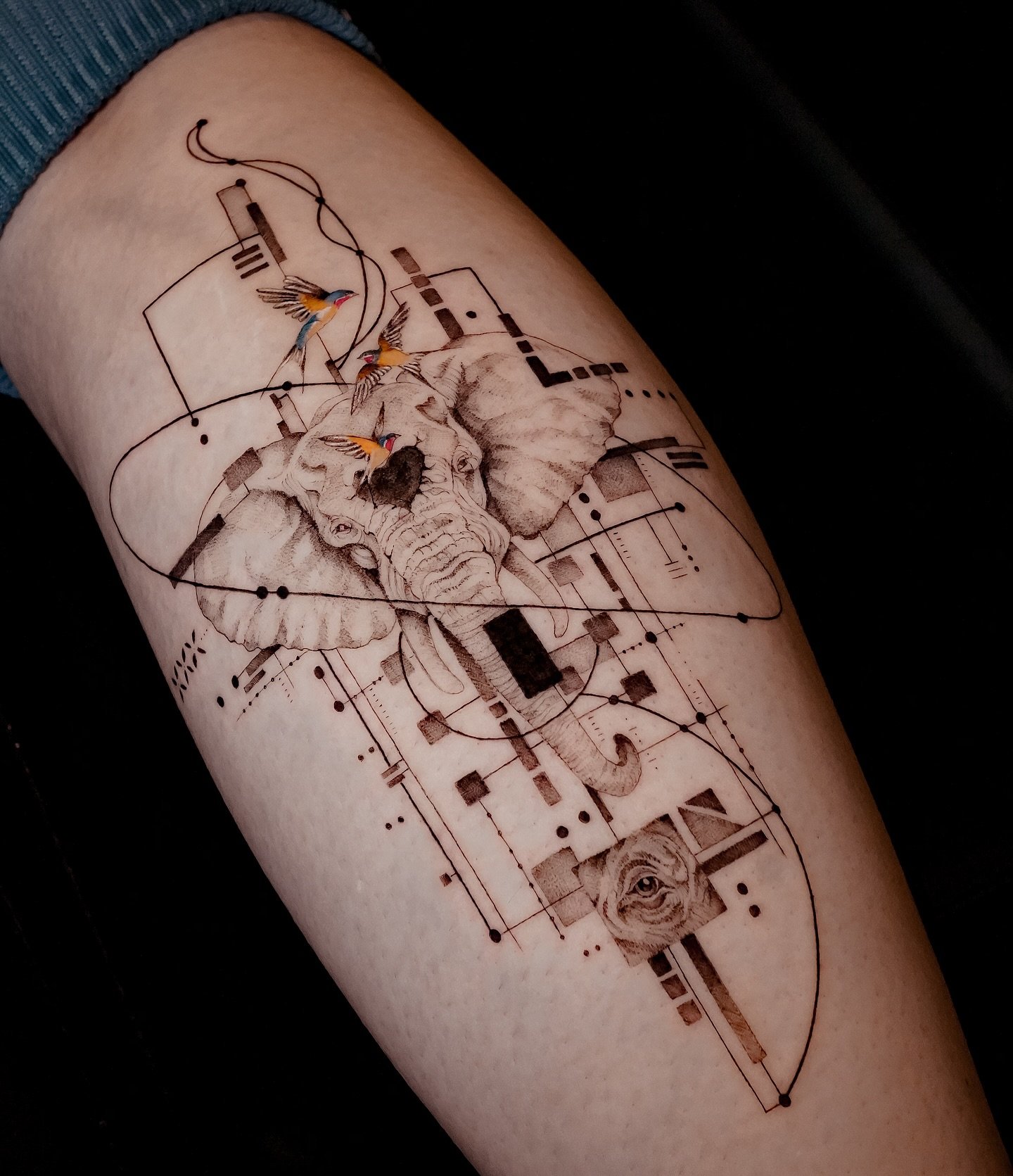
22. Elephant Footprint Tattoo Holding a Small Memorial Silhouette
An elephant’s rounded print can hold a second, much smaller walking elephant as a private memorial image. Let the print’s outer edge remain broken and textured, with a generous blank center around the silhouette. A date or initial is optional; the contrast in scale can carry the remembrance on its own.
This needs more space than a tiny wrist mark because the inner elephant must have four readable legs. Consider the upper arm or calf. Ask the artist to distinguish an elephant track from a generic paw print, and to show the design at actual size before tattooing.
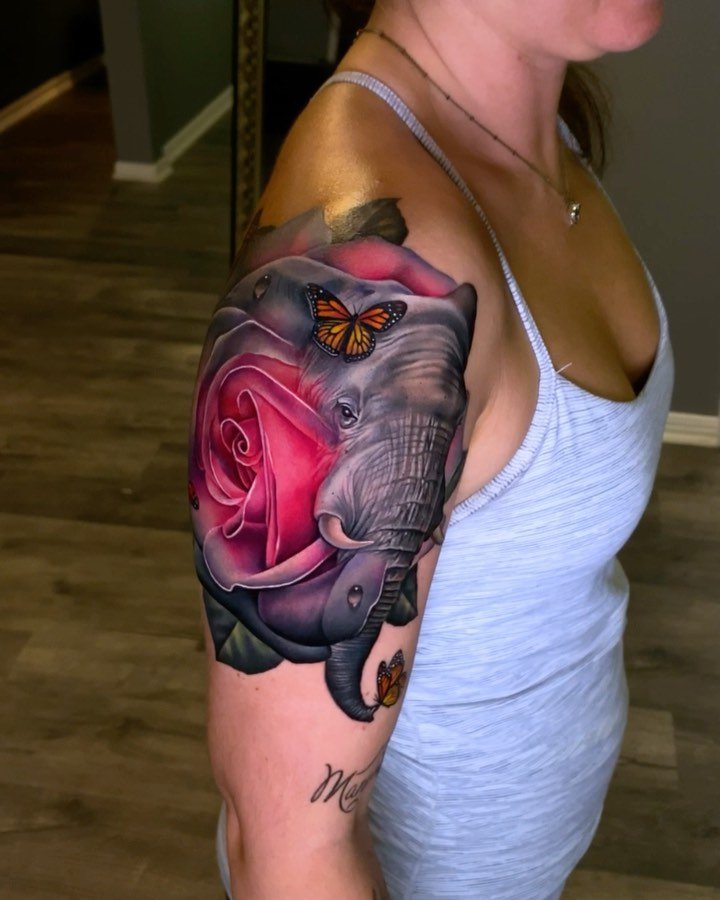
What Does an Elephant Tattoo Mean Alone or in a Herd?
A solitary elephant can feel like a portrait of steadiness, independence, or a particular remembered animal. Several elephants bring relationships into view: their sizes, the space between them, and who leads can suggest generations or people moving through life together. There is no fixed rule that a raised trunk means luck or a downward trunk means sadness. Choose a gesture that reflects the story you want to keep.
If the tattoo commemorates someone, a quiet detail may matter more than a collection of symbols. The direction of a walk, a calf held close, or one empty space in a procession can be personal without explaining itself to strangers. Discuss that choice with the artist before they settle the composition.
How Can You Tell African and Asian Elephants Apart in a Tattoo?
The broad ears of African elephants and the smaller ears of Asian elephants are a useful first cue. Asian elephants also tend to show a higher, more rounded back and a twin-domed forehead; African elephants have two fingerlike projections at the trunk tip, while Asian elephants have one. Smithsonian’s National Zoo explains these differences and notes the three living species: African savanna, African forest, and Asian.
Choose the species before drawing an elaborate ear or adding a landscape. A savanna setting paired with an Asian elephant is possible as deliberate fantasy, but it should be a choice. Tusks are a poor universal shortcut: sex and species affect their appearance. If accuracy matters, bring wildlife photographs of the same species and viewing angle to your consultation.
When Does an Elephant Tattoo Design Become Religious Imagery?
A naturalistic elephant is an animal subject. An elephant-headed human figure with attributes such as multiple arms, ritual objects, or a particular seated pose can depict Ganesha, a Hindu deity. The Metropolitan Museum of Art’s Ganesha entry identifies the deity and describes the meaning of his iconographic attributes.
Ornamental cloth, a lotus, and temple architecture can also shift a tattoo toward a specific religious or ceremonial context. If that is your intention, study the tradition with an artist who knows the imagery. If you want a wildlife tattoo, keep those elements out rather than mixing them in for visual texture alone.
Final Thoughts on Elephant Tattoos
The most memorable elephant tattoos give the animal a believable body and a clear action. Decide what the viewer should notice first: an eye, a meeting of trunks, a calf’s position, or the distance still ahead. Leave enough skin around that detail for it to remain clear. Use the Instagram posts as references when talking with an artist, and ask for a drawing fitted to your body and the space you can give it.

